School of Public Administration, Zhongnan University of Economics and Law, Wuhan, Hubei, 430073, PR China; Institute of Income Distribution and Public Finance, Zhongnan University of Economics and Law, Wuhan, Hubei, 430073, PR China.
School of Public Administration, Zhongnan University of Economics and Law, Wuhan, Hubei, 430073, PR China; Institute of Income Distribution and Public Finance, Zhongnan University of Economics and Law, Wuhan, Hubei, 430073, PR China.
J Environ Manage. 2021 Mar 15;282:111907. doi: 10.1016/j.jenvman.2020.111907. Epub 2020 Dec 30.
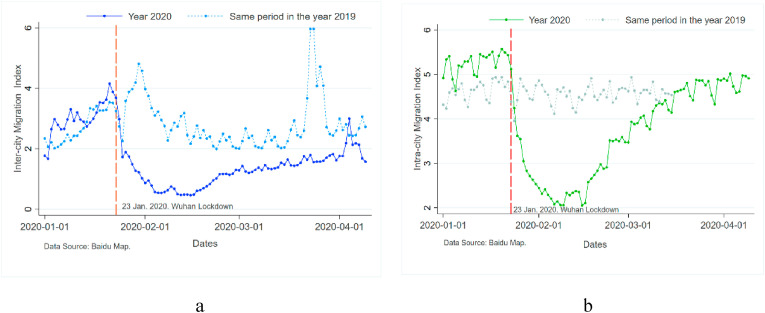
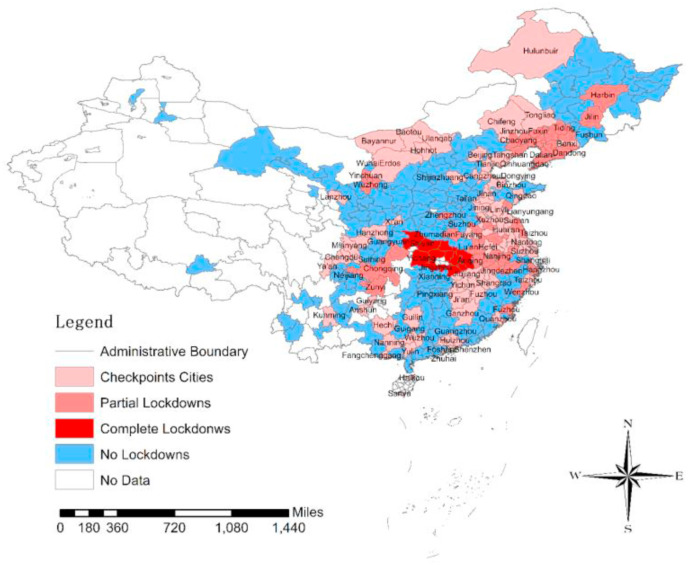
The outbreak of COVID-19 continues to bring unprecedented shock to mankind's socioeconomic activities, and to the wider environment. China, as the early epicenter of the pandemic, locked down one-third of its cities in an attempt to prevent the rapid spread of the virus. Human migration patterns have subsequently been radically altered and many regions have seen perceived improvements in air quality during the lockdowns. This study empirically examines the relationship between human migration and air pollution and further evaluates the causal impacts of the lockdowns. A spatial econometric method and a spatial explicit counterfactual framework are employed in this study. The key findings are as follows: i) a considerable amount of variation in AQI, PM, PM, and NO concentration can be explained by human migration but we fail to find suggestive evidence in the cases of SO and CO; ii) the implementation of lockdown measures led to a significant reduction in AQI (18.1%), PM (22.2%), NO (20.5%), and PM (10.7%), but has no meaningful impacts on SO CO and O levels; iii) further analysis indicates that the impacts of lockdown policies varied by control stringency and by regional heterogeneity. Our findings are of great importance for the Chinese government to create a stronger and more coherent framework in its efforts to tackle air pollution.
新冠疫情的爆发继续给人类的社会经济活动乃至更广泛的环境带来前所未有的冲击。中国作为疫情的早期中心,为了防止病毒的迅速传播,封锁了三分之一的城市。此后,人类的迁移模式发生了根本性的改变,许多地区在封锁期间空气质量得到了明显改善。本研究通过实证检验了人类迁移与空气污染之间的关系,并进一步评估了封锁措施的因果影响。本研究采用了空间计量经济学方法和空间明确反事实框架。主要发现如下:i)AQI、PM、PM和NO浓度的大量变化可以用人迁移来解释,但在 SO 和 CO 的情况下,我们没有找到有意义的证据;ii)实施封锁措施导致 AQI(18.1%)、PM(22.2%)、NO(20.5%)和 PM(10.7%)显著下降,但对 SO、CO 和 O 水平没有显著影响;iii)进一步分析表明,封锁政策的影响因控制力度和区域异质性而异。本研究的结果对中国政府在应对空气污染方面制定更强有力、更协调一致的框架具有重要意义。