College of Agricultural Engineering, Sher-e-Kashmir University of Agricultural Sciences and Technology, Shalimar Srinagar, India.
Division of Food Science and Technology, Sher-e-Kashmir University of Agricultural Sciences and Technology, Shalimar Srinagar, India.
Environ Res. 2021 Apr;195:110839. doi: 10.1016/j.envres.2021.110839. Epub 2021 Feb 4.
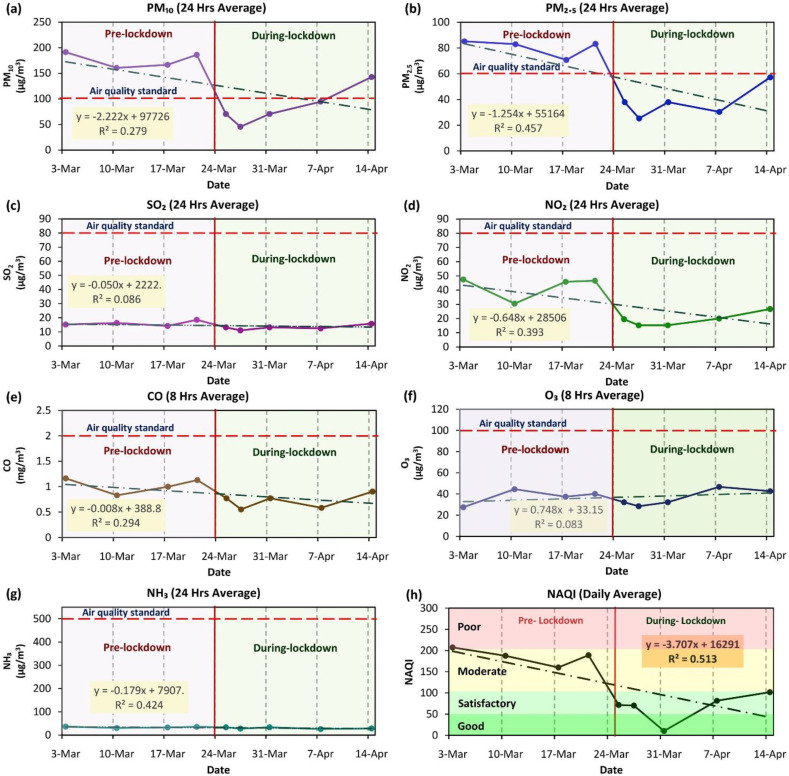
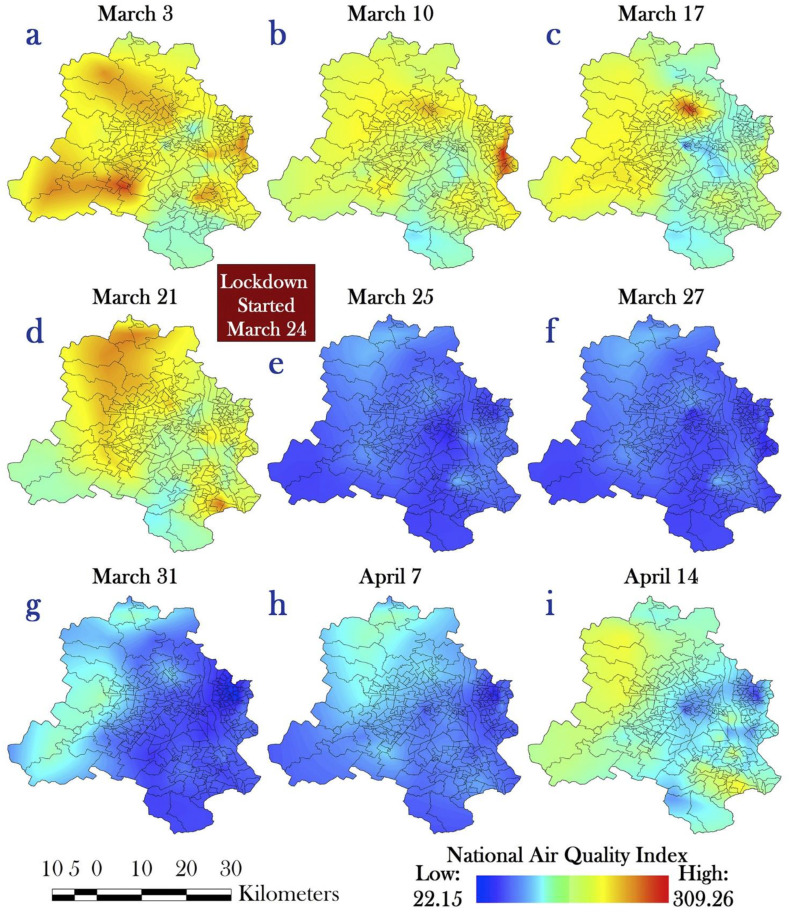
The outbreak of COVID-19 pandemic has emerged as a major challenge from human health perspective. The alarming exponential increase in the transmission and fatality rates related to this disease has brought the world to a halt so as to cope up with its stern consequences. This has led to the imposition of lockdown across the globe to prevent the further spread of this disease. This lock down brought about drastic impacts at social and economic fronts. However, it also posed some positive impacts on environment as well particularly in the context of air quality due to reduction in concentrations of particulate matter (PM), NO and CO across the major cities of the globe as indicated by several research organizations. In China, Italy, France and Spain, there were about 20-30% reduction in NO emission while in USA 30% reduction in NO emission were observed. Compared to previous year, there was 11.4% improvement in the air quality in China. Drastic reductions in NO (-77.3%), NO (-54.3%) and CO (-64.8%) (negative sign indicating a decline) concentrations were observed in Brazil during partial lockdown compared to the five year monthly mean. In India there were about -51.84, -53.11, -17.97, -52.68, -30.35, 0.78 and -12.33% reduction in the concentration of PM PM, SO NO CO, O and NH respectively. This article highlights the impact of lockdown on the environment and also discusses the pre and post lockdown air pollution scenario across major cities of the world. Several aspect of environment such as air, water, noise pollution and waste management during, pre and post lockdown scenario were studied and evaluated comprehensively. This research would therefore serve as a guide to environmentalist, administrators and frontline warriors for fighting our the way to beat this deadly disease and minimize its long term implications on health and environment.
COVID-19 大流行的爆发对人类健康构成了重大挑战。这种疾病的传播和致死率呈惊人的指数增长,使全球陷入停顿,以应对其严峻后果。这导致全球范围内实施封锁以阻止疾病的进一步传播。这种封锁给社会和经济带来了巨大的冲击。然而,它也对环境产生了一些积极的影响,特别是在空气质量方面,因为全球主要城市的颗粒物 (PM)、NO 和 CO 浓度有所降低,这一点被几个研究机构所证实。在中国、意大利、法国和西班牙,NO 的排放量减少了约 20-30%,而在美国,NO 的排放量减少了 30%。与前一年相比,中国的空气质量提高了 11.4%。与五年月平均值相比,巴西在部分封锁期间,NO(-77.3%)、NO(-54.3%)和 CO(-64.8%)(负号表示下降)浓度急剧下降。在印度,PM、SO、NO、CO、O 和 NH 的浓度分别减少了约 51.84%、53.11%、17.97%、52.68%、30.35%、0.78%和-12.33%。本文重点介绍了封锁对环境的影响,并讨论了世界主要城市封锁前后的空气污染情况。在封锁期间、封锁前和封锁后,对环境的各个方面,如空气、水、噪声污染和废物管理进行了全面研究和评估。因此,这项研究将为环保主义者、管理者和一线战士提供指导,帮助他们战胜这一致命疾病,并将其对健康和环境的长期影响降到最低。