Department of Gynecological Surgery and Oncology of Adults and Adolescents, Pomeranian Medical University, al. Powstańców Wielkopolskich 72, 70-111 Szczecin, Poland.
Int J Environ Res Public Health. 2021 Jan 5;18(1):356. doi: 10.3390/ijerph18010356.
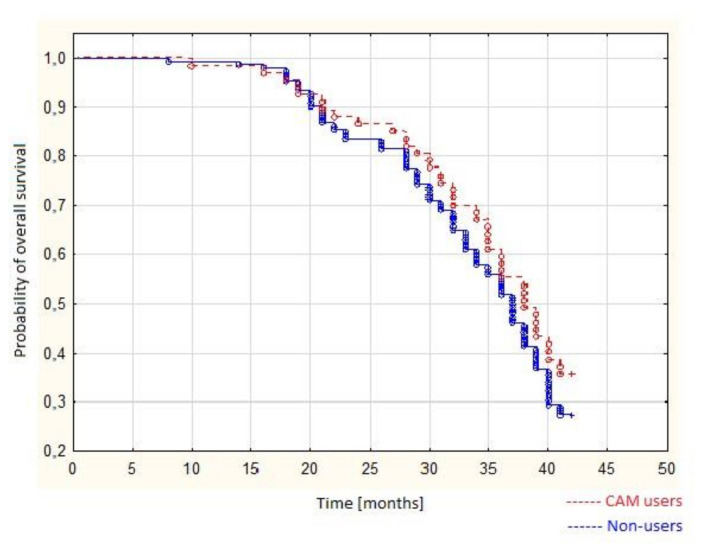
(1) Background: The prevalence of complementary and alternative methods (CAM) use among oncological patients has been rising constantly over the last few decades and a variety of both pharmacological and non-pharmacological methods have been developed. Many advertisements promise to relieve side effects of chemotherapy or even to cure the disease, thus encouraging patients to use CAM; (2) Methods: The objective of the study was to determine which patients' characteristics are associated with the use of complementary medicine during cancer treatment, their pattern of use, and if it has any association with its safety profile. This survey-based prospective multicenter study of 316 patients examined the use of complementary medicine among patients undergoing chemotherapy treatment in cancer centers in Poland between 2017 and 2019; (3) Results: The Chi2 analysis showed that patients' opinion regarding the safety of unconventional methods is related to the use of CAM ( = 0.00147). Moreover, patients' thinking that alternative medicine can replace traditional therapy was correlated with his/her education ( = 0.01198). Moreover, we performed univariate and multivariate analysis to determine factors associated with CAM use including sociodemographic and clinical characteristics. Finally, we conducted survival analysis of patients undergoing chemotherapy treatment with 42 months of follow-up time of our prospective study. Using Kaplan-Meier curves and log-rank analysis, we found no statistical difference in overall survival between the groups that used and did not use any form of CAM ( = 0.211); (4) Conclusions: CAM use is common among patients undergoing chemotherapy treatment and should be considered by medical teams as some agents may interact with chemotherapy drugs and affect their efficacy or cause adverse effects.
(1)背景:在过去几十年中,肿瘤患者对补充和替代方法(CAM)的使用不断增加,并且已经开发了各种药理学和非药理学方法。许多广告承诺可以缓解化疗的副作用,甚至可以治愈疾病,从而鼓励患者使用 CAM;(2)方法:本研究的目的是确定哪些患者特征与癌症治疗期间使用补充医学有关,他们的使用模式,以及它是否与安全性有关。这项基于调查的前瞻性多中心研究对 2017 年至 2019 年期间在波兰癌症中心接受化疗治疗的 316 名患者进行了检查,以研究补充医学的使用情况;(3)结果:卡方分析表明,患者对非常规方法安全性的看法与 CAM 的使用有关(= 0.00147)。此外,患者认为替代医学可以替代传统疗法与他/她的教育程度有关(= 0.01198)。此外,我们进行了单变量和多变量分析,以确定与 CAM 使用相关的因素,包括社会人口统计学和临床特征。最后,我们对接受化疗治疗的患者进行了生存分析,前瞻性研究的随访时间为 42 个月。使用 Kaplan-Meier 曲线和对数秩分析,我们发现使用和不使用任何形式的 CAM 的患者之间的总生存率没有统计学差异(= 0.211);(4)结论:CAM 的使用在接受化疗治疗的患者中很常见,医疗团队应予以考虑,因为某些药物可能会与化疗药物相互作用,影响其疗效或引起不良反应。