Nomura Yoshiaki, Ishii Yoshimasa, Chiba Yota, Suzuki Shunsuke, Suzuki Akira, Suzuki Senichi, Morita Kenji, Tanabe Joji, Yamakawa Koji, Ishiwata Yasuo, Ishikawa Meu, Sogabe Kaoru, Kakuta Erika, Okada Ayako, Otsuka Ryoko, Hanada Nobuhiro
Department of Translational Research, Tsurumi University School of Dental Medicine, Yokohama 230-8501, Japan.
Ebina Dental Association, Kanagawa 243-0421, Japan.
Healthcare (Basel). 2021 Jan 5;9(1):45. doi: 10.3390/healthcare9010045.
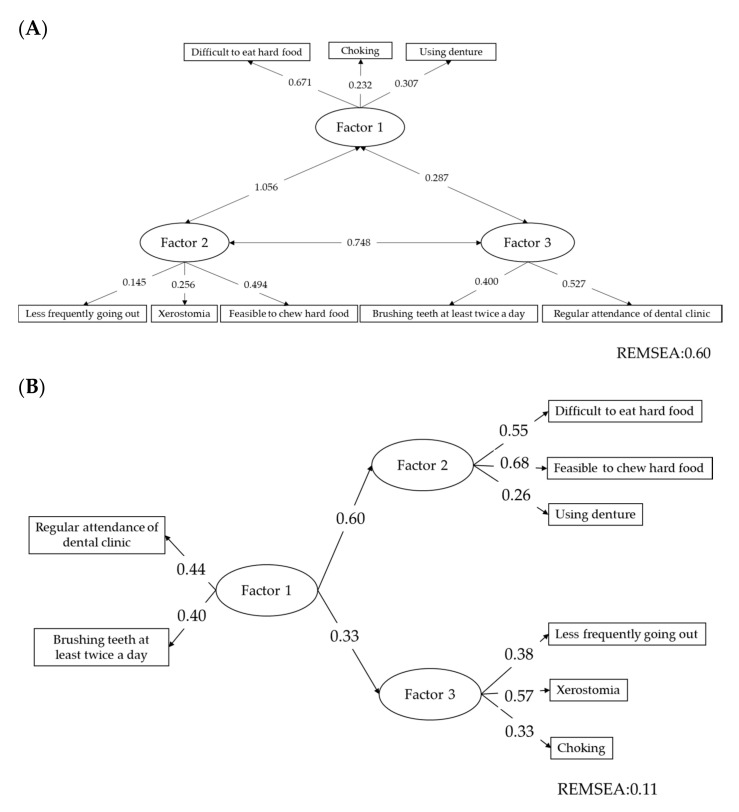
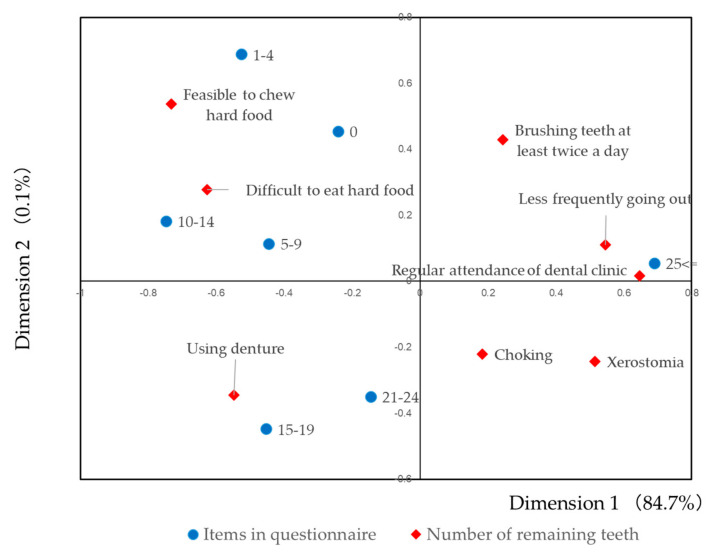
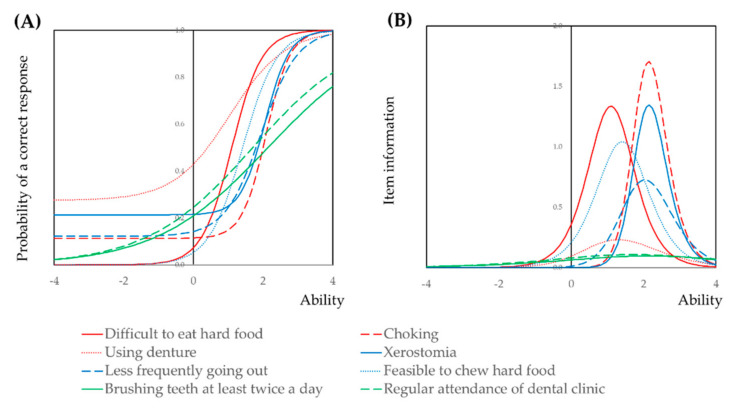
Oral frailty is defined as the mild decline in oral function and located at the early and reversible stage of frailty. Therefore, early detection and early treatment of oral frailty is very useful. Simple and easy questionnaires, such as an oral frailty checklist, have been widely used for the screening and enlightenment of oral frailty of the Japanese people. We evaluate the structure and validity of the oral frailty checklist. The questionnaire of oral frailty was distributed for the citizens more than 50 years old from December 2018 to January 2019. The structural validity of the questionnaire is analyzed by structural equation modeling (SEM). The characteristics of the items are analyzed by Item Response Theory (IRT). The data of 725 subjects (360 men, 359 women, 6 no answer, mean age 71.3 ± 9.05) are analyzed. The questionnaire consisted of three latent variables. Items of "Brushing teeth at least twice a day", "Regular attendance of dental clinic", and "Using denture", had low discrimination ability. The questionnaire used in this study is a useful tool for the screening of oral frailty. However, its scoring system needs to be improved.
口腔衰弱被定义为口腔功能的轻度下降,处于衰弱的早期且可逆阶段。因此,早期发现和治疗口腔衰弱非常有用。简单易操作的问卷,如口腔衰弱检查表,已被广泛用于日本人群口腔衰弱的筛查和认知。我们评估口腔衰弱检查表的结构和效度。2018年12月至2019年1月,向50岁以上的市民发放了口腔衰弱问卷。通过结构方程模型(SEM)分析问卷的结构效度。通过项目反应理论(IRT)分析项目特征。对725名受试者(360名男性,359名女性,6名未作答,平均年龄71.3±9.05)的数据进行分析。该问卷由三个潜在变量组成。“每天至少刷牙两次”“定期去牙科诊所”和“使用假牙”等项目的区分能力较低。本研究中使用的问卷是筛查口腔衰弱的有用工具。然而,其评分系统需要改进。