School of Social Work, Tulane University, New Orleans, LA 70112, USA.
Int J Environ Res Public Health. 2021 Jan 14;18(2):666. doi: 10.3390/ijerph18020666.
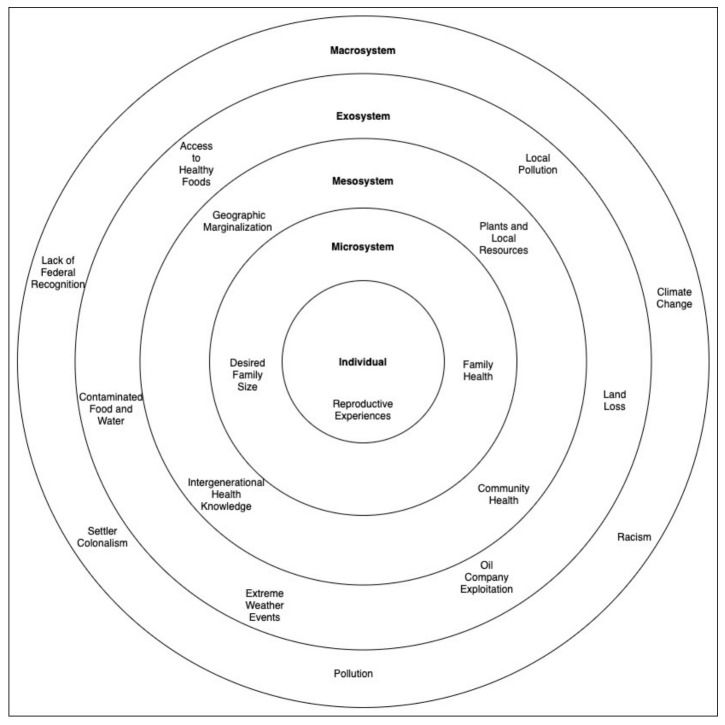
Environmental reproductive justice is increasingly being utilized as a framework for exploring how environmental exploitation and pollution contribute to reproductive health and reproductive injustices. However, little research explores how settler colonialism and historical oppression contribute to the physical transformation of land, and how this undermines tribal members' health. Even less research explores the intersection of environmental justice and reproductive justice among Indigenous groups, especially in the Gulf South, who are especially vulnerable to environmental justice issues due to climate change, land loss, and oil company exploitation, and for tribes that are non-federally recognized. A qualitative description research methodology was used to conduct 31 life-history interviews with women from a Gulf Coast Indigenous tribe. Findings of this study reveal that central components of reproductive justice, including the ability to have children and the ability to raise children in safe and healthy environments, are undermined by environmental justice issues in the community. Among concerns raised by women were high rates of chronic healthcare issues among community members, and issues with infertility. Recognizing Indigenous sovereignty is central to addressing these environmental reproductive justice issues. This research is unique in exploring the topic of environmental reproductive justice among a state-recognized Gulf Coast tribe.
环境生殖正义越来越多地被用作一个框架,来探讨环境剥削和污染如何影响生殖健康和生殖不公。然而,很少有研究探讨定居者殖民主义和历史压迫如何导致土地的物理变化,以及这如何破坏部落成员的健康。甚至更少的研究探讨环境正义和生殖正义在土著群体中的交叉,特别是在海湾南部,由于气候变化、土地流失和石油公司的剥削,以及对于非联邦认可的部落来说,他们特别容易受到环境正义问题的影响。本研究采用定性描述研究方法,对来自海湾海岸土著部落的 31 名女性进行了生活史访谈。这项研究的结果表明,生殖正义的核心组成部分,包括生育子女的能力和在安全健康的环境中抚养子女的能力,都受到社区环境正义问题的破坏。女性提出的关切包括社区成员中慢性健康问题的高发病率和不孕问题。承认土著主权对于解决这些环境生殖正义问题至关重要。这项研究在探索海湾海岸州认可部落的环境生殖正义主题方面具有独特性。