Antonio Jose, Kenyon Madaline, Ellerbroek Anya, Carson Cassandra, Burgess Victoria, Tyler-Palmer Denvyr, Mike Jonathan, Roberts Justin, Angeli Gerseli, Peacock Corey
Exercise and Sport Science, Nova Southeastern University, Davie, FL 33328, USA.
Exercise Science, Grand Canyon University, Phoenix, AZ 85017, USA.
J Funct Morphol Kinesiol. 2019 Apr 25;4(2):23. doi: 10.3390/jfmk4020023.
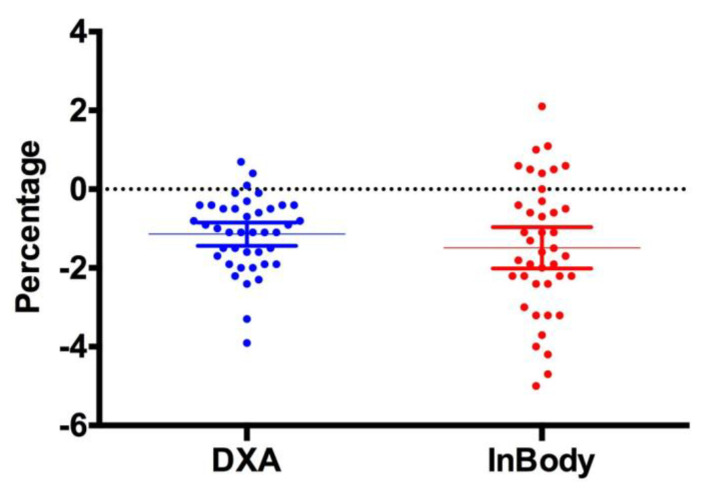
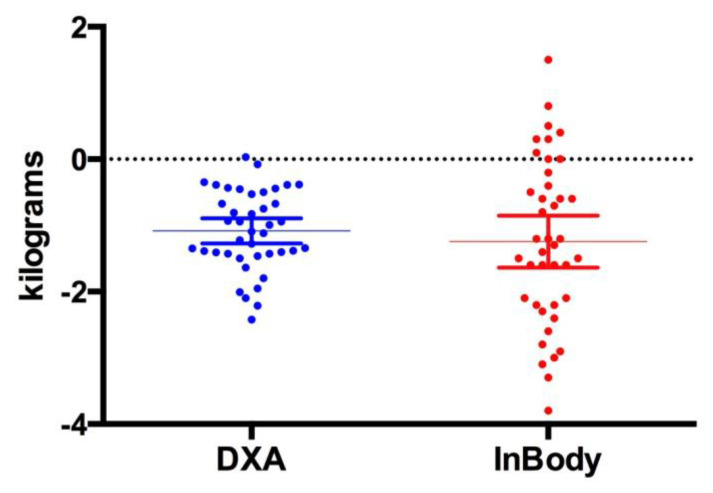
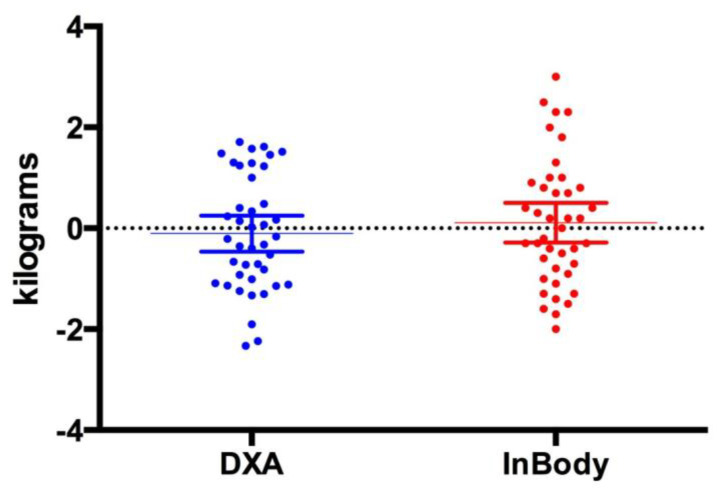
The purpose of this investigation was to compare two different methods of assessing body composition (i.e., a multi-frequency bioelectrical impedance analysis (MF-BIA) and dual-energy x-ray absorptiometry (DXA)) over a four-week treatment period in exercise-trained men and women. Subjects were instructed to reduce their energy intake while maintaining the same exercise regimen for a period of four weeks. Pre and post assessments for body composition (i.e., fat-free mass, fat mass, percent body fat) were determined via the MF-BIA and DXA. On average, subjects reduced their energy intake by ~18 percent. The MF-BIA underestimated fat mass and percentage body fat and overestimated fat-free mass in comparison to the DXA. However, when assessing the change in fat mass, fat-free mass or percent body fat, there were no statistically significant differences between the MF-BIA vs. DXA. Overall, the change in percent body fat using the DXA vs. the MF-BIA was -1.3 ± 0.9 and -1.4 ± 1.8, respectively. Our data suggest that when tracking body composition over a period of four weeks, the MF-BIA may be a viable alternative to the DXA in exercise-trained men and women.
本研究的目的是在为期四周的治疗期内,比较两种不同的身体成分评估方法(即多频生物电阻抗分析(MF-BIA)和双能X线吸收法(DXA))在经过运动训练的男性和女性中的应用。受试者被要求在维持相同运动方案的同时,在四周内减少能量摄入。通过MF-BIA和DXA对身体成分(即去脂体重、脂肪量、体脂百分比)进行前后评估。平均而言,受试者的能量摄入减少了约18%。与DXA相比,MF-BIA低估了脂肪量和体脂百分比,高估了去脂体重。然而,在评估脂肪量、去脂体重或体脂百分比的变化时,MF-BIA与DXA之间没有统计学上的显著差异。总体而言,使用DXA和MF-BIA测得的体脂百分比变化分别为-1.3±0.9和-1.4±1.8。我们的数据表明,在对经过运动训练的男性和女性进行为期四周的身体成分跟踪时,MF-BIA可能是DXA的一种可行替代方法。