Exercise and Sport Science, Nova Southeastern University, 3401 South University Drive, Davie, FL, 33328, USA.
Department of Psychology and Neuroscience, NSU Florida, Davie, FL, USA.
J Int Soc Sports Nutr. 2019 Sep 2;16(1):36. doi: 10.1186/s12970-019-0307-6.
Variations in the fat mass and obesity-associated gene (FTO) are associated with obesity; however, it is unclear if changes in energy intake affect the adaptive response to caloric restriction in those with risk variants. The three FTO single nucleotide polymorphisms (SNPs), rs1421085, rs17817449 and rs9939609, are in strong linkage disequilibrium. Thus, the purpose of this investigation was to determine the role of these FTO SNPs vis-à-vis the effects of a 4-week hypocaloric diet on body composition in exercise-trained men and women. Two salivary biomarkers that associate with energy expenditure were also assessed (cortisol and salivary alpha-amylase, sAA).
Forty-seven exercise-trained men (n = 11) and women (n = 36) (mean ± SD: age 32 ± 9 years; height 169 ± 8 cm, body mass index 24.5 ± 2.9 kg/m, hours of aerobic training per week 4.9 ± 3.8, hours of weight training per week 3.9 ± 2.4, years of training experience 13.4 ± 7.0) completed a 4-week hypocaloric diet (i.e., decrease total calories by ~ 20-25% while maintaining a protein intake of ~ 2.0 g/kg/d). Subjects were instructed to maintain the same training regimen and to decrease energy intake via carbohydrate and/or fat restriction during the treatment period. Body composition was assessed via dual-energy X-ray absorptiometry (DXA) (Model: Hologic Horizon W; Hologic Inc., Danbury CT USA). Total body water was determined via a multifrequency bioelectrical impedance (BIA) device (InBody 770). Saliva samples were collected pre and post intervention in order to genotype the participants as well as to determine the concentrations of cortisol and sAA.
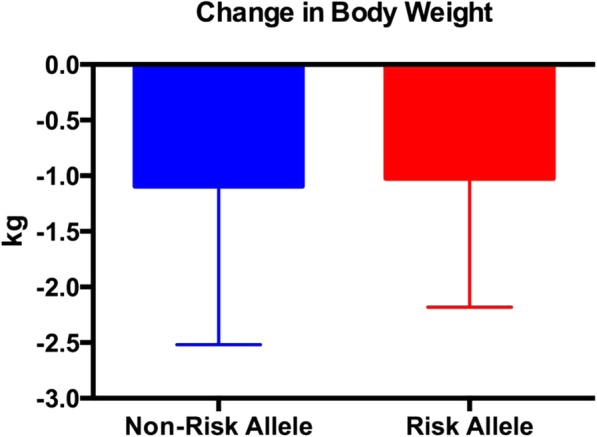
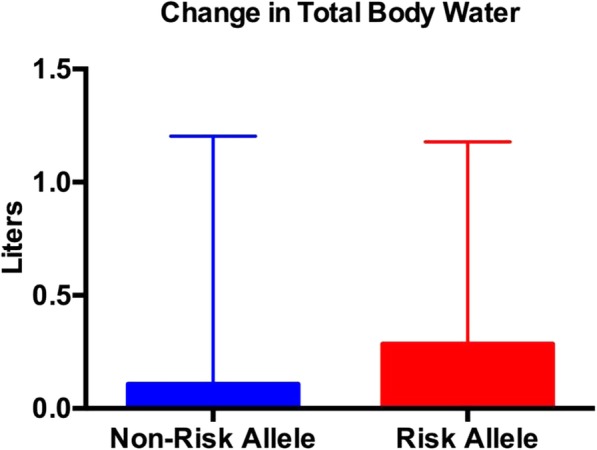
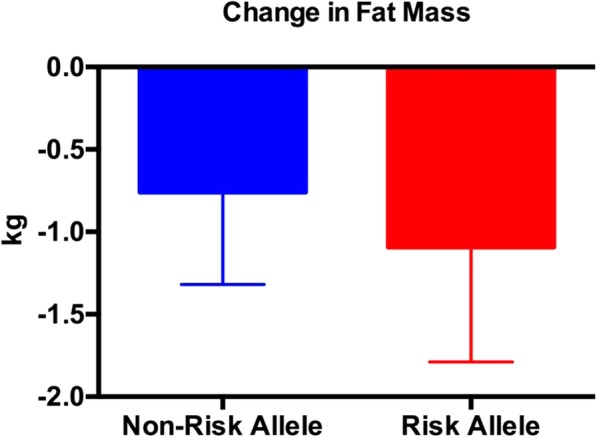
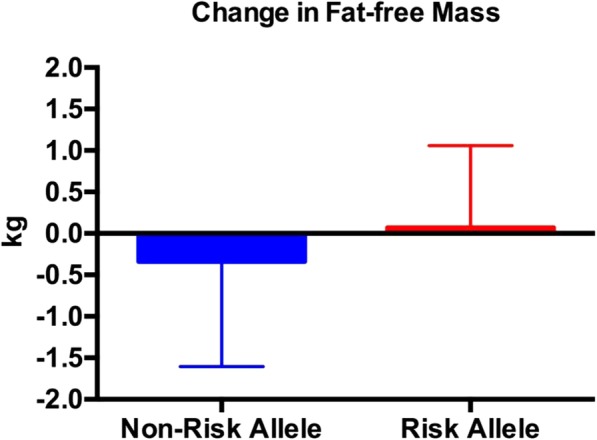
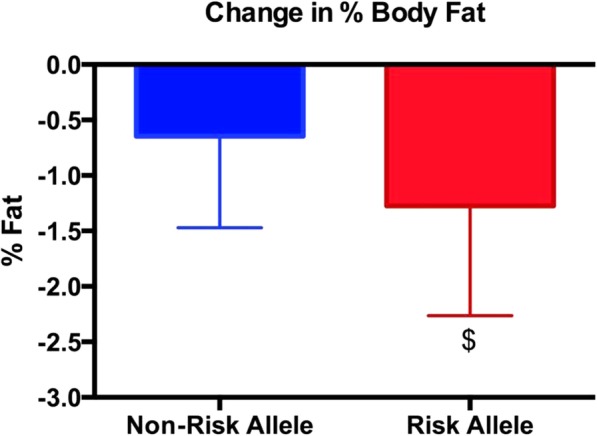
Of the 47 subjects, 15 were of normal risk for obesity whereas 32 were carriers of the FTO gene risk alleles. Subjects were grouped based on their genotype for the three FTO SNPs (i.e., rs1421085, rs17817449 and rs9939609) due to their strong linkage disequilibrium. We have classified those with the normal obesity risk as "non-risk allele" versus those that carry the "risk allele" (i.e., both heterozygous and homozygous). Both groups experienced a significant decrease in total energy intake (p < 0.01); non-risk allele: pre kcal 2081 ± 618, post kcal 1703 ± 495; risk allele: pre kcal 1886 ± 515, post kcal 1502 ± 366). Both groups lost a significant amount of body weight (p < 0.01); however, there was no difference between groups for the change (post minus pre) in each group (risk allele change: - 1.0 ± 1.2 kg, non-risk allele change: - 1.2 ± 1.4 kg). Additionally, both groups lost a significant amount of fat mass (p < 0.01) with no differences between groups for the change in fat mass (risk allele change for fat mass: 1.1 ± 0.7 kg, non-risk allele change - 0.9 ± 0.4 kg). There were no significant changes in either group for fat free mass or total body water. The change in salivary alpha-amylase or cortisol was not different between groups.
In the short-term (i.e., 4 weeks), exercise-trained men and women consuming a hypocaloric diet that is relatively high in protein experience similar changes in body composition due exclusively to a decrement in fat mass and independent of FTO allele status. Therefore, weight and fat loss on a hypocaloric diet is, at least in the short-term, unaffected by the FTO gene.
脂肪量和肥胖相关基因(FTO)的变异与肥胖有关;然而,尚不清楚能量摄入的变化是否会影响具有风险变异体的人对热量限制的适应性反应。三个 FTO 单核苷酸多态性(SNP),rs1421085、rs17817449 和 rs9939609,处于强烈的连锁不平衡状态。因此,本研究的目的是确定这些 FTO SNP 与为期 4 周的低热量饮食对运动训练的男性和女性身体成分的影响之间的关系。还评估了两个与能量消耗相关的唾液生物标志物(皮质醇和唾液α-淀粉酶,sAA)。
47 名运动训练的男性(n=11)和女性(n=36)(平均±标准差:年龄 32±9 岁;身高 169±8cm,体重指数 24.5±2.9kg/m,每周有氧训练时间 4.9±3.8 小时,每周举重训练时间 3.9±2.4 小时,训练经验年数 13.4±7.0 年)完成了为期 4 周的低热量饮食(即通过减少总热量约 20-25%,同时保持蛋白质摄入量约 2.0g/kg/d)。受试者被指示在治疗期间保持相同的训练方案,并通过减少碳水化合物和/或脂肪摄入来减少能量摄入。通过双能 X 射线吸收法(DXA)(型号:Hologic Horizon W;Hologic Inc.,Danbury CT USA)评估身体成分。通过多频生物电阻抗(BIA)设备(InBody 770)测定总体水。在干预前后采集唾液样本,以便对参与者进行基因分型,并确定皮质醇和 sAA 的浓度。
在 47 名受试者中,15 名具有正常肥胖风险,而 32 名是 FTO 基因风险等位基因携带者。由于它们之间存在强烈的连锁不平衡,根据三个 FTO SNP(即 rs1421085、rs17817449 和 rs9939609)对受试者进行分组。我们将具有正常肥胖风险的受试者归类为“非风险等位基因”,而将携带“风险等位基因”的受试者归类为(即杂合子和纯合子)。两组的总能量摄入均显著减少(p<0.01);非风险等位基因组:摄入前 kcal 2081±618,摄入后 kcal 1703±495;风险等位基因组:摄入前 kcal 1886±515,摄入后 kcal 1502±366)。两组的体重均显著减轻(p<0.01);然而,两组之间的变化(后减去前)没有差异(风险等位基因变化:-1.0±1.2kg,非风险等位基因变化:-1.2±1.4kg)。此外,两组的脂肪量均显著减少(p<0.01),两组之间的脂肪量变化没有差异(风险等位基因的脂肪量变化:1.1±0.7kg,非风险等位基因的脂肪量变化:-0.9±0.4kg)。两组的无脂肪量或总体水量均无显著变化。两组的唾液α-淀粉酶或皮质醇变化无差异。
在短期(即 4 周)内,摄入高蛋白低热量饮食的运动训练的男性和女性由于仅脂肪量减少而导致身体成分发生相似的变化,这与 FTO 等位基因状态无关。因此,低热量饮食引起的体重和脂肪减少至少在短期内不受 FTO 基因的影响。