Pickering Craig, Kiely John
Institute of Coaching and Performance, School of Sport and Wellbeing, University of Central Lancashire, Preston PR1 2HE, UK.
J Funct Morphol Kinesiol. 2019 May 16;4(2):25. doi: 10.3390/jfmk4020025.
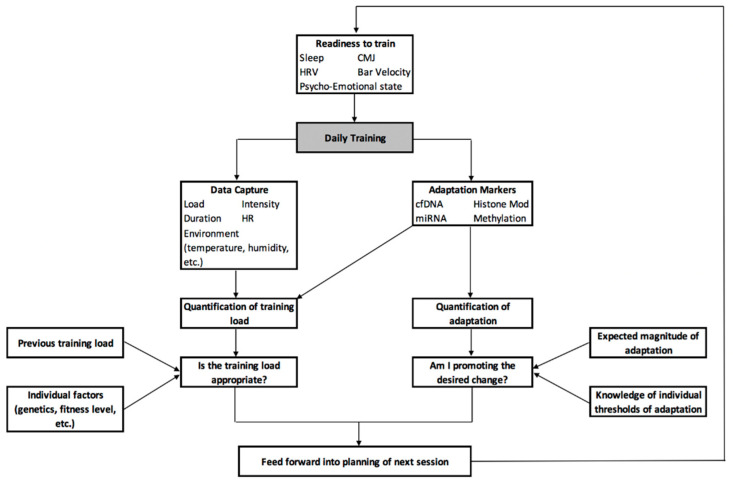
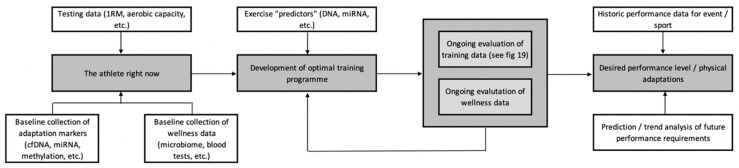
Over the last decade, there has been considerable interest in the individualisation of athlete training, including the use of genetic information, alongside more advanced data capture and analysis techniques. Here, we explore the evidence for, and practical use of, a number of these emerging technologies, including the measurement and quantification of epigenetic changes, microbiome analysis and the use of cell-free DNA, along with data mining and machine learning. In doing so, we develop a theoretical model for the use of these technologies in an elite sport setting, allowing the coach to better answer six key questions: (1) To what training will my athlete best respond? (2) How well is my athlete adapting to training? (3) When should I change the training stimulus (i.e., has the athlete reached their adaptive ceiling for this training modality)? (4) How long will it take for a certain adaptation to occur? (5) How well is my athlete tolerating the current training load? (6) What load can my athlete handle today? Special consideration is given to whether such an individualised training framework will outperform current methods as well as the challenges in implementing this approach.
在过去十年中,人们对运动员训练的个性化产生了浓厚兴趣,包括利用基因信息,以及更先进的数据采集和分析技术。在此,我们探讨了其中一些新兴技术的证据及实际应用,包括表观遗传变化的测量和量化、微生物组分析、游离DNA的使用,以及数据挖掘和机器学习。在此过程中,我们为这些技术在精英运动环境中的应用开发了一个理论模型,使教练能够更好地回答六个关键问题:(1)我的运动员对何种训练反应最佳?(2)我的运动员对训练的适应情况如何?(3)我应该何时改变训练刺激(即运动员是否已达到这种训练方式的适应上限)?(4)某种适应需要多长时间才能发生?(5)我的运动员对当前训练负荷的耐受情况如何?(6)我的运动员今天能承受多大负荷?我们特别考虑了这样一个个性化训练框架是否会优于当前方法以及实施该方法所面临的挑战。