Adedeji Olulana Abimbola Feyisara, Soler Miguel A, Lotteri Martina, Vondracek Hendrik, Casalis Loredana, Marasco Daniela, Castronovo Matteo, Fortuna Sara
Department of Medical and Biological Sciences, University of Udine, 33100 Udine, Italy.
Department of Physics, PhD School of Nanotechnology, University of Trieste, 34127 Trieste, Italy.
Int J Mol Sci. 2021 Jan 15;22(2):812. doi: 10.3390/ijms22020812.
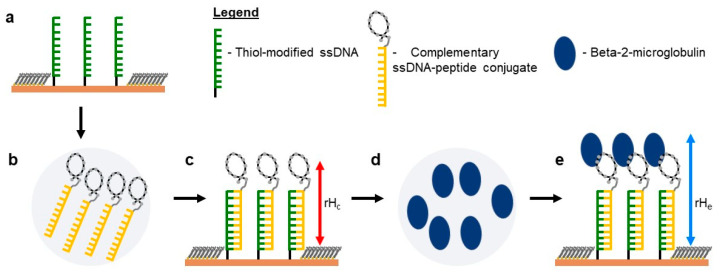
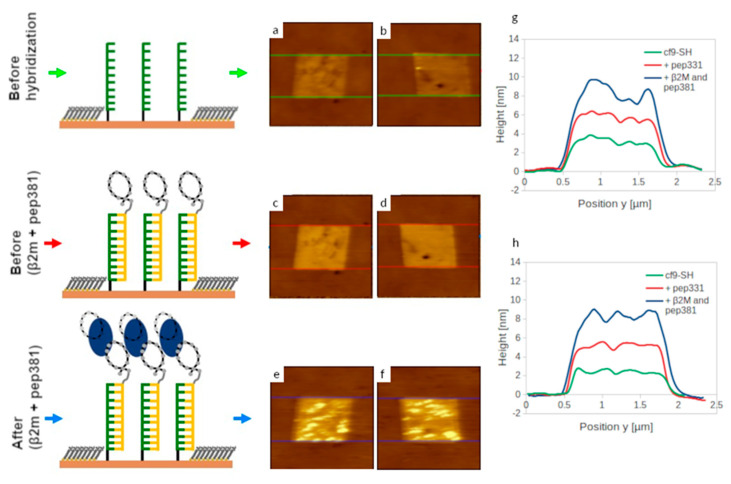
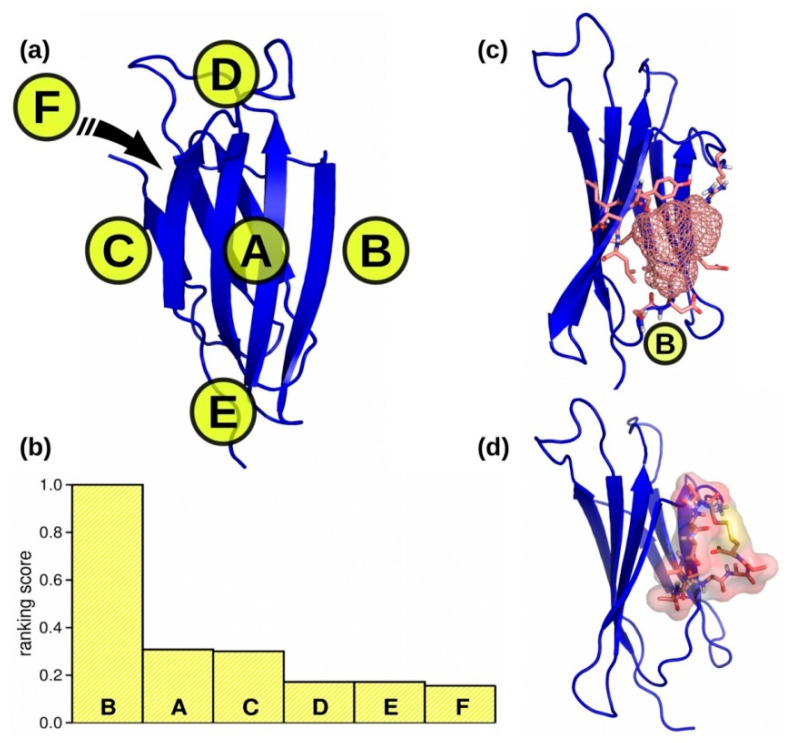
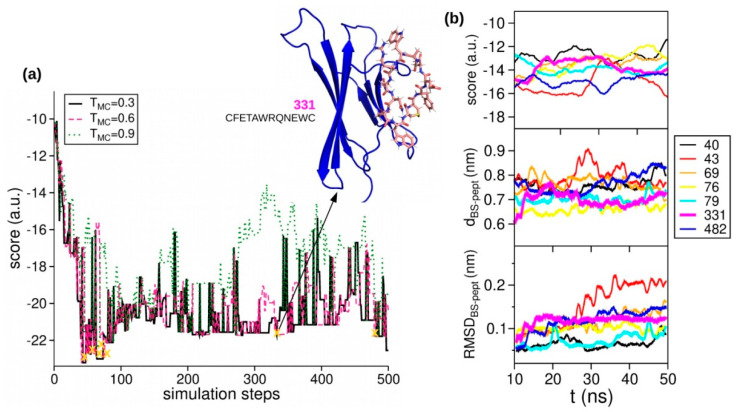
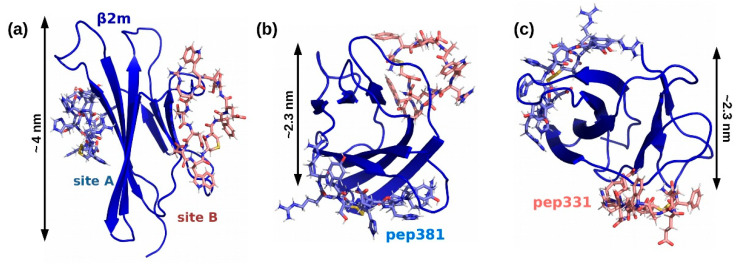
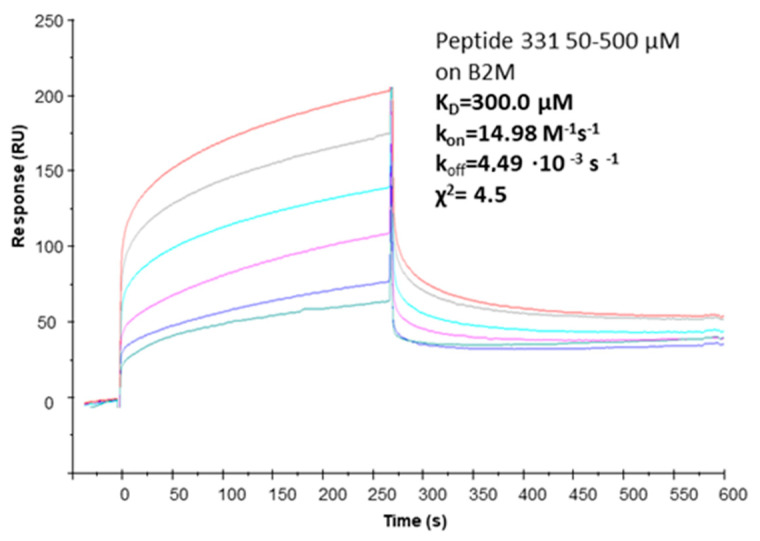
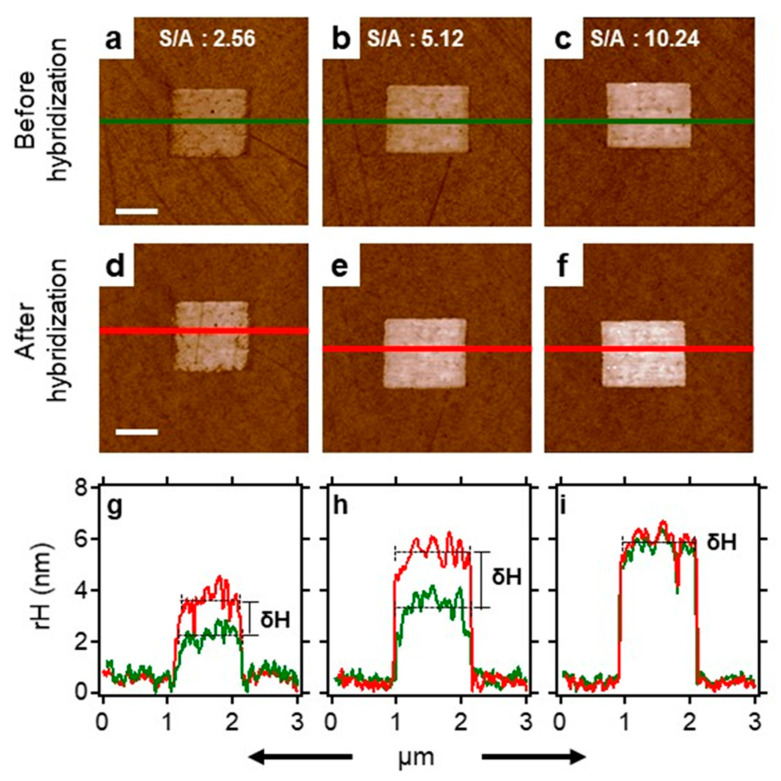
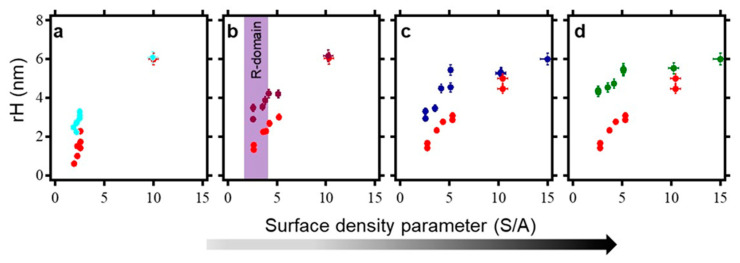
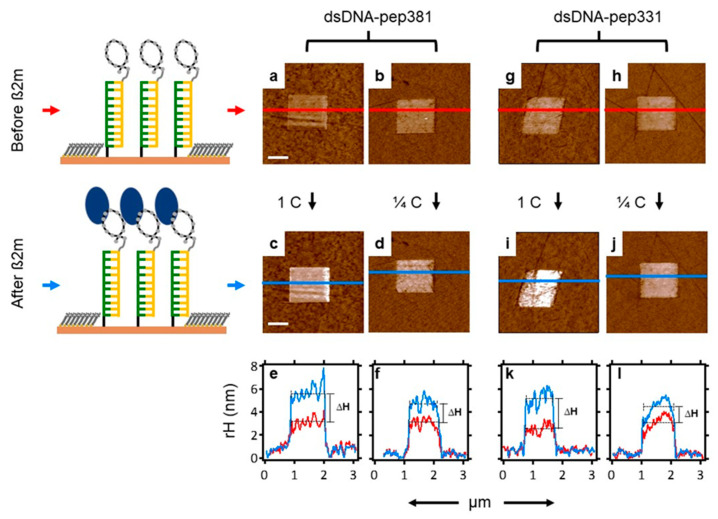
The bottom-up design of smart nanodevices largely depends on the accuracy by which each of the inherent nanometric components can be functionally designed with predictive methods. Here, we present a rationally designed, self-assembled nanochip capable of capturing a target protein by means of pre-selected binding sites. The sensing elements comprise computationally evolved peptides, designed to target an arbitrarily selected binding site on the surface of beta-2-Microglobulin (β2m), a globular protein that lacks well-defined pockets. The nanopatterned surface was generated by an atomic force microscopy (AFM)-based, tip force-driven nanolithography technique termed nanografting to construct laterally confined self-assembled nanopatches of single stranded (ss)DNA. These were subsequently associated with an ssDNA-peptide conjugate by means of DNA-directed immobilization, therefore allowing control of the peptide's spatial orientation. We characterized the sensitivity of such peptide-containing systems against β2m in solution by means of AFM-based differential topographic imaging and surface plasmon resonance (SPR) spectroscopy. Our results show that the confined peptides are capable of specifically capturing β2m from the surface-liquid interface with micromolar affinity, hence providing a viable proof-of-concept for our approach to peptide design.
智能纳米器件的自下而上设计在很大程度上取决于能否通过预测方法对每个固有纳米组件进行功能设计的准确性。在此,我们展示了一种经过合理设计的自组装纳米芯片,它能够通过预先选择的结合位点捕获目标蛋白。传感元件包括通过计算演化得到的肽,其设计目的是靶向β2-微球蛋白(β2m)表面任意选择的结合位点,β2m是一种缺乏明确口袋结构的球状蛋白。纳米图案化表面是通过基于原子力显微镜(AFM)的、由针尖力驱动的纳米光刻技术(称为纳米嫁接)生成的,用于构建横向受限的单链(ss)DNA自组装纳米片。随后,通过DNA定向固定将这些纳米片与ssDNA-肽缀合物结合,从而实现对肽空间取向的控制。我们通过基于AFM的差分形貌成像和表面等离子体共振(SPR)光谱对这种含肽系统在溶液中对β2m的灵敏度进行了表征。我们的结果表明,受限肽能够以微摩尔亲和力从表面-液体界面特异性捕获β2m,从而为我们的肽设计方法提供了一个可行的概念验证。