Base2bio, LLC, Oshkosh, WI 54905, USA.
Viruses. 2021 Jan 15;13(1):110. doi: 10.3390/v13010110.
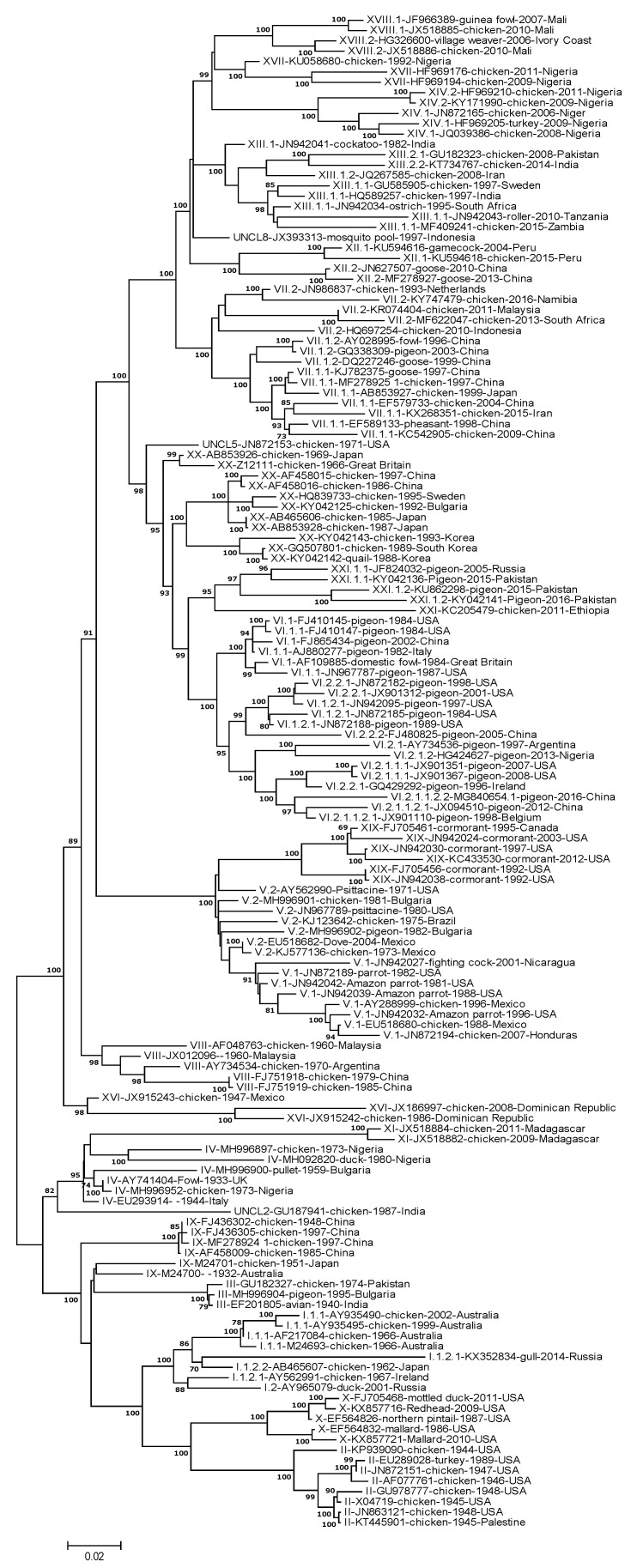
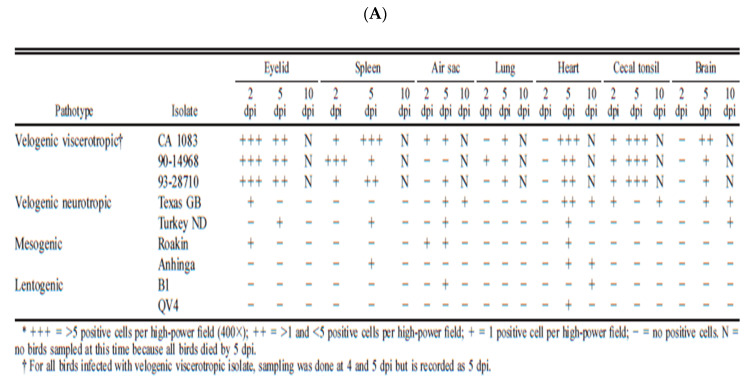
The hypothesis that host adaptation in virulent Newcastle disease viruses (NDV) has been accompanied by virulence modulation is reviewed here. Historical records, experimental data, and phylogenetic analyses from available GenBank sequences suggest that currently circulating NDVs emerged in the 1920-1940's from low virulence viruses by mutation at the fusion protein cleavage site. These viruses later gave rise to multiple virulent genotypes by modulating virulence in opposite directions. Phylogenetic and pathotyping studies demonstrate that older virulent NDVs further evolved into chicken-adapted genotypes by increasing virulence (velogenic-viscerotropic pathotypes with intracerebral pathogenicity indexes [ICPIs] of 1.6 to 2), or into cormorant-adapted NDVs by moderating virulence (velogenic-neurotropic pathotypes with ICPIs of 1.4 to 1.6), or into pigeon-adapted viruses by further attenuating virulence (mesogenic pathotypes with ICPIs of 0.9 to 1.4). Pathogenesis and transmission experiments on adult chickens demonstrate that chicken-adapted velogenic-viscerotropic viruses are more capable of causing disease than older velogenic-neurotropic viruses. Currently circulating velogenic-viscerotropic viruses are also more capable of replicating and of being transmitted in naïve chickens than viruses from cormorants and pigeons. These evolutionary virulence changes are consistent with theories that predict that virulence may evolve in many directions in order to achieve maximum fitness, as determined by genetic and ecologic constraints.
本文回顾了强毒新城疫病毒(NDV)宿主适应性伴随着毒力调节的假说。现有 GenBank 序列的历史记录、实验数据和系统发育分析表明,目前循环的 NDV 是在 20 世纪 20 年代至 40 年代由低毒力病毒通过融合蛋白裂解位点的突变而产生的。这些病毒后来通过相反方向的毒力调节产生了多种强毒基因型。系统发育和定型研究表明,较老的强毒 NDV 通过增加毒力(脑内致病指数 [ICPI] 为 1.6 至 2 的速发型-内脏型)进一步进化为适应鸡的基因型,或通过调节毒力(ICPI 为 1.4 至 1.6 的速发型-神经型)适应鸬鹚的 NDV,或通过进一步降低毒力(ICPI 为 0.9 至 1.4 的中发型)适应鸽子的病毒。对成年鸡的发病机制和传播实验表明,适应鸡的强毒速发型内脏型病毒比老的强毒神经型病毒更能引起疾病。目前循环的强毒速发型内脏型病毒在幼鸡中也比来自鸬鹚和鸽子的病毒更能复制和传播。这些进化的毒力变化与预测一致,即毒力可能朝着许多方向进化,以达到最大适应性,这取决于遗传和生态限制。