Chambers Earle C, McAuliff Kathleen E, Heller Caroline G, Fiori Kevin, Hollingsworth Nicole
Albert Einstein College of Medicine, Bronx, NY, USA.
Montefiore Health System, Bronx, NY, USA.
J Prim Care Community Health. 2021 Jan-Dec;12:2150132720985044. doi: 10.1177/2150132720985044.
INTRODUCTION/OBJECTIVES: Uncontrolled diabetes can lead to major health complications, and significantly contributes to diabetes-related morbidity, mortality, and healthcare costs. Few studies have examined the relationship between unmet social needs and diabetes control among predominantly Black and Hispanic patient populations.
In a large urban hospital system in the Bronx, NY, 5846 unique patients with diabetes seen at a primary care visit between April 2018 and December 2019 completed a social needs screener. Measures included diabetes control (categorized as Hemoglobin (Hb) A1c <9.0 as controlled and Hb A1C ≥9.0 as uncontrolled), social needs (10-item screen), and demographic covariates, including age, sex, race/ethnicity, insurance status, percentage of block-group poverty, patient's preferred language, and the Elixhauser Comorbidity Index.
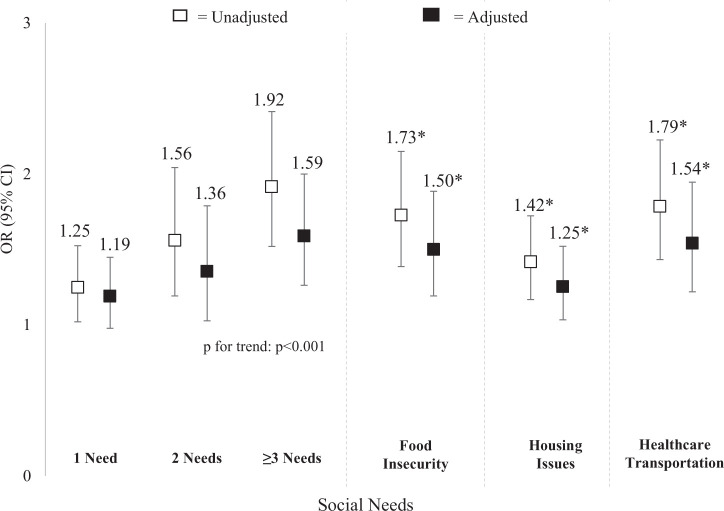
Twenty-two percent (22%) of the patient sample had at least 1 unmet social need, and the most prevalent unmet social needs were housing issues (including housing quality and insecurity), food insecurity, and lack of healthcare transportation. Logistic regression analysis showed a significant relationship between social needs and uncontrolled diabetes, with more social needs indicating a greater likelihood of uncontrolled diabetes (Adjusted Odds Ratio (AOR) for ≥3 needs: 1.59, 95% CI: 1.26, 2.00). Of the patients with most frequently occurring unmet social needs, lack of healthcare transportation (AOR: 1.54, 95% CI: 1.22, 1.95) and food insecurity (AOR: 1.50, 95% CI: 1.19, 1.89) had the greatest likelihood of having uncontrolled diabetes, after adjusting for covariates.
Unmet social needs appear to be linked to a greater likelihood of uncontrolled diabetes. Implications for healthcare systems to screen and address social needs for patients with diabetes are discussed.
引言/目的:未得到控制的糖尿病会导致严重的健康并发症,并显著增加与糖尿病相关的发病率、死亡率和医疗成本。很少有研究探讨在以黑人和西班牙裔为主的患者群体中,未满足的社会需求与糖尿病控制之间的关系。
在纽约布朗克斯区的一个大型城市医院系统中,2018年4月至2019年12月期间在初级保健就诊时被诊断为糖尿病的5846名独特患者完成了一项社会需求筛查。测量指标包括糖尿病控制情况(糖化血红蛋白(Hb)A1c<9.0为控制良好,Hb A1C≥9.0为控制不佳)、社会需求(10项筛查)以及人口统计学协变量,包括年龄、性别、种族/族裔、保险状况、街区贫困率、患者首选语言和埃利克斯豪泽合并症指数。
22%的患者样本至少有1项未满足的社会需求,最普遍的未满足社会需求是住房问题(包括住房质量和不安全)、粮食不安全和缺乏医疗运输。逻辑回归分析显示社会需求与未控制的糖尿病之间存在显著关系,社会需求越多表明未控制的糖尿病可能性越大(≥3项需求的调整优势比(AOR):1.59,95%置信区间:1.26,2.00)。在最常出现未满足社会需求的患者中,调整协变量后,缺乏医疗运输(AOR:1.54,95%置信区间:1.22,1.95)和粮食不安全(AOR:1.50,95%置信区间:1.19,1.89)导致未控制糖尿病的可能性最大。
未满足的社会需求似乎与未控制的糖尿病可能性更大有关。讨论了医疗系统对糖尿病患者筛查和解决社会需求的意义。