Evers Caroline, Jordan Suzana, Maurer Britta, Becker Mike Oliver, Mihai Carina, Dobrota Rucsandra, Hoederath Petra, Distler Oliver
Department of Rheumatology, University Hospital Zurich, University of Zurich, Gloriastrasse 25, 8091, Zurich, Switzerland.
Centre of Neurosurgery Hirslanden Ostschweiz, Paintherapy Stephanshorn, Brauerstrasse 95a, 9016, St. Gallen, Switzerland.
Arthritis Res Ther. 2021 Jan 19;23(1):34. doi: 10.1186/s13075-021-02421-1.
Pain is a frequent, yet inadequately explored challenge in patients with systemic sclerosis (SSc). This study aimed to conduct an extensive pain assessment, examining pain chronification and its association with disease manifestations.
Consecutive SSc patients attending their annual assessment were included. SSc-specific features were addressed as defined by the European Scleroderma Trials and Research (EUSTAR) guidelines. Pain analysis included intensity, localization, treatment, chronification grade according to the Mainz Pain Staging System (MPSS), general well-being using the Marburg questionnaire on habitual health findings (MFHW) and symptoms of anxiety and depression using the Hospital Anxiety and Depression Scale (HADS).
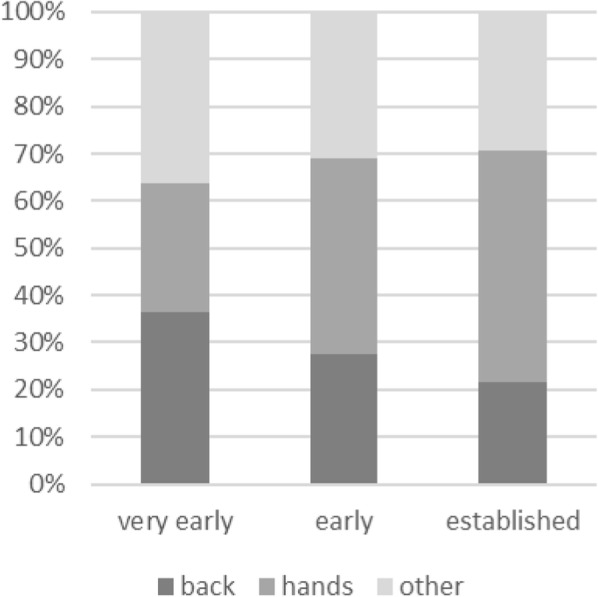
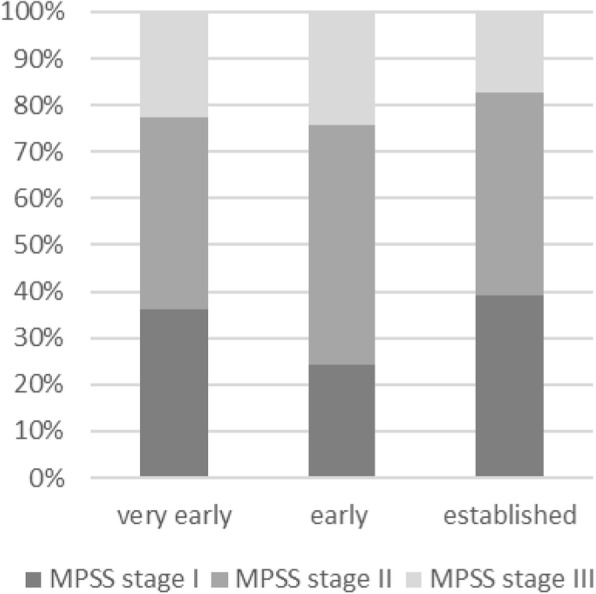
One hundred forty-seven SSc patients completed a pain questionnaire, and 118/147 patients reporting pain were included in the analysis. Median pain intensity was 4/10 on a numeric rating scale (NRS). The most frequent major pain localizations were hand and lower back. Low back pain as the main pain manifestation was significantly more frequent in patients with very early SSc (p = 0.01); those patients also showed worse HADS and MFHW scores. Regarding pain chronification, 34.8% were in stage I according to the MPSS, 45.2% in stage II and 20.0% in stage III. There was no significant correlation between chronification grade and disease severity, but advanced chronification was significantly more frequent in patients with low back pain (p = 0.024). It was also significantly associated with pathological HADS scores (p < 0.0001) and linked with decreased well-being and higher use of analgesics.
Our study implies that also non-disease-specific symptoms such as low back pain need to be considered in SSc patients, especially in early disease. Since low back pain seems to be associated with higher grades of pain chronification and psychological problems, our study underlines the importance of preventing pain chronification in order to enhance the quality of life.
疼痛是系统性硬化症(SSc)患者中常见但未得到充分研究的挑战。本研究旨在进行广泛的疼痛评估,检查疼痛慢性化及其与疾病表现的关联。
纳入参加年度评估的连续性SSc患者。根据欧洲硬皮病试验与研究(EUSTAR)指南确定SSc特异性特征。疼痛分析包括强度、部位、治疗、根据美因茨疼痛分期系统(MPSS)的慢性化分级、使用马尔堡习惯性健康状况问卷(MFHW)评估的总体健康状况以及使用医院焦虑抑郁量表(HADS)评估的焦虑和抑郁症状。
147例SSc患者完成了疼痛问卷,分析纳入了118/147例报告有疼痛的患者。数字评分量表(NRS)上的中位疼痛强度为4/10。最常见的主要疼痛部位是手部和下背部。下背部疼痛作为主要疼痛表现,在极早期SSc患者中显著更常见(p = 0.01);这些患者的HADS和MFHW评分也更差。关于疼痛慢性化,根据MPSS,34.8%处于I期,45.2%处于II期,20.0%处于III期。慢性化分级与疾病严重程度之间无显著相关性,但下背部疼痛患者中晚期慢性化显著更常见(p = 0.024)。它还与HADS病理评分显著相关(p < 0.0001),并与幸福感降低和镇痛药使用增加有关。
我们的研究表明,SSc患者,尤其是在疾病早期,也需要考虑诸如下背部疼痛等非疾病特异性症状。由于下背部疼痛似乎与更高程度的疼痛慢性化和心理问题相关,我们的研究强调了预防疼痛慢性化以提高生活质量的重要性。