Population Health Sciences Institute, Newcastle University, The Baddiley-Clark Building, Richardson Road, Newcastle Upon TyneNE2 4AX, UK.
Department of Primary Care & Population Health, Institute of Epidemiology and Health Care, University College London, London, UK.
Br J Nutr. 2021 Jul 14;126(1):118-130. doi: 10.1017/S0007114521000180. Epub 2021 Jan 20.
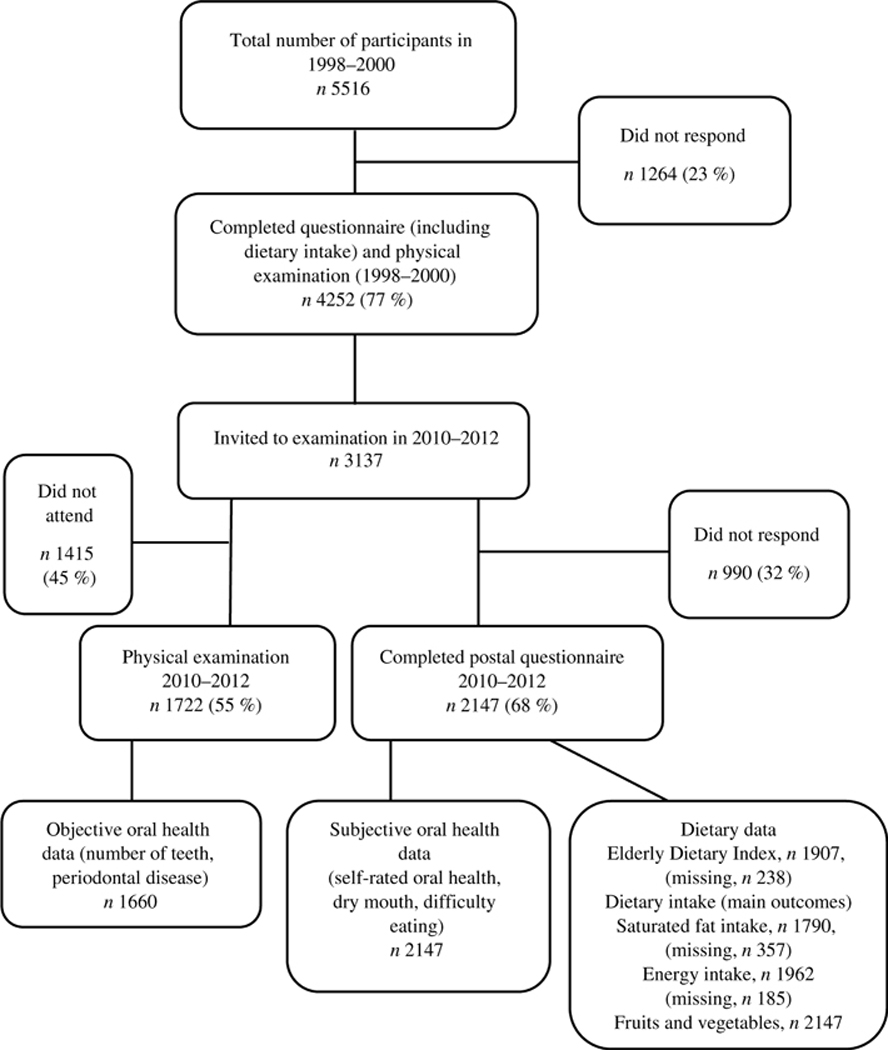
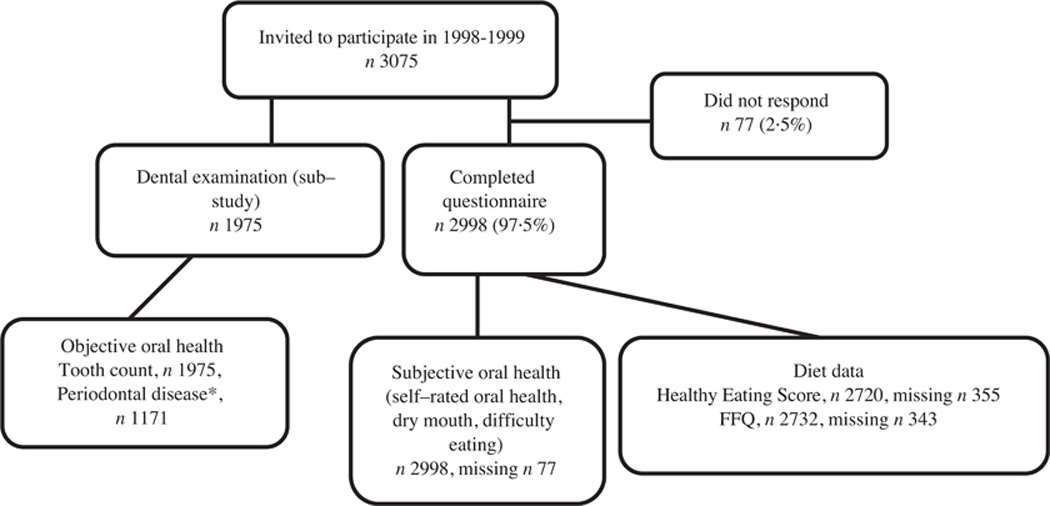
We aimed to investigate the associations of poor oral health cross-sectionally with diet quality and intake in older people. We also examined whether change in diet quality is associated with oral health problems. Data from the British Regional Heart Study (BRHS) comprising British males aged 71-92 years and the Health, Aging and Body Composition (HABC) Study comprising American males and females aged 71-80 years were used. Dental data included tooth loss, periodontal disease, dry mouth and self-rated oral health. Dietary data included diet quality (based on Elderly Dietary Index (BRHS) and Healthy Eating Score (HABC Study)) and several nutrients. In the BRHS, change in diet quality over 10 years (1998-2000 to 2010-2012) was also assessed. In the BRHS, tooth loss, fair/poor self-rated oral health and accumulation of oral health problems were associated with poor diet quality, after adjustment. Similar associations were reported for high intake of processed meat. Poor oral health was associated with the top quartile of percentage of energy content from saturated fat (self-rated oral health, OR 1·34, 95 % CI 1·02, 1·77). In the HABC Study, no significant associations were observed for diet quality after adjustment. Periodontal disease was associated with the top quartile of percentage of energy content from saturated fat (OR 1·48, 95 % CI 1·09, 2·01). In the BRHS, persistent low diet quality was associated with higher risk of tooth loss and accumulation of oral health problems. Older individuals with oral health problems had poorer diets and consumed fewer nutrient-rich foods. Persistent poor diet quality was associated with oral health problems later in life.
我们旨在研究老年人的口腔健康状况与饮食质量和摄入量之间的横断面关联。我们还检查了饮食质量的变化是否与口腔健康问题有关。使用了英国区域心脏研究(BRHS)的数据,该研究包括 71-92 岁的英国男性,以及健康、衰老和身体成分(HABC)研究的数据,该研究包括 71-80 岁的美国男性和女性。牙齿数据包括牙齿缺失、牙周病、口干和自我评估的口腔健康。饮食数据包括饮食质量(基于老年人饮食指数(BRHS)和健康饮食评分(HABC 研究))和几种营养素。在 BRHS 中,还评估了 10 年内饮食质量的变化(1998-2000 年至 2010-2012 年)。在 BRHS 中,调整后,牙齿缺失、自我评估的口腔健康状况一般/差和口腔健康问题的积累与饮食质量差有关。同样的关联也报告了加工肉类的高摄入量。口腔健康状况差与饱和脂肪能量含量的前四分之一(自我评估的口腔健康,OR 1.34,95%CI 1.02,1.77)有关。在 HABC 研究中,调整后饮食质量没有显著关联。牙周病与饱和脂肪能量含量的前四分之一有关(OR 1.48,95%CI 1.09,2.01)。在 BRHS 中,持续的低饮食质量与牙齿缺失和口腔健康问题的积累风险较高有关。口腔健康问题的老年个体饮食较差,摄入的营养丰富的食物较少。持续的不良饮食质量与晚年的口腔健康问题有关。