Department of Health Sciences, Faculty of Earth and Life Sciences, Amsterdam Public Health Research Institute, Vrije Universiteit, Amsterdam, Netherlands.
Laboratory of Epidemiology and Population Sciences, Intramural Research Program, National Institute of Aging, Bethesda, MD.
Am J Clin Nutr. 2018 Feb 1;107(2):155-164. doi: 10.1093/ajcn/nqx020.
Protein-energy malnutrition (PEM) is a major problem in older adults. Whether poor diet quality is an indicator for the long-term development of PEM is unknown.
The aim was to determine whether poor diet quality is associated with the incidence of PEM in community-dwelling older adults.
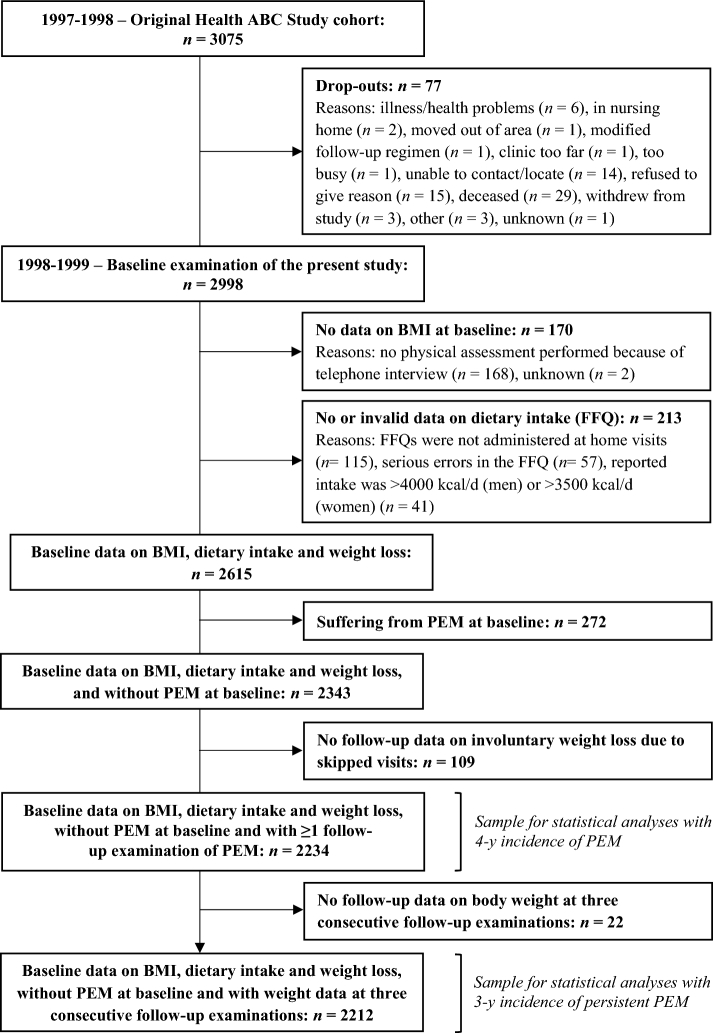
We used data on 2234 US community-dwelling older adults aged 70-79 y of the Health, Aging, and Body Composition (Health ABC) Study. In 1998-1999, dietary intake over the preceding year was measured by using a Block food-frequency questionnaire. Indicators of diet quality include the Healthy Eating Index (HEI), energy intake, and protein intake. Outcomes were determined annually by using measured weight and height and included the following: 1) incident PEM [body mass index (in kg/m2) <20, involuntary weight loss of ≥5% in the preceding year at any follow-up examination, or both] and 2) incident persistent PEM (having PEM at 2 consecutive follow-up examinations). Associations of indicators of diet quality with 4-y and 3-y incidence of PEM and persistent PEM, respectively, were examined by multivariable Cox regression analyses.
The quality of the diet, as assessed with the HEI, was rated as "poor" for 6.4% and as "needs improvement" for 73.0% of the participants. During follow-up, 24.9% of the participants developed PEM and 8.5% developed persistent PEM. A poor HEI score was not associated with incident PEM or persistent PEM. Lower baseline energy intake was associated with a lower incidence of PEM (HR per 100-kcal/d lower intake: 0.98; 95% CI: 0.97, 0.99) and persistent PEM (HR: 0.97; 95% CI: 0.95, 0.99), although lower baseline protein intake was observed to be associated with a higher incidence of persistent PEM (HR per 10-g/d lower intake: 1.15; 95% CI: 1.03, 1.29).
These findings do not indicate that a poor diet quality is a risk factor for the long-term development of PEM in community-dwelling older adults, although there is an indication that lower protein intake is associated with higher PEM risk.
蛋白质-能量营养不良(PEM)是老年人的一个主要问题。饮食质量差是否是 PEM 长期发展的指标尚不清楚。
本研究旨在确定饮食质量差是否与社区居住的老年人中 PEM 的发病率有关。
我们使用了来自美国健康老龄化和身体成分研究(Health ABC)中 2234 名年龄在 70-79 岁的社区居住的老年人的数据。1998-1999 年,通过使用 Block 食物频率问卷来测量过去一年的饮食摄入量。饮食质量的指标包括健康饮食指数(HEI)、能量摄入和蛋白质摄入。通过测量体重和身高,每年确定结局,包括以下内容:1)新发 PEM[体重指数(kg/m2)<20,在任何随访检查中过去一年体重不自主下降≥5%,或两者兼有]和 2)新发持续性 PEM(在连续两次随访检查中均有 PEM)。通过多变量 Cox 回归分析分别检查饮食质量指标与 4 年和 3 年新发 PEM 和持续性 PEM 的相关性。
参与者的饮食质量被评估为“差”的比例为 6.4%,“需要改进”的比例为 73.0%。在随访期间,24.9%的参与者发生 PEM,8.5%的参与者发生持续性 PEM。HEI 评分差与新发 PEM 或持续性 PEM 无关。较低的基线能量摄入与较低的 PEM 发生率相关(每 100 千卡/天摄入量降低 100 千卡的 HR:0.98;95%CI:0.97,0.99)和持续性 PEM(HR:0.97;95%CI:0.95,0.99),尽管较低的基线蛋白质摄入与持续性 PEM 的发生率较高有关(每 10 克/天摄入量降低 10 克的 HR:1.15;95%CI:1.03,1.29)。
这些发现表明,饮食质量差并不是社区居住的老年人中 PEM 长期发展的危险因素,尽管有迹象表明较低的蛋白质摄入与较高的 PEM 风险相关。