Graduate School of Health and Sports Science, Juntendo University, Chiba, Japan.
Department of Administrative Nutrition, Faculty of Health and Nutrition, Tokyo Seiei College, Tokyo, Japan.
Aging (Albany NY). 2021 Jan 19;13(2):1692-1717. doi: 10.18632/aging.202529.
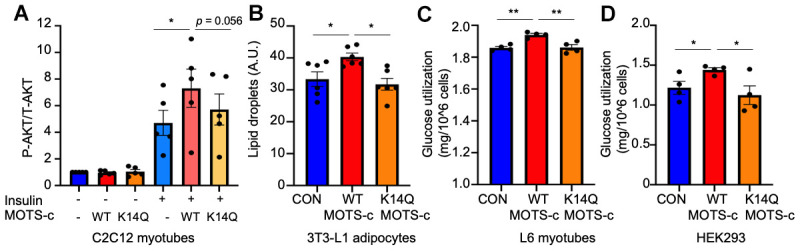
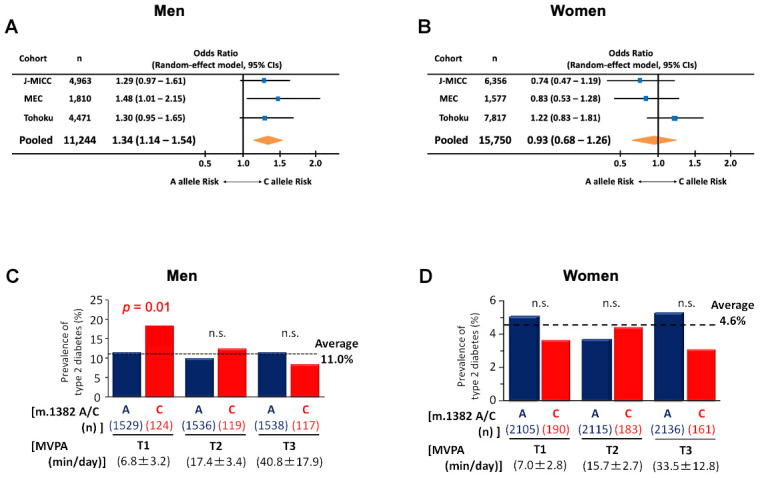
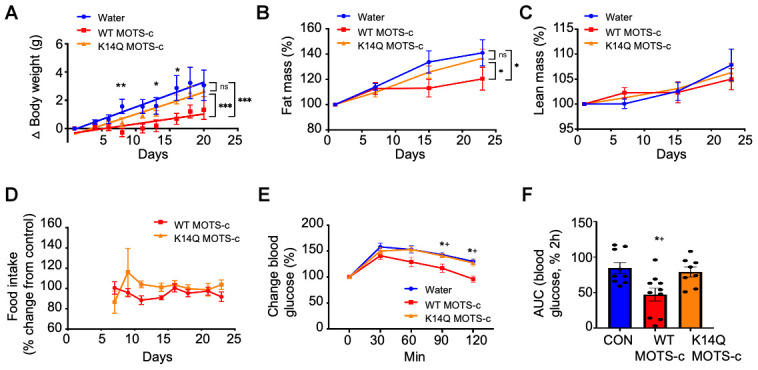
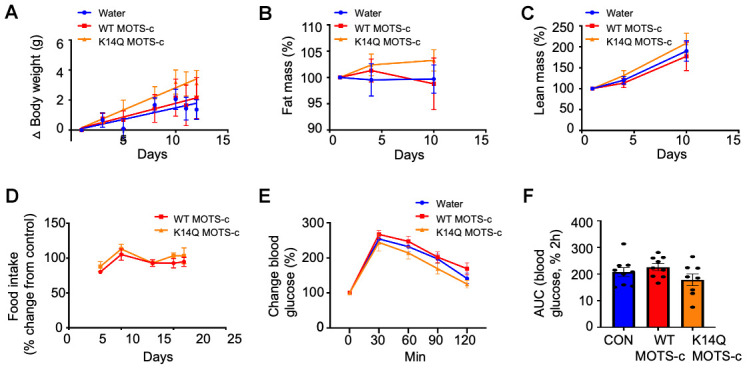
Type 2 Diabetes (T2D) is an emerging public health problem in Asia. Although ethnic specific mtDNA polymorphisms have been shown to contribute to T2D risk, the functional effects of the mtDNA polymorphisms and the therapeutic potential of mitochondrial-derived peptides at the mtDNA polymorphisms are underexplored. Here, we showed an Asian-specific mitochondrial DNA variation m.1382A>C (rs111033358) leads to a K14Q amino acid replacement in MOTS-c, an insulin sensitizing mitochondrial-derived peptide. Meta-analysis of three cohorts (n = 27,527, J-MICC, MEC, and TMM) show that males but not females with the C-allele exhibit a higher prevalence of T2D. In J-MICC, only males with the C-allele in the lowest tertile of physical activity increased their prevalence of T2D, demonstrating a kinesio-genomic interaction. High-fat fed, male mice injected with MOTS-c showed reduced weight and improved glucose tolerance, but not K14Q-MOTS-c treated mice. Like the human data, female mice were unaffected. Mechanistically, K14Q-MOTS-c leads to diminished insulin-sensitization . Thus, the m.1382A>C polymorphism is associated with susceptibility to T2D in men, possibly interacting with exercise, and contributing to the risk of T2D in sedentary males by reducing the activity of MOTS-c.
2 型糖尿病(T2D)是亚洲日益严重的公共卫生问题。虽然已经证明特定于种族的 mtDNA 多态性有助于 T2D 风险,但 mtDNA 多态性的 mtDNA 多态性的功能影响和线粒体衍生肽的治疗潜力仍未得到充分探索。在这里,我们展示了一种亚洲特有的线粒体 DNA 变异 m.1382A>C(rs111033358)导致 MOTS-c 中的 K14Q 氨基酸替换,MOTS-c 是一种胰岛素增敏的线粒体衍生肽。对三个队列(n=27527、J-MICC、MEC 和 TMM)的荟萃分析表明,携带 C 等位基因的男性而非女性 T2D 患病率更高。在 J-MICC 中,只有在体力活动最低三分位的 C 等位基因的男性才会增加 T2D 的患病率,表明存在运动基因组相互作用。用 MOTS-c 注射高脂肪喂养的雄性小鼠显示体重减轻和葡萄糖耐量改善,但 K14Q-MOTS-c 处理的小鼠没有。与人类数据一样,雌性小鼠不受影响。从机制上讲,K14Q-MOTS-c 导致胰岛素敏感性降低。因此,m.1382A>C 多态性与男性 T2D 的易感性相关,可能与运动相互作用,并通过降低 MOTS-c 的活性来增加久坐男性患 T2D 的风险。