Department of Physics and Engineering, ITMO University, St. Petersburg, Russia.
General and Theoretical Electrical Engineering (ATE), Faculty of Engineering, University of Duisburg-Essen, and CENIDE - Center for Nanointegration Duisburg-Essen, Duisburg, Germany.
Nat Commun. 2021 Jan 19;12(1):455. doi: 10.1038/s41467-020-20708-w.
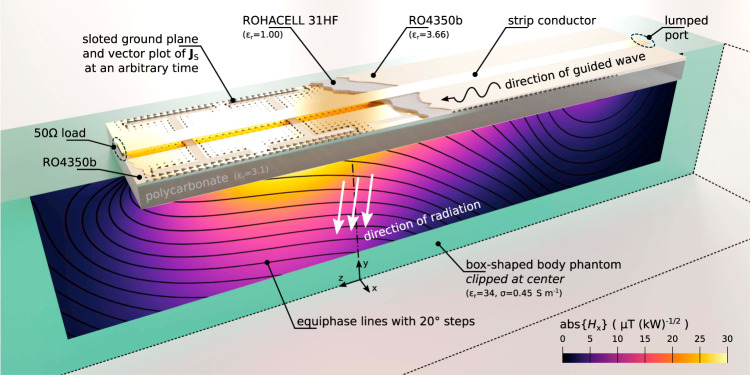
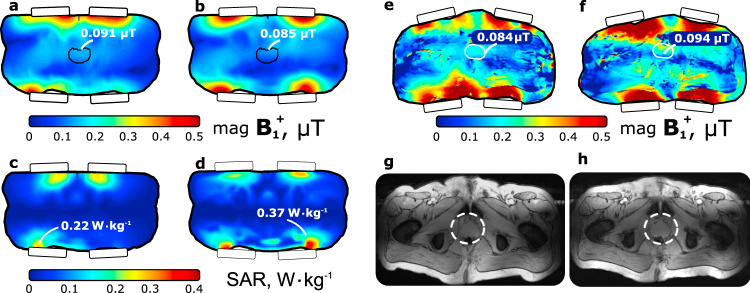
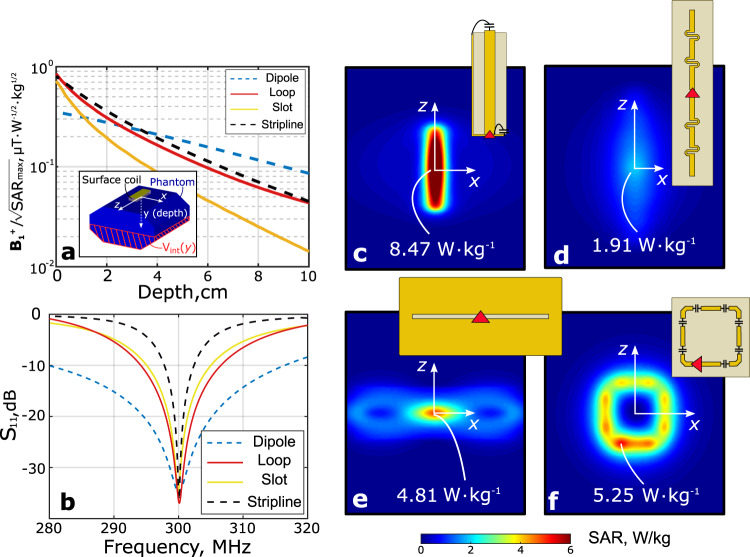
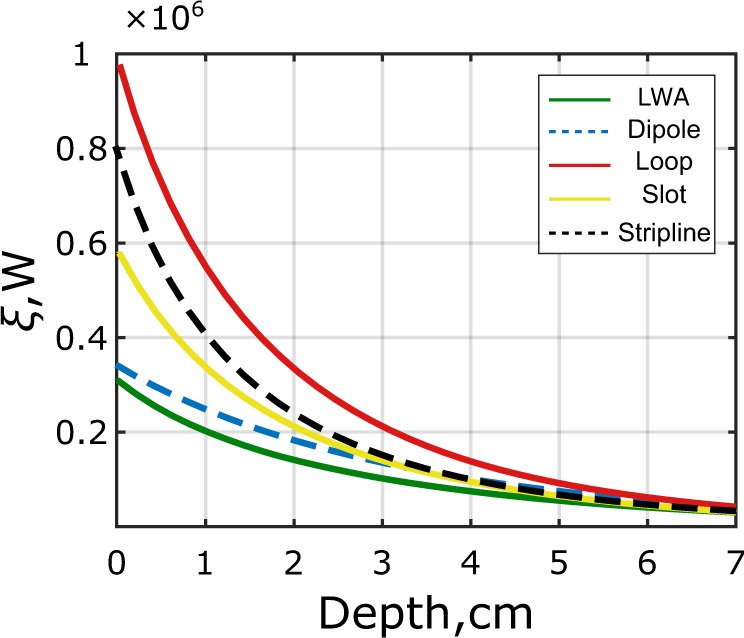
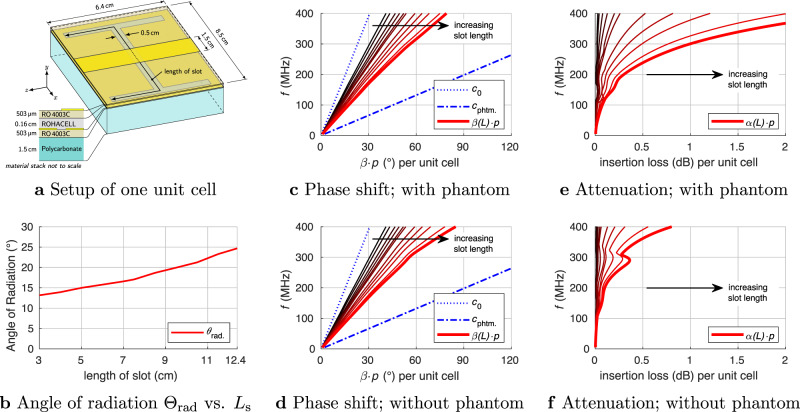
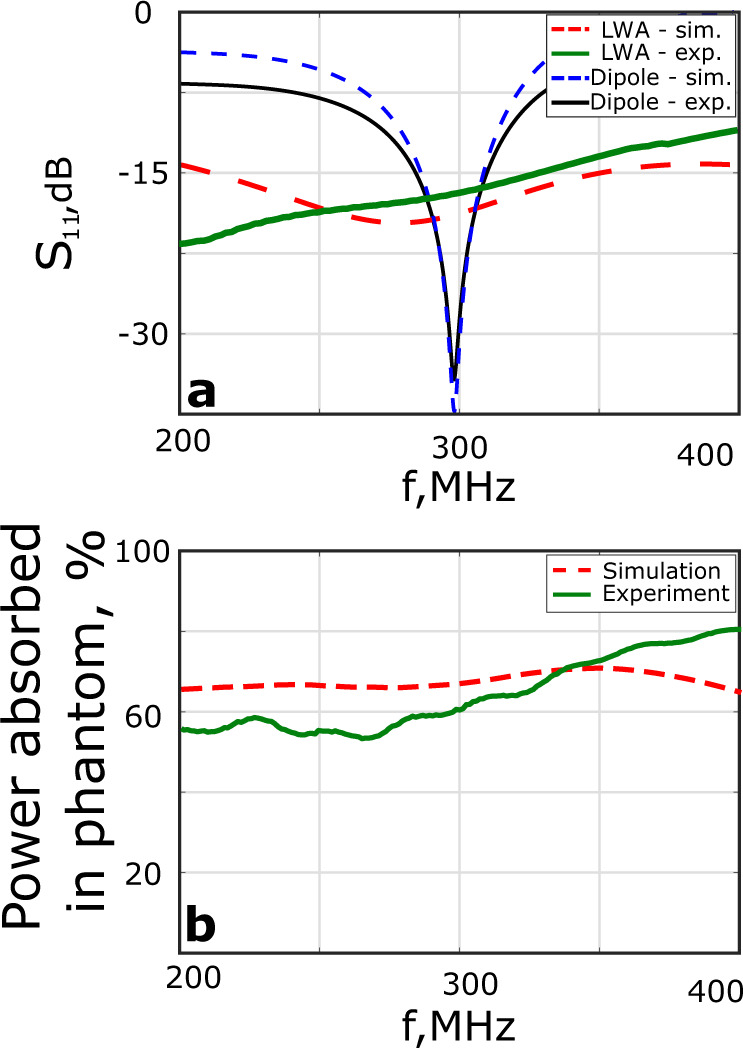
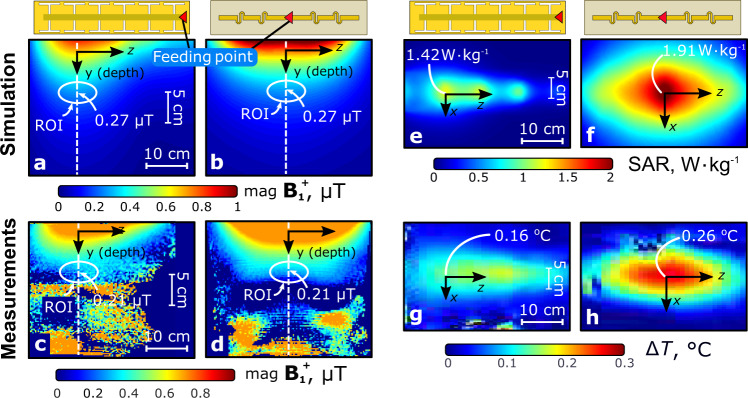
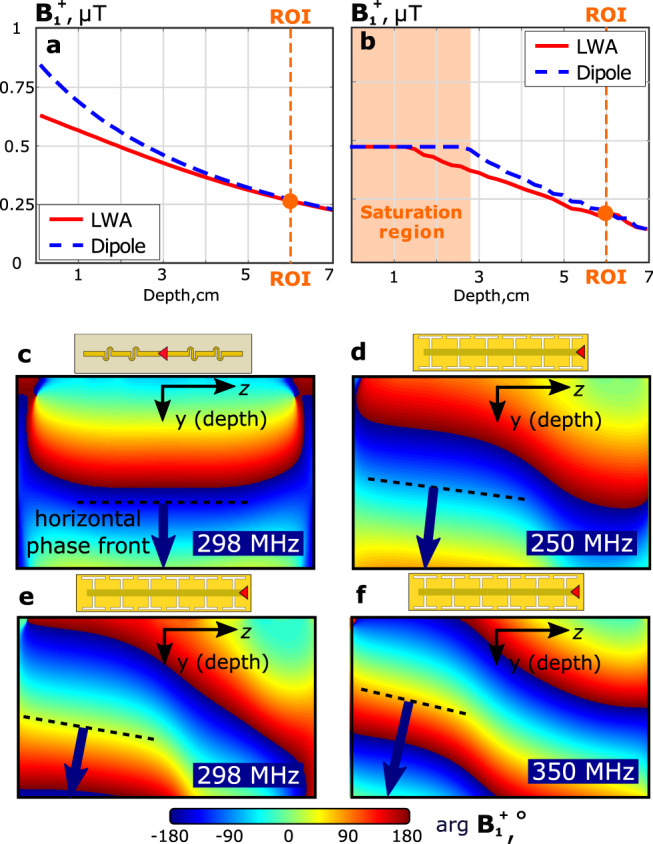
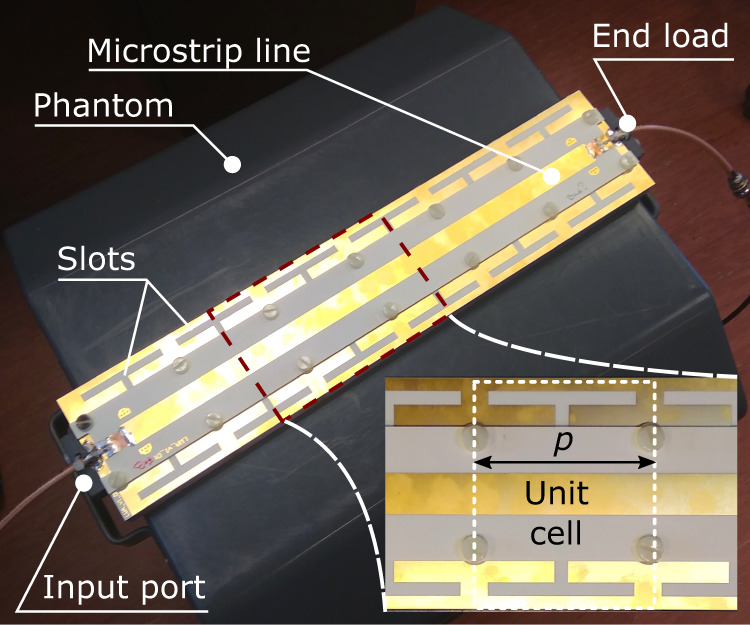
The technology of magnetic resonance imaging is developing towards higher magnetic fields to improve resolution and contrast. However, whole-body imaging at 7 T or even higher flux densities remains challenging due to wave interference, tissue inhomogeneities, and high RF power deposition. Nowadays, proper RF excitation of a human body in prostate and cardiac MRI is only possible to achieve by using phased arrays of antennas attached to the body (so-called surface coils). Due to safety concerns, the design of such coils aims at minimization of the local specific absorption rate (SAR), keeping the highest possible RF signal in the region of interest. Most previously demonstrated approaches were based on resonant structures such as e.g. dipoles, capacitively-loaded loops, TEM-line sections. In this study, we show that there is a better compromise between the transmit signal [Formula: see text] and the local SAR using non-resonant surface coils generating a low electric field in the proximity of their conductors. With this aim, we propose and experimentally demonstrate a leaky-wave antenna implemented as a periodically-slotted microstrip transmission line. Due to its non-resonant radiation, it induces only slightly over half the peak local SAR compared to a state-of-the-art dipole antenna but has the same transmit efficiency in prostate imaging at 7 T. Unlike other antennas for MRI, the leaky-wave antenna does not require to be tuned and matched when placed on a body, which makes it easy-to-use in prostate imaging at 7 T MRI.
磁共振成象技术正朝着更高的磁场方向发展,以提高分辨率和对比度。然而,由于波干扰、组织不均匀性和高射频功率沉积,在 7T 甚至更高的磁通密度下进行全身成象仍然具有挑战性。如今,只有通过将天线(所谓的表面线圈)连接到身体上,才能对人体的前列腺和心脏磁共振进行适当的射频激发。由于安全问题,此类线圈的设计旨在将局部比吸收率(SAR)最小化,同时保持感兴趣区域内尽可能高的射频信号。以前大多数演示的方法都是基于谐振结构,例如偶极子、电容加载环、TEM 线部分。在这项研究中,我们表明,在使用产生靠近导体的低电场的非谐振表面线圈来传输信号 [公式:见文本] 和局部 SAR 之间,可以达到更好的折衷。为此,我们提出并实验证明了一种漏波天线,它实现为周期性开槽微带传输线。由于其非谐振辐射,与最先进的偶极子天线相比,它仅引起峰值局部 SAR 略超过一半,但在 7T 前列腺成象中的发射效率相同。与其他 MRI 天线不同,漏波天线在放置在身体上时不需要调谐和匹配,这使其在 7T MRI 前列腺成像中易于使用。