School of Optometry and Vision Science, University of New South Wales Sydney, Sydney, Australia.
Prince of Wales Clinical School, University of New South Wales Sydney, Sydney, Australia.
Sci Rep. 2021 Jan 19;11(1):1786. doi: 10.1038/s41598-021-81398-y.
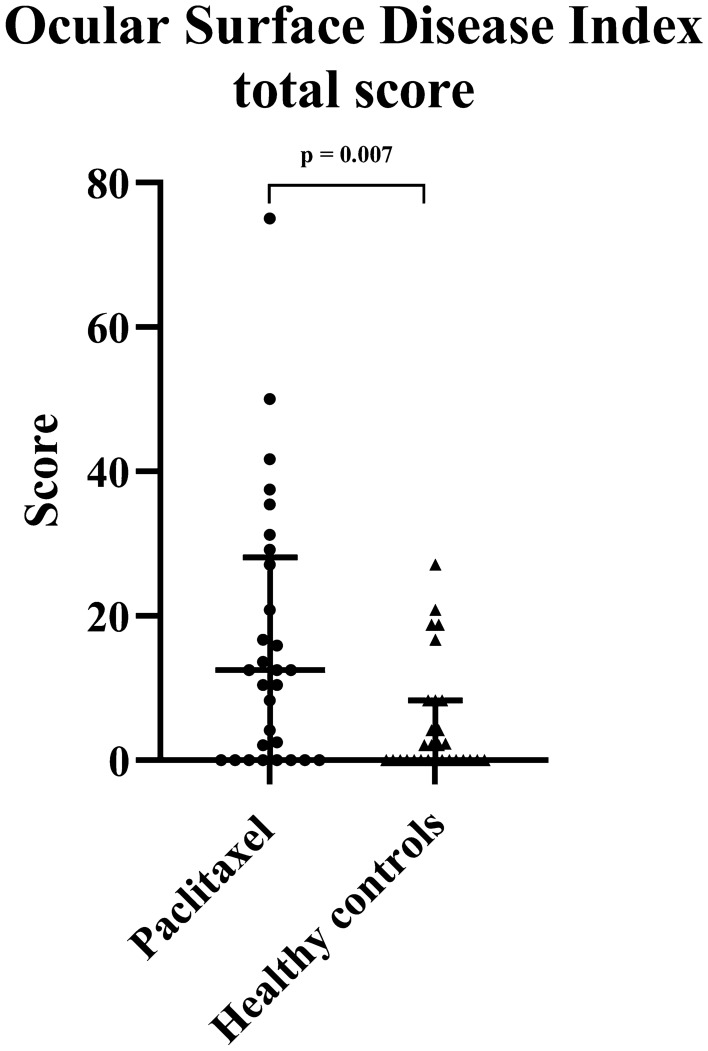
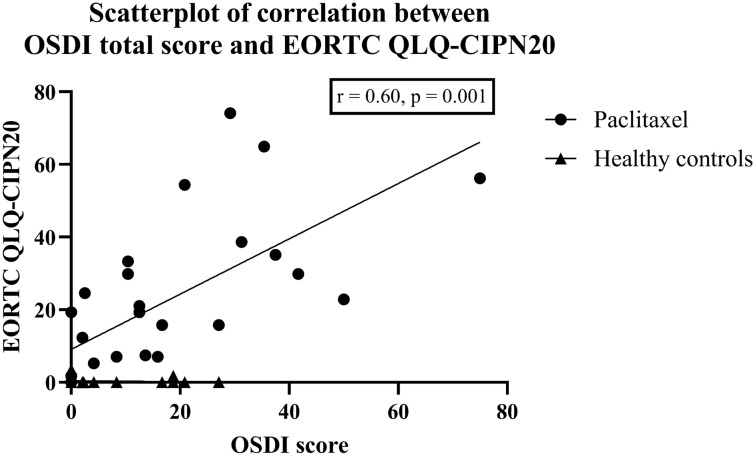
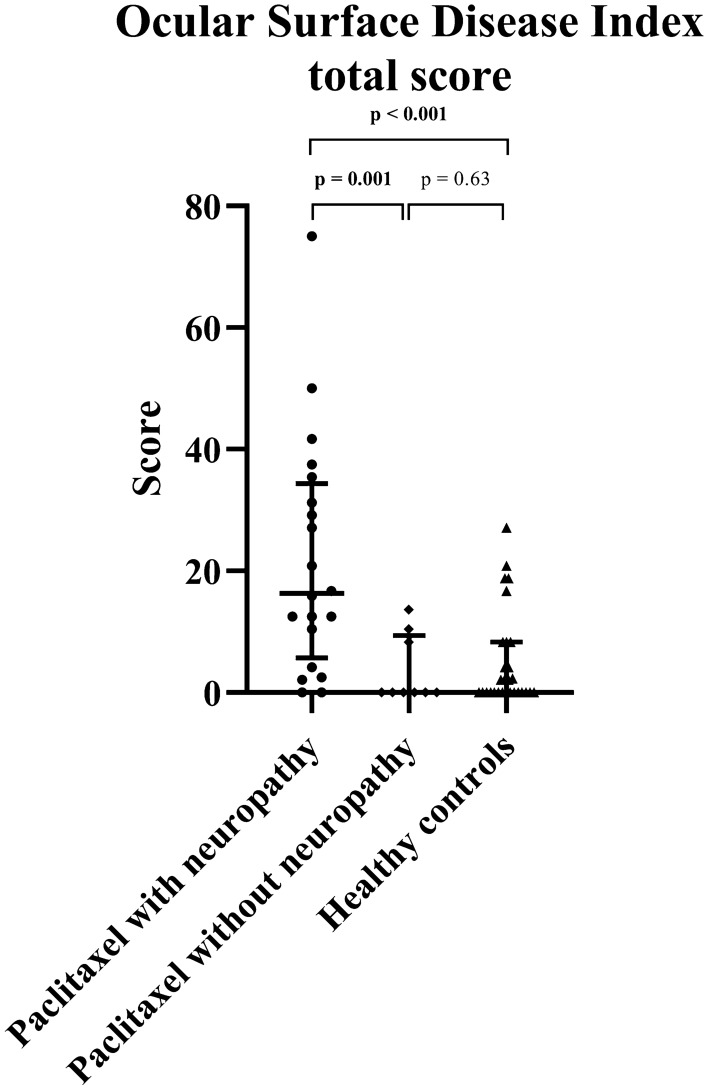
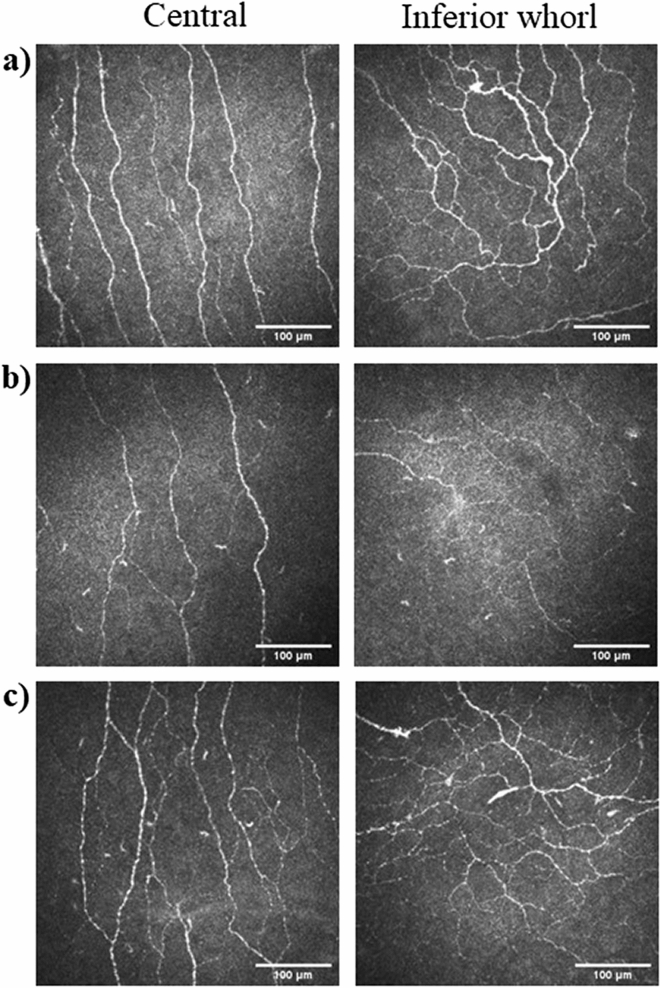
Ocular surface dysfunction is common in patients receiving anti-cancer drug treatment. The effects of paclitaxel, a neurotoxic chemotherapeutic drug, on ocular surface discomfort associated with dry eye disease was investigated. Patients with cancer who had completed paclitaxel treatment between 3 and 24 months prior to assessment (n = 29) and age- and sex-matched healthy control subjects (n = 29) were recruited and assessed with the Ocular Surface Disease Index (OSDI) to measure ocular surface discomfort. In-vivo corneal confocal microscopy was used to evaluate corneal nerve parameters in the right eye. Peripheral neurotoxicity was assessed using patient-reported outcomes and clinical grading scales. The paclitaxel group had significantly worse OSDI total scores compared with controls (Median, Md = 19.3 and Md = 0, p = 0.007, respectively). Corneal nerve fiber and inferior whorl lengths were reduced in the paclitaxel group compared with controls (14.2 ± 4.0 and 14.4 ± 4.0 mm/mm vs. 16.4 ± 4.0 and 16.9 ± 4.9 mm/mm, respectively, p = 0.04). When analyzed by presence of peripheral neuropathy, paclitaxel-treated patients with neuropathy showed worse OSDI total scores compared to those without peripheral neuropathy post-treatment (p = 0.001) and healthy controls (p < 0.001). More severe ocular discomfort and worse visual function was associated with greater peripheral neurotoxicity symptoms (r = 0.60, p = 0.001) and neuropathy severity (r = 0.49, p = 0.008), respectively. Patients who have been treated with paclitaxel have a higher risk of ocular surface discomfort associated with dry eye disease, particularly those with peripheral neuropathy. Future longitudinal studies should investigate the clinical impact of corneal nerve reduction in dry eye disease.
眼表面功能障碍在接受抗癌药物治疗的患者中很常见。本研究旨在探讨神经毒性化疗药物紫杉醇对与干眼症相关的眼表面不适的影响。招募了在评估前 3 至 24 个月已完成紫杉醇治疗的癌症患者(n=29)和年龄、性别匹配的健康对照者(n=29),并使用眼表面疾病指数(OSDI)评估眼表面不适,评估右眼的角膜神经参数。采用患者报告的结局和临床分级量表评估周围神经毒性。紫杉醇组的 OSDI 总分明显高于对照组(中位数分别为 19.3 和 0,p=0.007)。与对照组相比,紫杉醇组的角膜神经纤维和下神经环长度减少(分别为 14.2±4.0 和 14.4±4.0mm/mm 与 16.4±4.0 和 16.9±4.9mm/mm,p=0.04)。按周围神经病变的存在进行分析时,紫杉醇治疗后有周围神经病变的患者的 OSDI 总分明显高于无周围神经病变的患者(p=0.001)和健康对照组(p<0.001)。更严重的眼部不适和更差的视觉功能与更严重的周围神经毒性症状(r=0.60,p=0.001)和周围神经病变严重程度(r=0.49,p=0.008)相关。接受紫杉醇治疗的患者发生与干眼症相关的眼表面不适的风险更高,尤其是有周围神经病变的患者。未来的纵向研究应探讨角膜神经减少对干眼症的临床影响。