Department of Mathematics and Natural Sciences, BRAC University, Mohakhali, Dhaka, Bangladesh.
School of Environment and Life Sciences, Independent University, Bangladesh (IUB), Bashundhara, Dhaka, Bangladesh.
PLoS One. 2021 Jan 20;16(1):e0245584. doi: 10.1371/journal.pone.0245584. eCollection 2021.
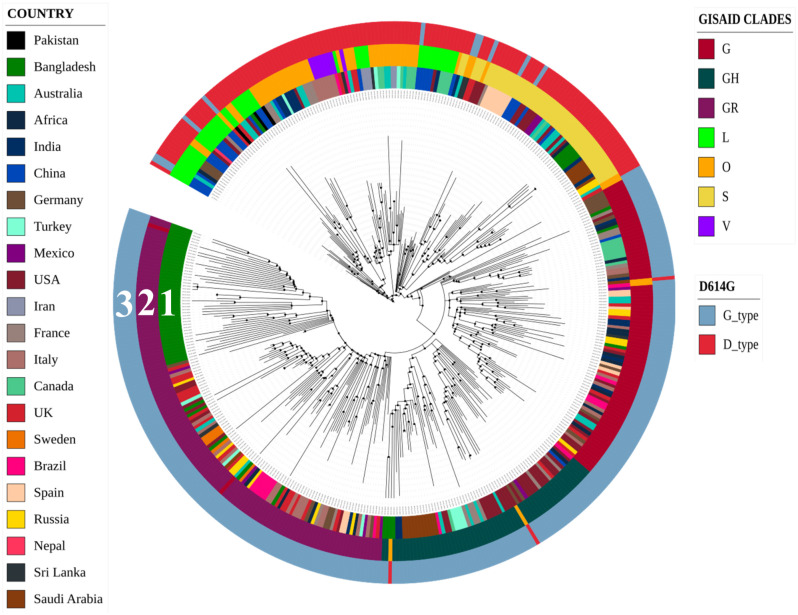
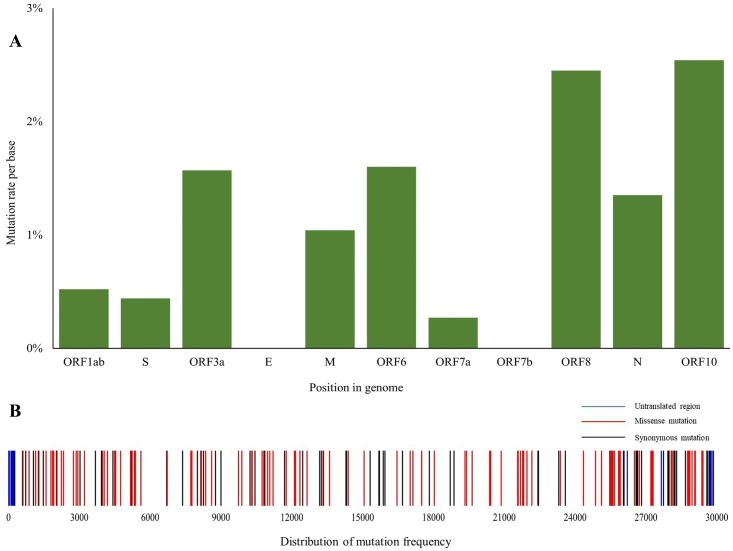
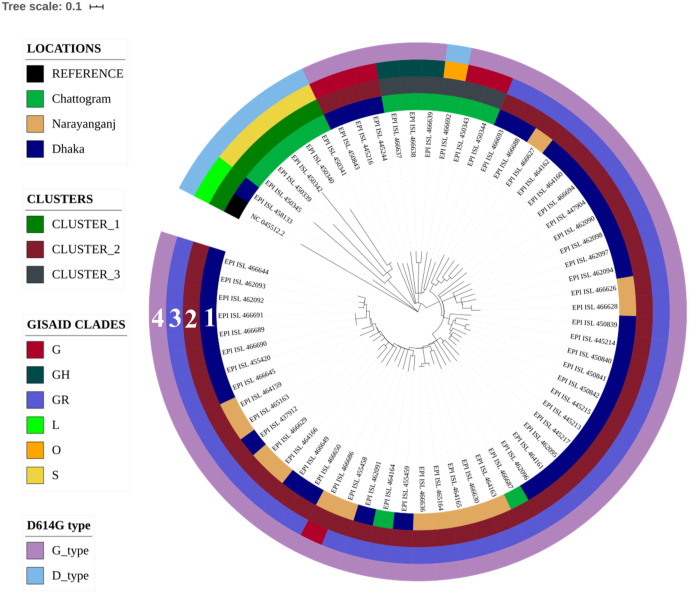
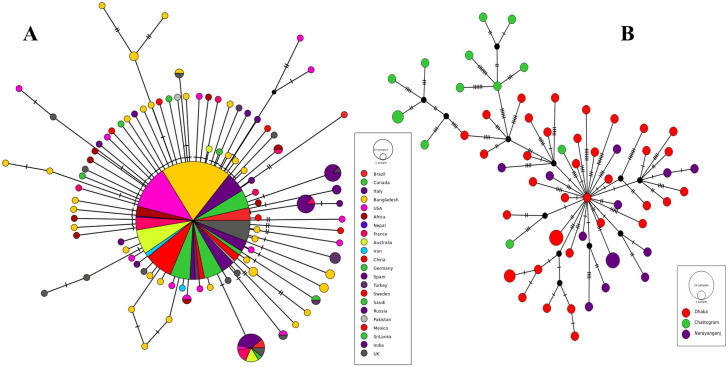
The COVID19 pandemic caused by SARS-CoV-2 virus has severely affected most countries of the world including Bangladesh. We conducted comparative analysis of publicly available whole-genome sequences of 64 SARS-CoV-2 isolates in Bangladesh and 371 isolates from another 27 countries to predict possible transmission routes of COVID19 to Bangladesh and genomic variations among the viruses. Phylogenetic analysis indicated that the pathogen was imported in Bangladesh from multiple countries. The viruses found in the southern district of Chattogram were closely related to strains from Saudi Arabia whereas those in Dhaka were similar to that of United Kingdom and France. The 64 SARS-CoV-2 sequences from Bangladesh belonged to three clusters. Compared to the ancestral SARS-CoV-2 sequence reported from China, the isolates in Bangladesh had a total of 180 mutations in the coding region of the genome, and 110 of these were missense. Among these, 99 missense mutations (90%) were predicted to destabilize protein structures. Remarkably, a mutation that leads to an I300F change in the nsp2 protein and a mutation leading to D614G change in the spike protein were prevalent in SARS-CoV-2 genomic sequences, and might have influenced the epidemiological properties of the virus in Bangladesh.
由 SARS-CoV-2 病毒引起的 COVID19 大流行严重影响了包括孟加拉国在内的世界上大多数国家。我们对孟加拉国的 64 个 SARS-CoV-2 分离株和来自另外 27 个国家的 371 个分离株的公开全基因组序列进行了比较分析,以预测 COVID19 可能传入孟加拉国的途径和病毒之间的基因组变异。系统进化分析表明,病原体是从多个国家传入孟加拉国的。在 Chattogram 南部地区发现的病毒与沙特阿拉伯的菌株密切相关,而在达卡发现的病毒则与英国和法国的菌株相似。孟加拉国的 64 个 SARS-CoV-2 序列属于三个聚类。与中国报告的原始 SARS-CoV-2 序列相比,孟加拉国的分离株在基因组编码区共有 180 个突变,其中 110 个为错义突变。在这些错义突变中,有 99 个(90%)错义突变预计会破坏蛋白质结构的稳定性。值得注意的是,nsp2 蛋白中的 I300F 突变和刺突蛋白中的 D614G 突变在 SARS-CoV-2 基因组序列中普遍存在,这可能影响了病毒在孟加拉国的流行病学特性。