Na Dong Gyu, Paik Wooyul, Cha Jaehyung, Gwon Hye Yun, Kim Suh Young, Yoo Roh-Eul
Department of Radiology, GangNeung Asan Hospital, University of Ulsan College of Medicine, Gangneung, Korea.
Medical Science Research Center, Korea University College of Medicine, Seoul, Korea.
Ultrasonography. 2021 Oct;40(4):474-485. doi: 10.14366/usg.20148. Epub 2020 Dec 9.
The aim of this study was to evaluate the diagnostic performance of the modified Korean Thyroid Imaging Reporting and Data System (K-TIRADS) compared with five society risk stratification systems (RSSs) according to nodule size.
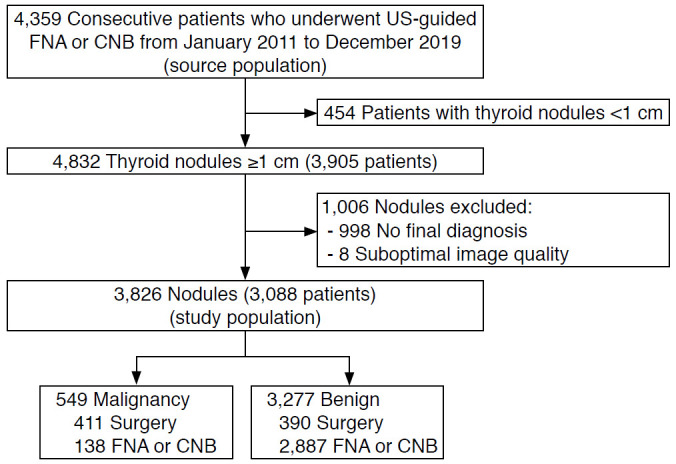
In total, 3,826 consecutive thyroid nodules (≥1 cm) with final diagnoses in 3,088 patients were classified according to five RSSs. The K-TIRADS was modified by raising the biopsy size threshold for low-suspicion nodules and subcategorizing intermediate-suspicion nodules. We assessed the performance of the RSSs as triage tests and their diagnostic accuracy according to nodule size (with a threshold of 2 cm).
Of all nodules, 3,277 (85.7%) were benign and 549 (14.3%) were malignant. In small thyroid nodules (≤2 cm), the American College of Radiology Thyroid Imaging Reporting and Data System (ACR TI-RADS) had the highest reduction rate of unnecessary biopsies (76.3%) and the lowest sensitivity (76.1%). The modified K-TIRADS had the second highest reduction rate of unnecessary biopsies (67.6%) and sensitivity (86.6%). The modified K-TIRADS and ACR TI-RADS had the highest diagnostic odds ratios (P=0.165) and the highest areas under the curve (P=0.315). In large nodules (>2 cm), the sensitivity of the ACR TI-RADS for malignancy was significantly lower (88.8%) than the sensitivities of the modified K-TIRADS and other RSSs, which were very high (98.7%-99.3%) (P<0.001).
The modified K-TIRADS allows a large proportion of unnecessary biopsies to be avoided, while maintaining high sensitivity and diagnostic accuracy for small malignant tumors and very high sensitivity for large malignant tumors.
本研究旨在根据结节大小,评估改良的韩国甲状腺影像报告和数据系统(K-TIRADS)与五种社会风险分层系统(RSSs)的诊断性能。
对3088例患者中最终确诊的3826个连续甲状腺结节(≥1 cm),根据五种RSSs进行分类。通过提高低可疑结节的活检大小阈值并对中度可疑结节进行亚分类,对K-TIRADS进行了改良。我们评估了RSSs作为分流检查的性能及其根据结节大小(阈值为2 cm)的诊断准确性。
所有结节中,3277个(85.7%)为良性,549个(14.3%)为恶性。在小甲状腺结节(≤2 cm)中,美国放射学会甲状腺影像报告和数据系统(ACR TI-RADS)的不必要活检减少率最高(76.3%),敏感性最低(76.1%)。改良的K-TIRADS的不必要活检减少率第二高(67.6%),敏感性为(86.6%)。改良的K-TIRADS和ACR TI-RADS的诊断比值比最高(P = 0.165),曲线下面积最大(P = 0.315)。在大结节(>2 cm)中,ACR TI-RADS对恶性肿瘤的敏感性显著低于改良的K-TIRADS和其他RSSs,后者非常高(98.7%-99.3%)(P<0.001)。
改良的K-TIRADS在避免大量不必要活检的同时,对小的恶性肿瘤保持高敏感性和诊断准确性,对大的恶性肿瘤保持非常高的敏感性。