Liang Fengping, Li Xiang, Ji Qiao, He Danni, Yang Mo, Xu Zuofeng
Department of Medical Ultrasound, The Seventh Affiliated Hospital of Sun Yat-sen University, Shenzhen, China.
Research Center, The Seventh Affiliated Hospital of Sun Yat-sen University, Shenzhen, China.
Quant Imaging Med Surg. 2023 Jun 1;13(6):3862-3872. doi: 10.21037/qims-22-1307. Epub 2023 May 15.
The incidence of thyroid lumps is more and more high in population, and most biopsies of thyroid nodules are benign. To develop a practical risk stratification system based on five ultrasound features to stratify the malignancy risk of thyroid neoplasms.
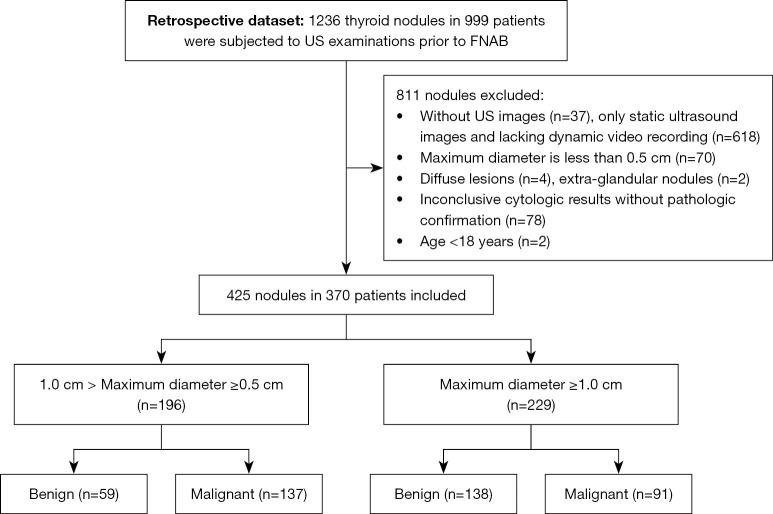
This retrospective investigation enrolled 999 consecutive patients with 1,236 thyroid nodules who underwent ultrasound screening. Fine-needle aspiration and/or surgery was performed, and pathology results were obtained at the Seventh Affiliated Hospital of Sun Yat-sen University in Shenzhen, China, which is a tertiary referral center, from May 2018 to February 2022. Each thyroid nodule's score was calculated based on five ultrasound features: composition, echogenicity, shape, margin, and echogenic foci. Additionally, each nodule's malignancy rate was calculated. The chi-square test was used to test whether the malignancy rate was different among the three subcategories (scores of 4-6, 7-8, and 9 or more) of thyroid nodules. We proposed the revised Thyroid Imaging Reporting and Data System (R-TIRADS), and its sensitivity and specificity were compared to the two existing systems [the American College of Radiology TIRADS (ACR TIRADS) and the Korean Society of Thyroid Radiology TIRADS (K-TIRADS)].
The final dataset consisted of 425 nodules from 370 patients. The malignancy rates of three subcategories [malignancy rate: 28.8% (scores from 4-6), 64.7% (scores from 7-8), and 84.2% (scores of 9 or more)] were significantly different (P<0.01). The unnecessary biopsy rates of the three systems (ACR TIRADS, R-TIRADS, and K-TIRADS) were 28.7%, 25.2%, and 14.8%, respectively. The R-TIRADS presented better diagnostic performance than the ACR TIRADS or K-TIRADS [area under the curve: 0.79 (95% CI: 0.74-0.83) 0.69 (95% CI: 0.64-0.75), P=0.046; 0.79 (95% CI: 0.74-0.83) . 0.66 (95% CI: 0.60-0.71), P=0.041, respectively]. The R-TIRADS had the highest sensitivity [0.746 (95% CI: 0.689-0.803)], followed by the K-TIRADS [0.399 (95% CI: 0.335-0.463), P=0.000] and ACR TIRADS [0.377 (95% CI: 0.314-0.441), P=0.000].
The R-TIRADS enables radiologists to diagnose thyroid nodules efficiently, and the number of unnecessary fine-needle aspirations can be considerably reduced.
甲状腺结节在人群中的发病率越来越高,大多数甲状腺结节活检为良性。基于五项超声特征建立一个实用的风险分层系统,以对甲状腺肿瘤的恶性风险进行分层。
这项回顾性研究纳入了999例连续接受超声筛查的患者,共1236个甲状腺结节。在中国深圳的中山大学附属第七医院(这是一家三级转诊中心),于2018年5月至2022年2月对这些患者进行了细针穿刺和/或手术,并获得了病理结果。根据五项超声特征(成分、回声、形状、边界和钙化灶)计算每个甲状腺结节的评分。此外,计算每个结节的恶性率。采用卡方检验来检验甲状腺结节的三个亚类(评分4 - 6分、7 - 8分和9分及以上)之间的恶性率是否存在差异。我们提出了修订后的甲状腺影像报告和数据系统(R - TIRADS),并将其敏感性和特异性与两个现有系统[美国放射学会TIRADS(ACR TIRADS)和韩国甲状腺放射学会TIRADS(K - TIRADS)]进行比较。
最终数据集包括来自370例患者的425个结节。三个亚类的恶性率[恶性率:28.8%(评分4 - 6分)、64.7%(评分7 - 8分)和84.2%(评分9分及以上)]差异有统计学意义(P<0.01)。三个系统(ACR TIRADS、R - TIRADS和K - TIRADS)的不必要活检率分别为28.7%、25.2%和14.8%。R - TIRADS的诊断性能优于ACR TIRADS或K - TIRADS[曲线下面积:0.79(95%CI:0.74 - 0.83)对0.69(95%CI:0.64 - 0.75),P = 0.046;0.79(95%CI:0.74 - 0.83)对0.66(95%CI:0.60 - 0.71),P = 0.041]。R - TIRADS的敏感性最高[0.746(9th5%CI:0.689 - 0.803)],其次是K - TIRADS[0.399(95%CI:0.335 - 0.463),P = 0.000]和ACR TIRADS[0.377(95%CI:0.314 - 0.441),P = 0.000]。
R - TIRADS使放射科医生能够高效诊断甲状腺结节,并可大幅减少不必要的细针穿刺次数。