College of Pharmacy, Rady Faculty of Health Sciences, University of Manitoba, 750 McDermot Ave, Winnipeg, MB, R3E 0T5, Canada.
Department of Physical Therapy, Faculty of Medicine, University of British Columbia, Vancouver, BC, Canada.
Hum Resour Health. 2021 Jan 20;19(1):12. doi: 10.1186/s12960-020-00551-2.
Academic institutions worldwide are embedding interprofessional education (IPE) into their health/social services education programs in response to global evidence that this leads to interprofessional collaborative practice (IPC). The World Health Organization (WHO) is holding its 193 member countries accountable for Indicator 3-06 ('IPE Accreditation') through its National Health Workforce Accounts. Despite the major influence of accreditation on the quality of health and social services education programs, little has been written about accreditation of IPE.
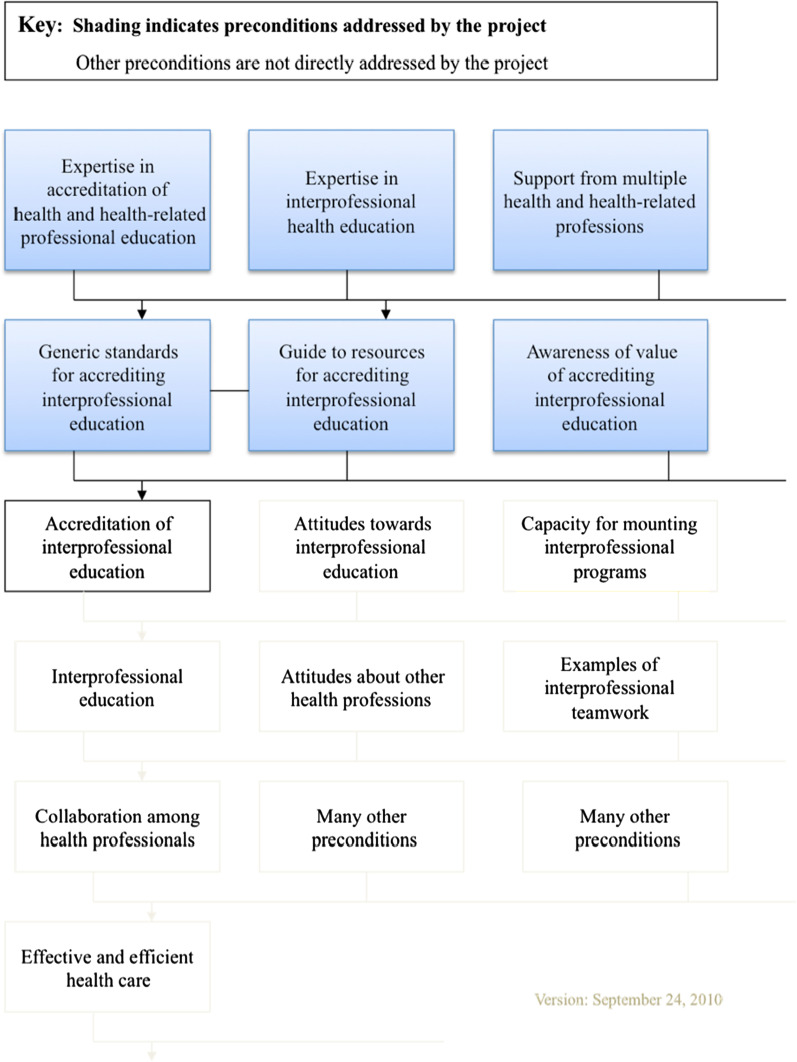
Canada has been a global leader in IPE Accreditation. The Accreditation of Interprofessional Health Education (AIPHE) projects (2007-2011) involved a collaborative of eight Canadian organizations that accredit pre-licensure education for six health/social services professions. The AIPHE vision was for learners to develop the necessary knowledge, skills and attitudes to provide IPC through IPE. The aim of this paper is to share the Canadian Case Study including policy context, supporting theories, preconditions, logic model and evaluation findings to achieve the primary project deliverable, increased awareness of the need to embed IPE language into the accreditation standards for health and social services academic programs. Future research implications are also discussed.
As a result of AIPHE, Canada is the only country in the world in which, for over a decade, a collective of participating health/social services accrediting organizations have been looking for evidence of IPE in the programs they accredit. This puts Canada in the unique position to now examine the downstream impacts of IPE accreditation.
为响应全球证据表明这将导致专业间协作实践(IPC)的证据,世界范围内的学术机构正在将跨专业教育(IPE)嵌入其健康/社会服务教育计划中。世界卫生组织(WHO)通过其国家卫生人力账户,要求其 193 个成员国对指标 3-06(“IPE 认证”)负责。尽管认证对卫生和社会服务教育计划的质量有重大影响,但关于 IPE 认证的研究却很少。
加拿大一直是 IPE 认证的全球领导者。认证的跨专业卫生教育(AIPHE)项目(2007-2011 年)涉及 8 个加拿大组织的合作,为六个健康/社会服务专业的预许可教育提供认证。AIPHE 的愿景是让学习者发展提供 IPC 通过 IPE 的必要知识、技能和态度。本文旨在分享加拿大案例研究,包括政策背景、支持理论、前提条件、逻辑模型和评估结果,以实现主要项目交付成果,提高对将 IPE 语言嵌入健康和社会服务学术课程认证标准的必要性的认识。还讨论了未来的研究影响。
由于 AIPHE,加拿大是世界上唯一一个在过去十年中,参与的健康/社会服务认证组织集体一直在他们认可的项目中寻找 IPE 证据的国家。这使加拿大处于独特的地位,可以现在检查 IPE 认证的下游影响。