Guangdong Provincial Key Laboratory of Proteomics, School of Basic Medical Sciences, Southern Medical University, Guangzhou, 510515, China.
Health Management Center, Affiliated Hospital of Guangdong Medical University, Zhanjiang, 524000, Guangdong, China.
Inflamm Res. 2021 Feb;70(2):193-203. doi: 10.1007/s00011-021-01437-2. Epub 2021 Jan 21.
Intracellular adhesion molecule-1 (ICAM-1), a transmembrane glycoprotein belonging to the immunoglobulin superfamily, plays a critical role in mediating cell-cell interaction and outside-in cell signaling during the immune response. ICAM-1 is expressed on the cell surface of several cell types including endothelial cells, epithelial cells, leucocytes, fibroblasts, and neutrophils. Despite ICAM-1 has been detected on macrophage, little is known about the function and mechanism of macrophage ICAM-1.
To investigate the role of lipopolysaccharide (LPS) in ICAM-1 regulation, both the protein and cell surface expression of ICAM-1 were measured. The phagocytosis of macrophage was evaluated by flow cytometry and Confocal microscopy. Small interfering RNA and neutralizing antibody of ICAM-1 were used to assess the effect of ICAM-1 on macrophage phagocytosis. TLR4 gene knockout mouse and cytoplasmic and mitochondrial ROS scavenger were used for the regulation of ICAM-1 expression. ROS was determined using flow cytometry.
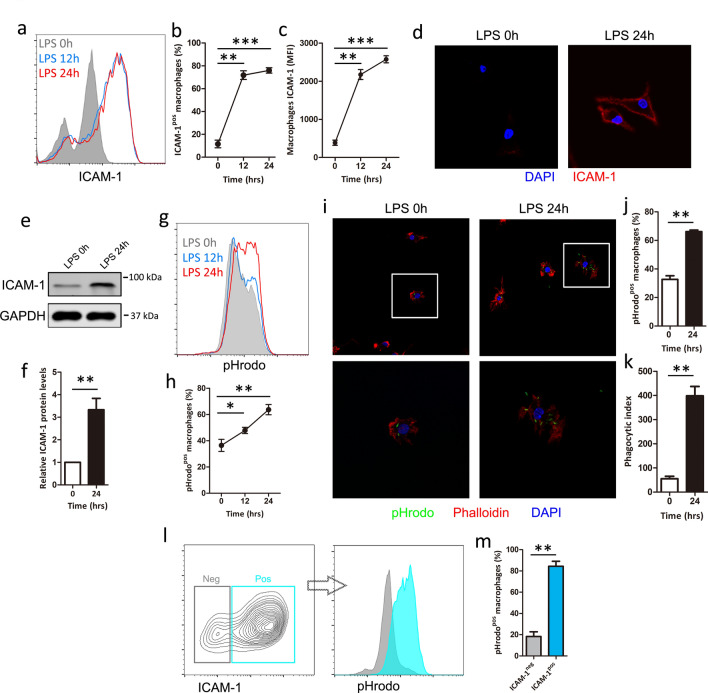
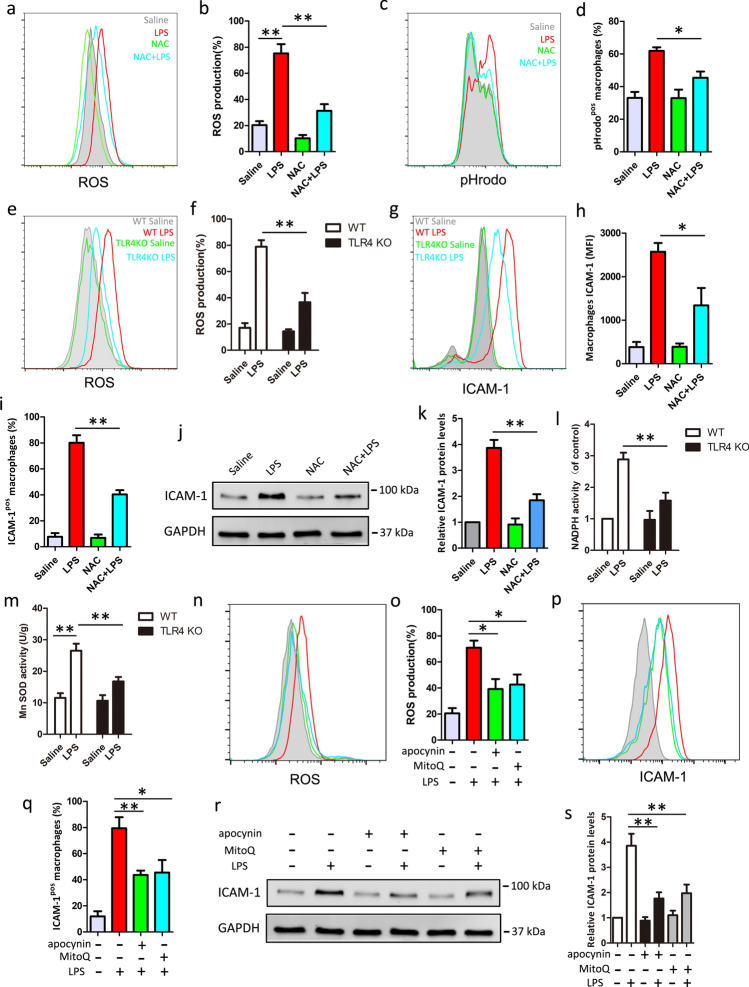
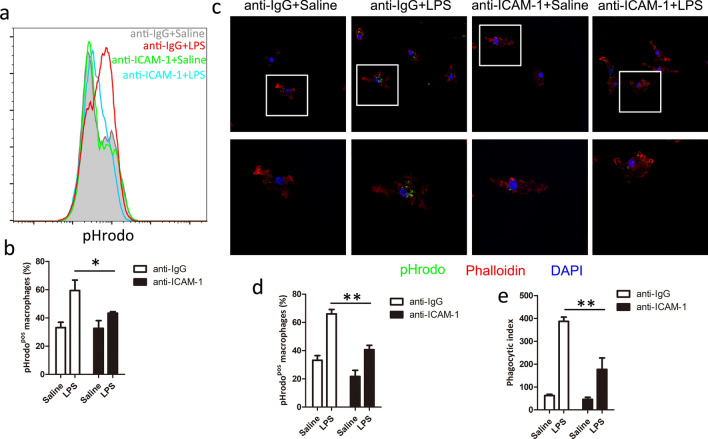
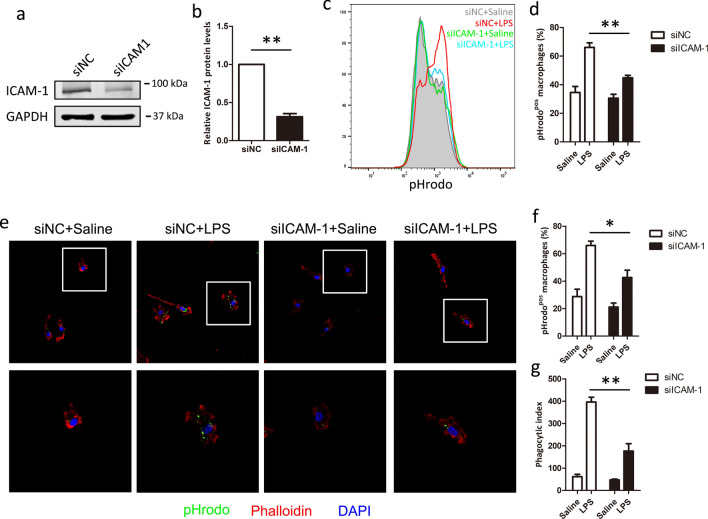
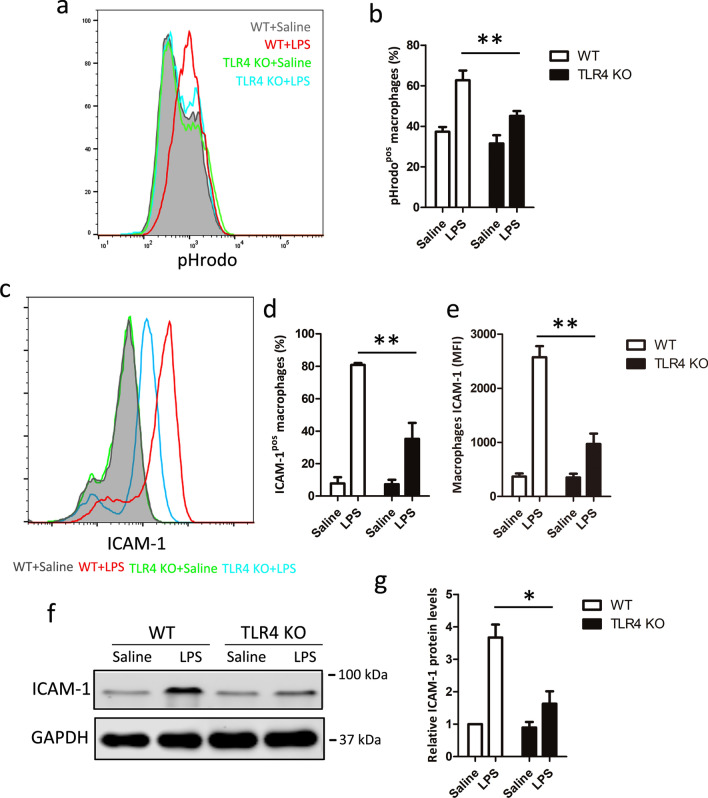
In this study, we reported that macrophage can be stimulated to increase both the protein and cell surface expression of ICAM-1 by LPS. Macrophage ICAM-1 expression was correlated with enhanced macrophage phagocytosis. We found that using ICAM-1 neutralizing antibody or ICAM-1 silencing to attenuate the function or expression of ICAM-1 could decrease LPS-induced macrophage phagocytosis. Furthermore, we found that knocking out of TLR4 led to inhibited cytoplasmic and mitochondrial ROS production, which in turn, attenuated ICAM-1 expression at both the protein and cell surface levels.
This study demonstrates that the mechanism of ICAM-1-mediated macrophage phagocytosis is depending on TLR4-mediated ROS production and provides significant light on macrophage ICAM-1 in endotoxemia.
细胞间黏附分子-1(ICAM-1)是一种免疫球蛋白超家族的跨膜糖蛋白,在免疫反应中,它在介导细胞-细胞相互作用和细胞外信号转导方面起着关键作用。ICAM-1 表达于几种细胞类型的细胞表面,包括内皮细胞、上皮细胞、白细胞、成纤维细胞和中性粒细胞。尽管已经在巨噬细胞上检测到 ICAM-1,但对于巨噬细胞 ICAM-1 的功能和机制知之甚少。
为了研究脂多糖(LPS)在 ICAM-1 调节中的作用,测量了 ICAM-1 的蛋白和细胞表面表达。通过流式细胞术和共聚焦显微镜评估巨噬细胞的吞噬作用。使用 ICAM-1 的小干扰 RNA 和中和抗体来评估 ICAM-1 对巨噬细胞吞噬作用的影响。使用 TLR4 基因敲除小鼠和细胞质和线粒体 ROS 清除剂来调节 ICAM-1 的表达。使用流式细胞术测定 ROS。
在这项研究中,我们报道 LPS 可以刺激巨噬细胞增加 ICAM-1 的蛋白和细胞表面表达。巨噬细胞 ICAM-1 的表达与增强的巨噬细胞吞噬作用相关。我们发现,使用 ICAM-1 中和抗体或 ICAM-1 沉默来削弱 ICAM-1 的功能或表达,可以降低 LPS 诱导的巨噬细胞吞噬作用。此外,我们发现敲除 TLR4 导致细胞质和线粒体 ROS 产生减少,进而减弱 ICAM-1 在蛋白和细胞表面水平的表达。
这项研究表明,ICAM-1 介导的巨噬细胞吞噬作用的机制依赖于 TLR4 介导的 ROS 产生,并为内毒素血症中的巨噬细胞 ICAM-1 提供了重要的启示。