University Department of Radiology, Royal Berkshire NHS Foundation Trust, Reading, UK.
University of Reading, Reading, UK.
Cardiovasc Intervent Radiol. 2021 Jun;44(6):931-940. doi: 10.1007/s00270-020-02764-3. Epub 2021 Jan 20.
Planned interim analysis of GENESIS; a prospective pilot study investigating the role of genicular artery embolization (GAE) in patients with mild to moderate osteoarthritis of the knee using permanent microspheres.
Thirty-eight patients, median age = 60 (45-83), attended for GAE using 100-300 μm permanent microspheres. All patients had mild to moderate knee OA, resistant to conservative treatments over 6 months. Knee MRI was performed at baseline, and 12 months, enabling semi-quantitative analysis using Whole-Organ Magnetic Resonance Imaging Score (WORMS). Knee Injury and Osteoarthritis Outcome Score (KOOS) and visual analogue scale (VAS) (0-100 mm) were completed at baseline, 6 weeks, 3 months (n = 32), and 1-year (n = 16). Adverse events were recorded prospectively.
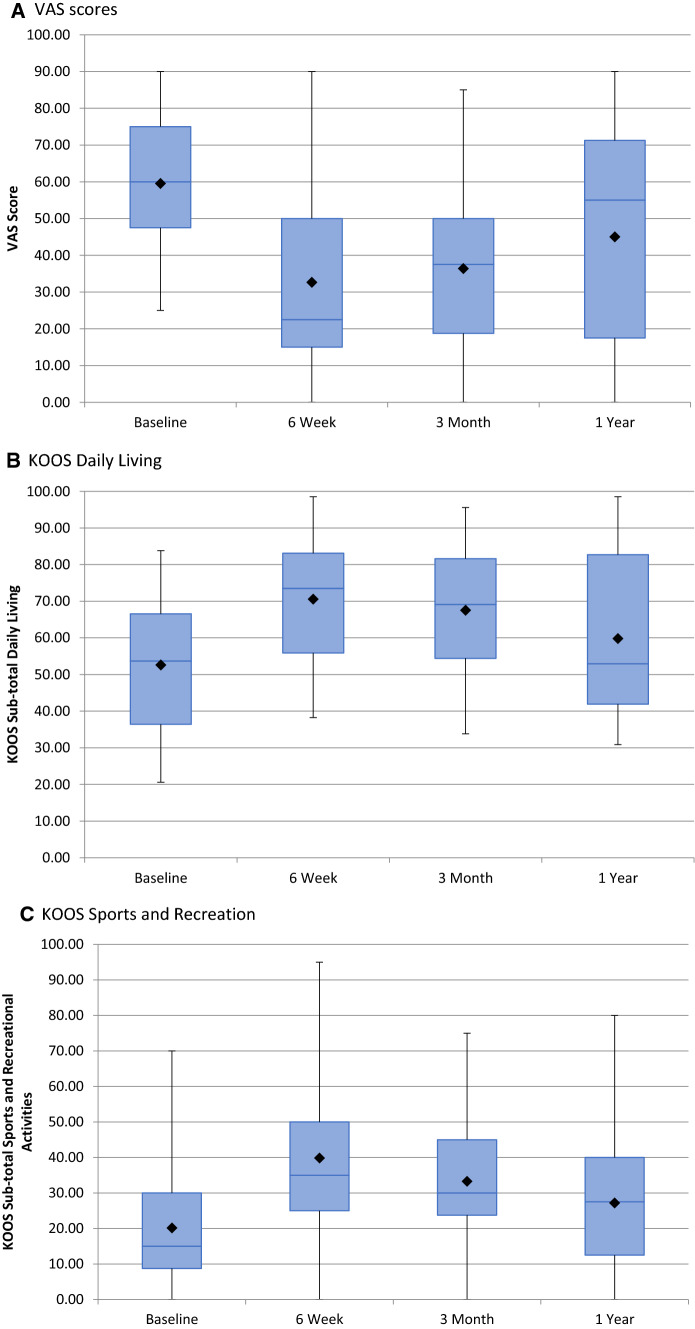
Technical success of accessing and embolizing the target genicular arteries was 84%. Six patients were not embolized: four due to a presumed risk of non-target embolization, and two due to a lack of hyperaemic target. Mean VAS improved from 60 (SD = 20, 95% CI 53-66) at baseline to 36 (SD = 24, 95% CI 28-44) at 3 months (p < 0.001) and 45 (SD = 30, 95% CI 30-60) at 1-year (p < 0.05). All KOOS subscales showed a significant improvement at 6-weeks, 3-months, and 1-year follow-up, except function in daily living, which reached borderline significance (p = 0.06) at 1-year. Four patients experienced mild self-limiting skin discoloration over the embolized territory. One patient experienced a small self-limiting groin haematoma. WORMS scores at 1-year follow-up showed significant improvement in synovitis (p < 0.05). There were no cases of osteonecrosis.
GAE using permanent microspheres in patients with mild to moderate knee OA is safe, with potential efficacy at early follow-up.
对 GENESIS 进行计划中的中期分析;这是一项前瞻性试点研究,旨在使用永久性微球调查膝部轻度至中度骨关节炎患者的膝内侧动脉栓塞 (GAE) 的作用。
38 名患者,平均年龄 60 岁(45-83 岁),接受了使用 100-300μm 永久性微球的 GAE。所有患者均患有轻度至中度膝骨关节炎,经过 6 个月的保守治疗仍未缓解。所有患者均在基线和 12 个月时进行膝关节 MRI 检查,使用全器官磁共振成像评分(WORMS)进行半定量分析。在基线、6 周、3 个月(n=32)和 1 年(n=16)时完成膝关节损伤和骨关节炎结果评分(KOOS)和视觉模拟量表(VAS)(0-100mm)。前瞻性记录不良事件。
成功进入并栓塞目标膝内侧动脉的技术成功率为 84%。有 6 名患者未进行栓塞:4 名患者由于存在非目标栓塞的风险,2 名患者由于缺乏充血性目标。VAS 从基线时的 60(SD=20,95%CI 53-66)降至 3 个月时的 36(SD=24,95%CI 28-44)(p<0.001),1 年时为 45(SD=30,95%CI 30-60)(p<0.05)。所有 KOOS 亚量表在 6 周、3 个月和 1 年随访时均显示出显著改善,除日常生活活动功能外,在 1 年时达到边缘显著(p=0.06)。4 名患者出现轻微的自限性皮肤变色,位于栓塞区域。1 名患者出现小的自限性腹股沟血肿。1 年随访时 WORMS 评分显示滑膜炎有显著改善(p<0.05)。无骨坏死病例。
在轻度至中度膝骨关节炎患者中使用永久性微球进行 GAE 是安全的,在早期随访中具有潜在疗效。