Agarwal Ashok, Leisegang Kristian, Majzoub Ahmad, Henkel Ralf, Finelli Renata, Panner Selvam Manesh Kumar, Tadros Nicholas, Parekh Neel, Ko Edmund Y, Cho Chak Lam, Arafa Mohamed, Alves Marco G, Oliveira Pedro Fontes, Alvarez Juan G, Shah Rupin
American Center for Reproductive Medicine, Cleveland Clinic, Cleveland, OH, USA.
School of Natural Medicine, Faculty of Community and Health Sciences, University of the Western Cape, Bellville, South Africa.
World J Mens Health. 2021 Apr;39(2):233-290. doi: 10.5534/wjmh.200196. Epub 2021 Jan 15.
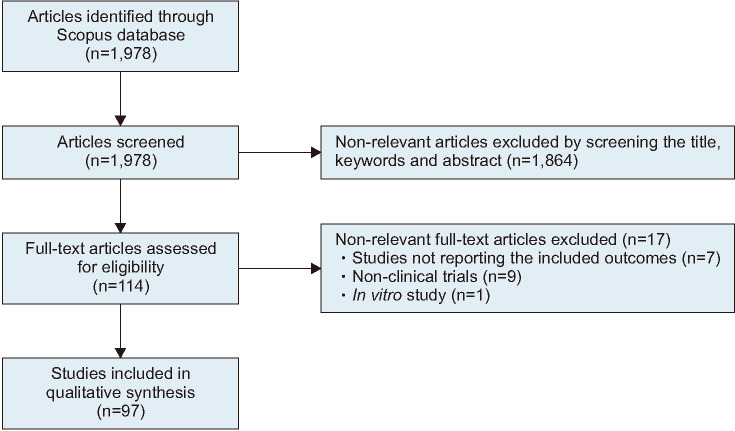
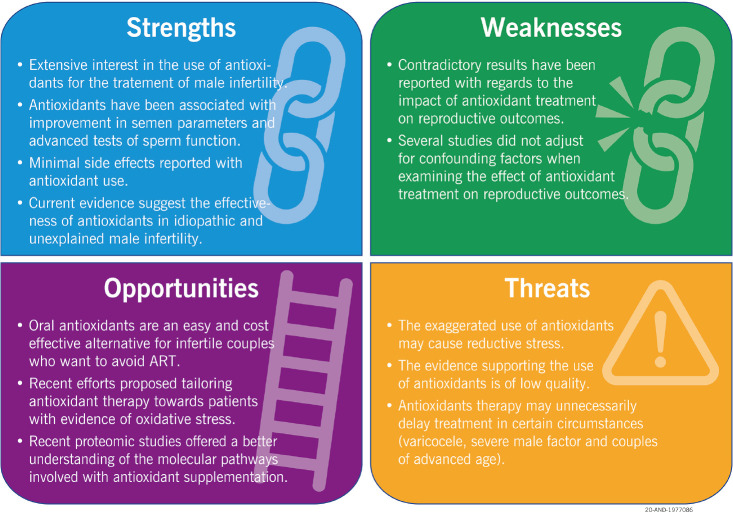
It is widely accepted that oxidative stress plays an important role in the pathophysiology of male infertility and that antioxidants could have a significant role in the treatment of male infertility. The main objectives of this study are: 1) to systematically review the current evidence for the utility of antioxidants in the treatment of male infertility; and 2) propose evidence-based clinical guidelines for the use of antioxidants in the treatment of male infertility. A systematic review of the available clinical evidence was performed, with articles published on Scopus being manually screened. Data extracted included the type of antioxidant used, the clinical conditions under investigation, the evaluation of semen parameters and reproductive outcomes. The adherence to the Cambridge Quality Checklist, Cochrane Risk of Bias for randomized controlled trials (RCTs), CONSORT guidelines and JADAD score were analyzed for each included study. Further, we provided a Strength Weakness Opportunity Threat (SWOT) analysis to analyze the current and future value of antioxidants in male infertility. Of the 1,978 articles identified, 97 articles were included in the study. Of these, 52 (53.6%) were uncontrolled (open label), 12 (12.4%) unblinded RCTs, and 33 (34.0%) blinded RCTs, whereas 44 (45.4%) articles tested individual antioxidants, 31 (32.0%) a combination of several products in variable dosages, and 22 (22.6%) registered antioxidant products. Based on the published evidence, we 1) critically examined the necessity of additional double-blind, randomized, placebo-controlled trials, and 2) proposed updated evidence-based clinical guidelines for antioxidant therapy in male infertility. The current systematic review on antioxidants and male infertility clearly shows that antioxidant supplementation improves semen parameters. In addition, it provides the indications for antioxidant treatment in specific clinical conditions, including varicocele, unexplained and idiopathic male infertility, as well as in cases of altered semen quality.
氧化应激在男性不育的病理生理学中起重要作用,抗氧化剂在男性不育治疗中可能发挥重要作用,这一观点已被广泛接受。本研究的主要目的是:1)系统回顾抗氧化剂在治疗男性不育方面的现有证据;2)提出基于证据的抗氧化剂治疗男性不育的临床指南。我们对现有临床证据进行了系统回顾,手动筛选了在Scopus上发表的文章。提取的数据包括所用抗氧化剂的类型、所研究的临床情况、精液参数评估和生殖结局。对每项纳入研究分析其对剑桥质量清单、随机对照试验(RCT)的Cochrane偏倚风险、CONSORT指南和JADAD评分的遵循情况。此外,我们进行了优势、劣势、机会、威胁(SWOT)分析,以分析抗氧化剂在男性不育方面的当前和未来价值。在识别出的1978篇文章中,97篇被纳入本研究。其中,52篇(53.6%)为非对照(开放标签)研究,12篇(12.4%)为非盲法RCT,33篇(34.0%)为盲法RCT,而44篇(45.4%)文章测试了单一抗氧化剂,31篇(32.0%)测试了几种不同剂量产品的组合,22篇(22.6%)测试了注册的抗氧化剂产品。基于已发表的证据,我们1)严格审查了额外进行双盲、随机、安慰剂对照试验的必要性,2)提出了男性不育抗氧化剂治疗的更新的基于证据的临床指南。目前关于抗氧化剂与男性不育的系统回顾清楚地表明,补充抗氧化剂可改善精液参数。此外,它还提供了在特定临床情况下抗氧化剂治疗的指征,包括精索静脉曲张、不明原因和特发性男性不育以及精液质量改变的情况。