Department of Ophthalmology, Eye and ENT Hospital Affiliated to Fudan University, Shanghai, China.
NHC Key Laboratory of Myopia (Fudan University); Key Laboratory of Myopia, Chinese Academy of Medical Sciences (Fudan University), Shanghai, China.
Invest Ophthalmol Vis Sci. 2021 Jan 4;62(1):21. doi: 10.1167/iovs.62.1.21.
To investigate the effect of short-wavelength light (SL) on guinea pigs with lens-induced myopia (LIM) and the possible retinoic acid (RA)-related mechanisms.
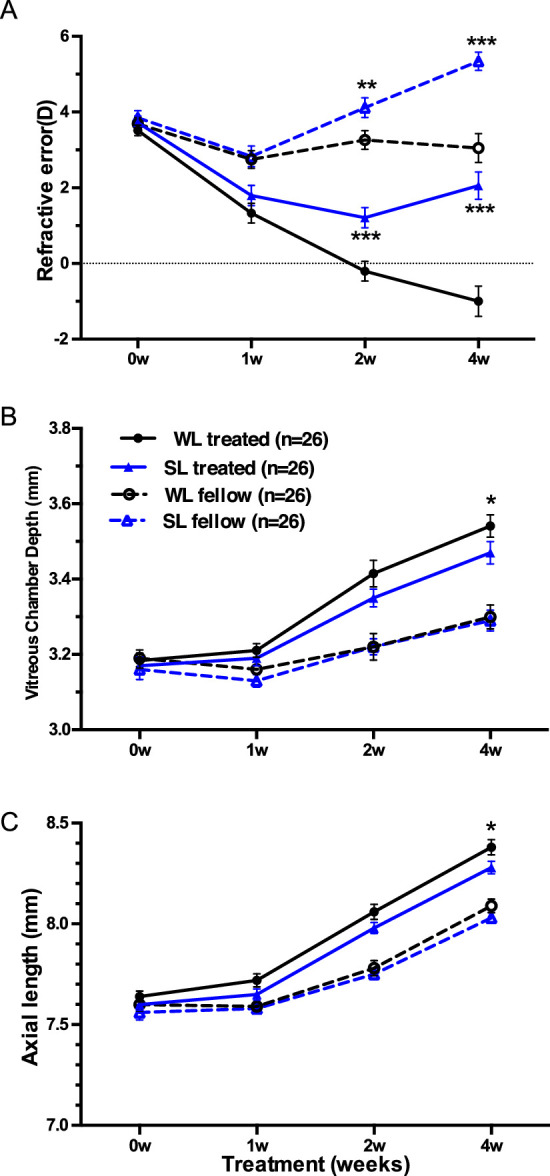
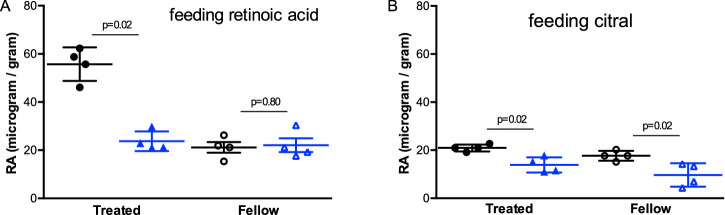
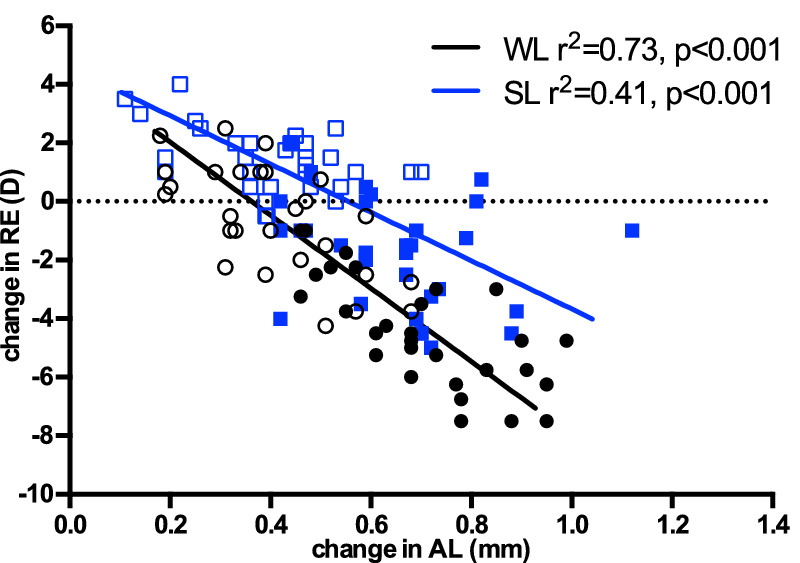
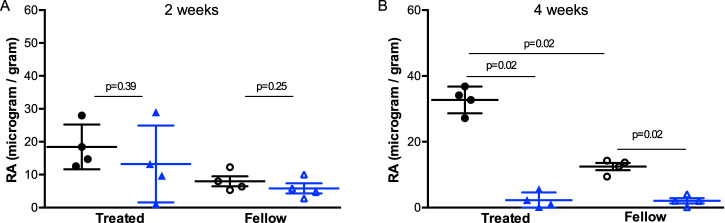
Two-week-old guinea pigs (n = 60) with monocular -5D lenses were reared under white light (WL, 580 lux) or SL (440 nm, 500 lux). The left eyes were uncovered as control. Refractive error (RE) and axial length (AL) were measured at baseline, one week, two weeks, and four weeks after intervention. Retinal RA was measured from four guinea pigs after two and four weeks of treatment with HPLC. Two-week-old guinea pigs (n = 52) with monocular -5D lens were fed with either RA or its synthesis inhibitor citral every third day in the morning, and half from each group were reared under WL or SL conditions. RE and AL were recorded at baseline and two and four weeks after intervention. Retinal RA was measured after four weeks of intervention.
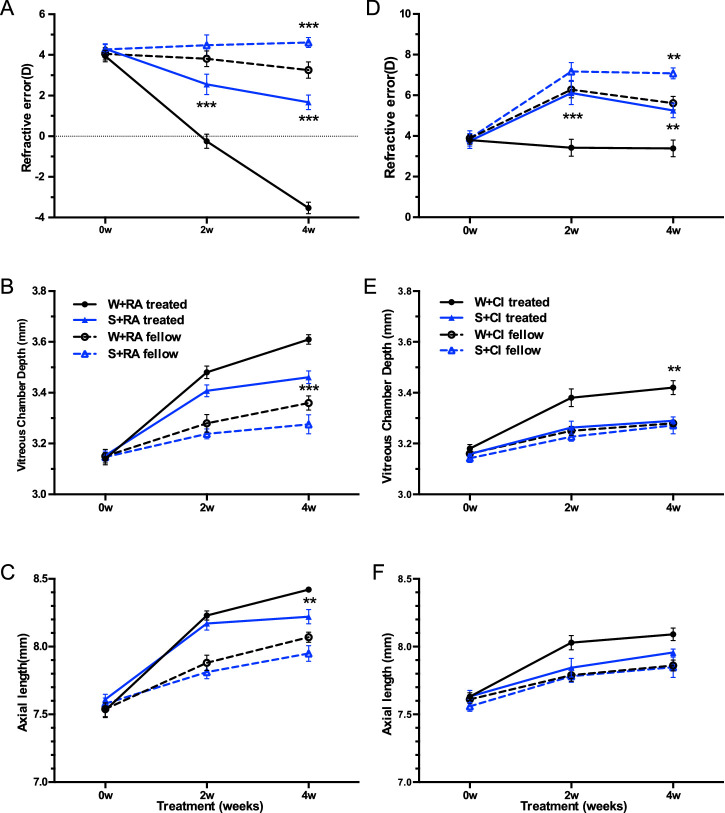
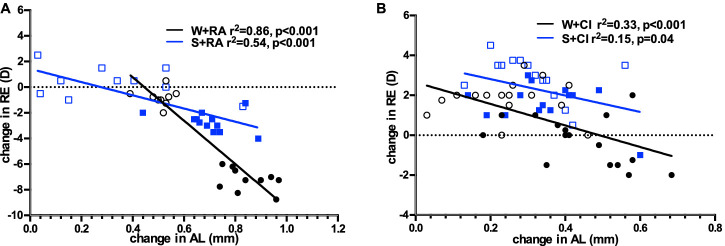
At the end of treatment, guinea pigs exposed to SL were less myopic than to WL (2.06 ± 1.69D vs. -1.00 ± 1.88D), accompanied with shorter AL (P = 0.01) and less retinal RA (P = 0.02). SL reduced retinal RA even after exogenous RA supplementation (P = 0.02) and decelerated LIM compared to WL (1.66 ± 1.03D vs. -3.53 ± 0.90D). Citral slowed ocular growth, leading to similar RE in W+CI and S+CI groups (3.39 ± 1.65D vs. 5.25 ± 0.80D).
Overall, SL reduced LIM in guinea pigs, even in those supplemented with oral RA, accompanied by reduced retinal RA levels. Oral RA accelerated eye elongation, but citral equally decelerated eye elongation under SL and WL with no significant retinal RA reduction.
研究短波长光(SL)对诱导性近视(LIM)的豚鼠的影响及其可能的视黄酸(RA)相关机制。
将 2 周龄的单眼 -5D 透镜豚鼠(n = 60)饲养在白光(WL,580 lux)或 SL(440nm,500 lux)下。左眼作为对照不遮盖。在干预后 1 周、2 周和 4 周测量屈光度(RE)和眼轴长度(AL)。用 HPLC 从 4 只接受 2 周和 4 周治疗的豚鼠中测量视网膜 RA。2 周龄的单眼 -5D 透镜豚鼠(n = 52)每隔一天早上喂食 RA 或其合成抑制剂柠檬醛,每组有一半饲养在 WL 或 SL 条件下。在干预前和干预后 2 周和 4 周记录 RE 和 AL。干预 4 周后测量视网膜 RA。
治疗结束时,暴露于 SL 的豚鼠比暴露于 WL 的豚鼠近视程度更低(2.06 ± 1.69D 比-1.00 ± 1.88D),眼轴长度更短(P = 0.01),视网膜 RA 更少(P = 0.02)。即使在外源性 RA 补充后,SL 仍能降低视网膜 RA(P = 0.02),并减缓 LIM 的进展,与 WL 相比(1.66 ± 1.03D 比-3.53 ± 0.90D)。柠檬醛减缓了眼球生长,导致 W+CI 和 S+CI 组的 RE 相似(3.39 ± 1.65D 比 5.25 ± 0.80D)。
总之,SL 减少了豚鼠的 LIM,即使在补充口服 RA 的情况下,同时降低了视网膜 RA 水平。口服 RA 加速了眼伸长,但柠檬醛在 SL 和 WL 下同样减缓了眼伸长,而视网膜 RA 没有明显减少。