Department of Ophthalmology, Eye and ENT Hospital of Fudan University, Shanghai, China.
NHC Key Laboratory of Myopia (Fudan University), Shanghai, China.
Invest Ophthalmol Vis Sci. 2021 Sep 2;62(12):20. doi: 10.1167/iovs.62.12.20.
Wavelength and temporal frequency have been found to influence refractive development. This study investigated whether retinal dopamine (DA) plays a role in these processes.
Guinea pigs were randomly divided into nine groups that received different lighting conditions for 4 weeks, as follows: white, green, or blue light at 0, 0.5, or 20.0 Hz. Refractions and axial lengths were measured using streak retinoscopy and A-scan ultrasound imaging. DA and its metabolites were measured by high-pressure liquid chromatography-electrochemical detection.
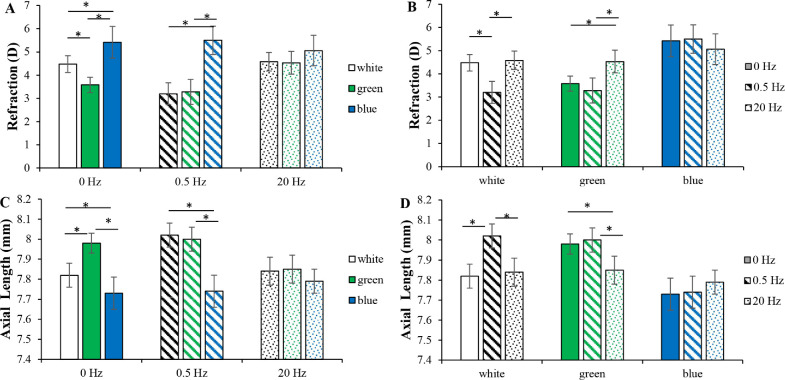
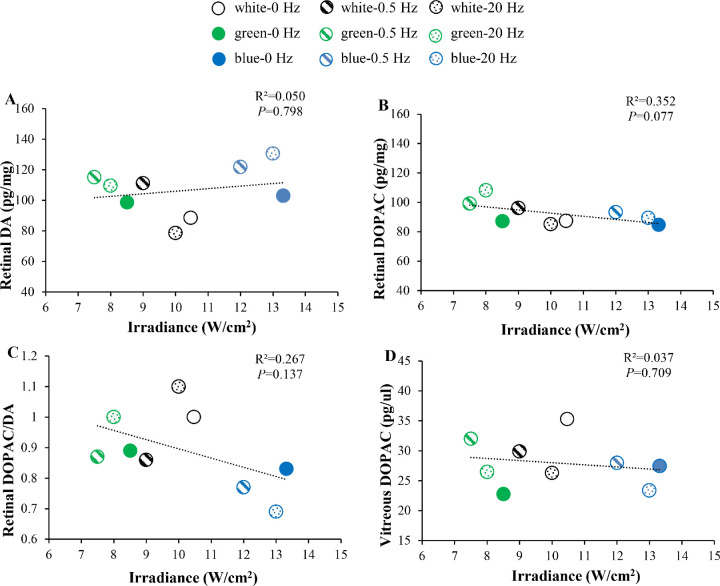
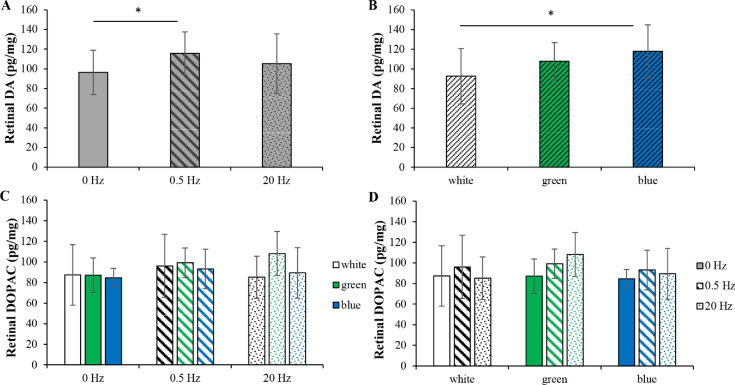
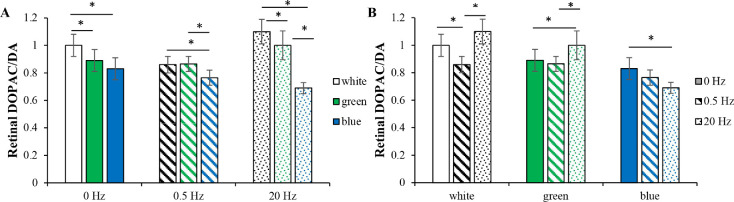
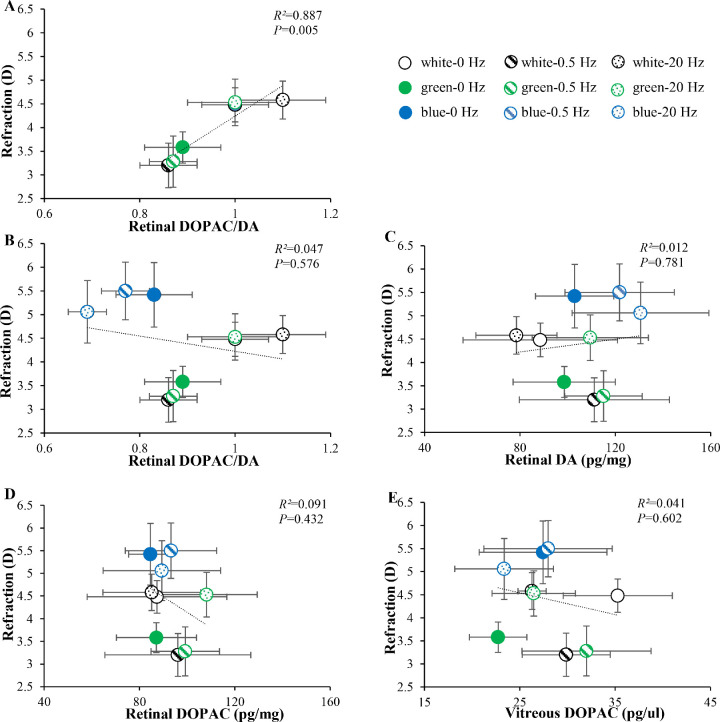
At 0 Hz, green and blue light produced myopic and hyperopic shifts compared with that of white light. At 0.5 Hz, no significant changes were observed compared with those of green or blue light at 0 Hz, whereas white light at 0.5 Hz induced a myopic shift compared with white light at 0 or 20 Hz. At 20 Hz, green and blue light acted like white light. Among all levels of DA and its metabolites, only vitreous 3, 4-dihydroxyphenylacetic acid (DOPAC) levels and retinal DOPAC/DA ratios were dependent on wavelength, frequency, and their interaction. Specifically, retinal DOPAC/DA ratios were positively correlated with refractions in white and green light conditions. However, blue light (0, 0.5, and 20.0 Hz) produced hyperopic shifts but decreased vitreous DOPAC levels and retinal DOPAC/DA ratios.
The retinal DOPAC/DA ratio, indicating the metabolic efficiency of DA, is correlated with ocular growth. It may underlie myopic shifts from light exposure with a long wavelength and low temporal frequency. However, different biochemical pathways may contribute to the hyperopic shifts from short wavelength light.
已发现波长和时间频率会影响屈光度发育。本研究旨在探讨视网膜多巴胺(DA)是否在这些过程中发挥作用。
豚鼠随机分为 9 组,接受以下 4 周不同的光照条件:白光、绿光或蓝光,频率分别为 0、0.5 或 20.0 Hz。采用条纹视网膜镜和 A 型超声扫描测量屈光度和眼轴长度。采用高效液相色谱电化学检测法测量 DA 及其代谢产物。
在 0 Hz 时,绿光和蓝光与白光相比产生近视性和远视性偏移。在 0.5 Hz 时,与 0 Hz 时的绿光或蓝光相比,没有观察到明显的变化,而 0.5 Hz 时的白光与 0 Hz 或 20 Hz 时的白光相比产生了近视性偏移。在 20 Hz 时,绿光和蓝光的作用类似于白光。在所有 DA 及其代谢产物水平中,只有玻璃体内 3,4-二羟基苯乙酸(DOPAC)水平和视网膜 DOPAC/DA 比值依赖于波长、频率及其相互作用。具体而言,视网膜 DOPAC/DA 比值与白光和绿光条件下的屈光度呈正相关。然而,蓝光(0、0.5 和 20.0 Hz)产生远视性偏移,但降低了玻璃体内 DOPAC 水平和视网膜 DOPAC/DA 比值。
视网膜 DOPAC/DA 比值,表明 DA 的代谢效率,与眼球生长有关。它可能是长波长、低时间频率光暴露导致近视性偏移的基础。然而,不同的生化途径可能导致短波长光引起的远视性偏移。