Department of Etiology and Epidemiology, Smorodintsev Research Institute of Influenza, 197376 Saint-Petersburg, Russia.
Children's City Hospital of St. Olga, 194017 Saint-Petersburg, Russia.
Viruses. 2021 Jan 17;13(1):119. doi: 10.3390/v13010119.
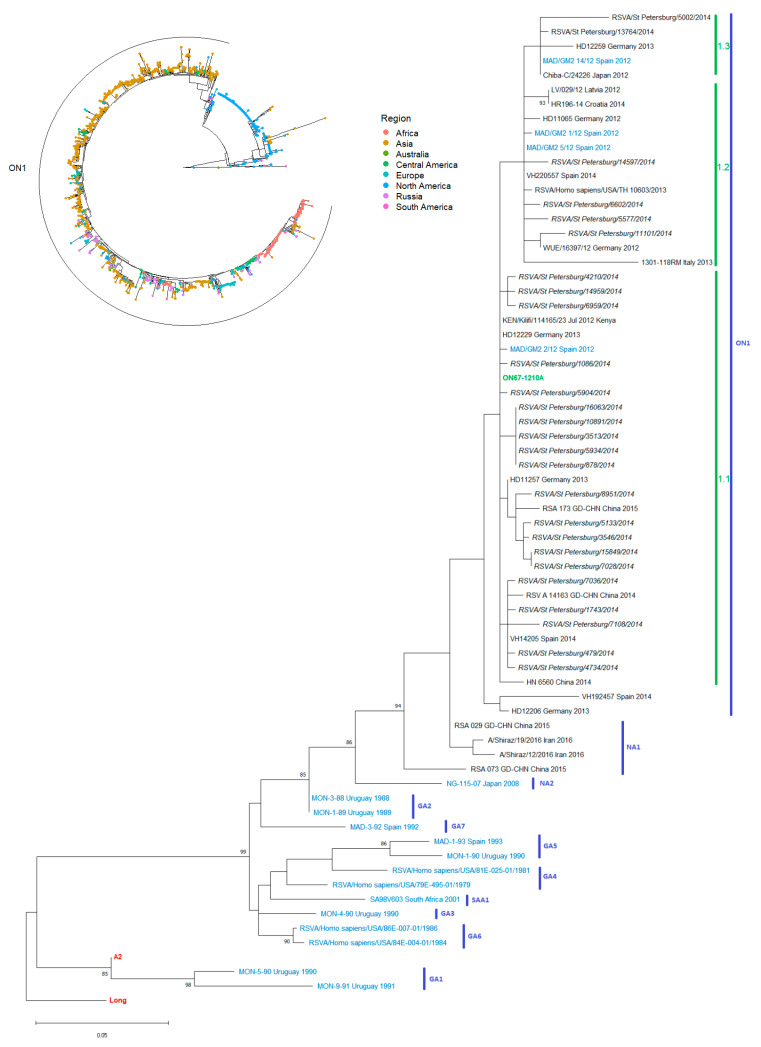
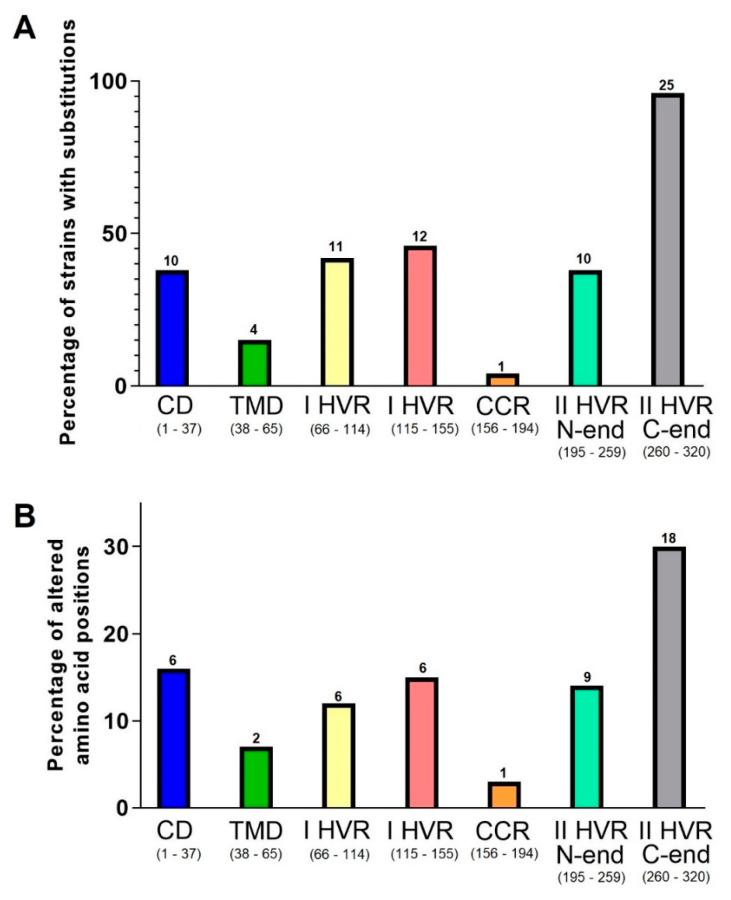
Human respiratory syncytial virus (RSV) is the most common cause of upper and lower respiratory tract infections in infants and young children. It is actively evolving under environmental and herd immunity influences. This work presents, for the first time, sequence variability analysis of RSV G gene and G protein using St. Petersburg (Russia) isolates. Viruses were isolated in a cell culture from the clinical samples of 61 children hospitalized (January-April 2014) with laboratory-confirmed RSV infection. Real-time RT-PCR data showed that 56 isolates (91.8%) belonged to RSV-A and 5 isolates (8.2%) belonged to RSV-B. The G genes were sequenced for 27 RSV-A isolates and all of them belonged to genotype ON1/GA2. Of these RSV-A, 77.8% belonged to the ON1(1.1) genetic sub-cluster, and 14.8% belonged to the ON1(1.2) sub-cluster. The ON1(1.3) sub-cluster constituted a minor group (3.7%). Many single-amino acid substitutions were identified in the G proteins of St. Petersburg isolates, compared with the Canadian ON1/GA2 reference virus (ON67-1210A). Most of the amino acid replacements were found in immunodominant B- and T-cell antigenic determinants of G protein. These may affect the antigenic characteristics of RSV and influence the host antiviral immune response to currently circulating viruses.
人呼吸道合胞病毒(RSV)是婴幼儿上呼吸道和下呼吸道感染的最常见原因。它在环境和群体免疫的影响下正在积极进化。本工作首次对圣彼得堡(俄罗斯)分离株的 RSV G 基因和 G 蛋白进行序列变异分析。从 61 例住院(2014 年 1 月至 4 月)实验室确诊 RSV 感染患儿的临床标本中通过细胞培养分离出病毒。实时 RT-PCR 数据显示,56 株(91.8%)属于 RSV-A,5 株(8.2%)属于 RSV-B。对 27 株 RSV-A 分离株进行了 G 基因测序,它们均属于 ON1/GA2 基因型。这些 RSV-A 中,77.8%属于 ON1(1.1)遗传亚群,14.8%属于 ON1(1.2)亚群。ON1(1.3)亚群构成了一个较小的群体(3.7%)。与加拿大 ON1/GA2 参考病毒(ON67-1210A)相比,圣彼得堡分离株的 G 蛋白中发现了许多单个氨基酸取代。大多数氨基酸取代发生在 G 蛋白的免疫显性 B 细胞和 T 细胞抗原决定簇中。这些可能会影响 RSV 的抗原特征,并影响宿主对当前流行病毒的抗病毒免疫反应。