Department of Biology and Ecology, Institute of Environmental Technologies, Faculty of Science, University of Ostrava, 710 00 Ostrava, Czech Republic.
Int J Mol Sci. 2021 Jan 18;22(2):922. doi: 10.3390/ijms22020922.
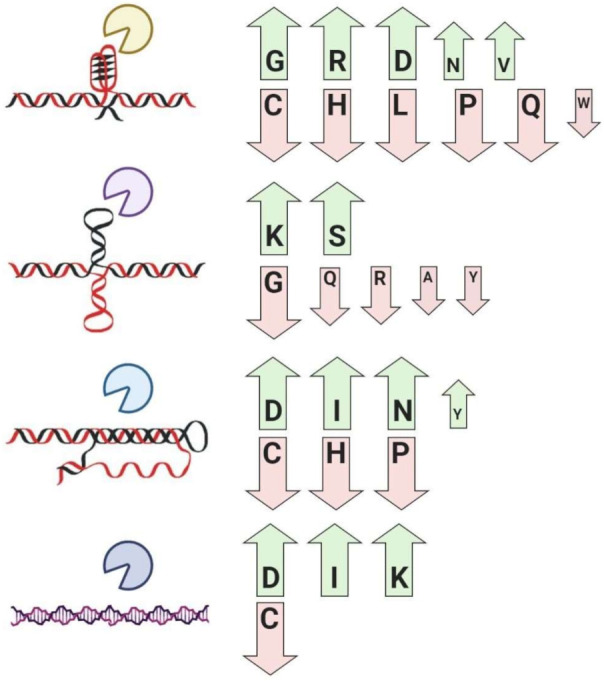
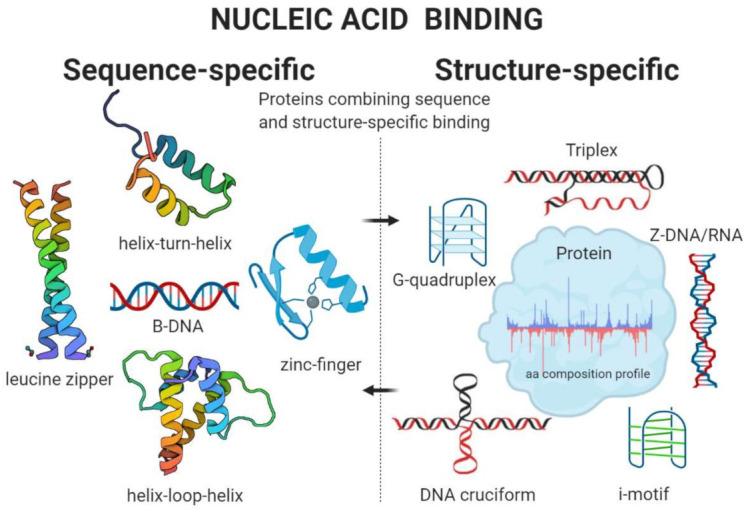
Nucleic acid-binding proteins are traditionally divided into two categories: With the ability to bind DNA or RNA. In the light of new knowledge, such categorizing should be overcome because a large proportion of proteins can bind both DNA and RNA. Another even more important features of nucleic acid-binding proteins are so-called sequence or structure specificities. Proteins able to bind nucleic acids in a sequence-specific manner usually contain one or more of the well-defined structural motifs (zinc-fingers, leucine zipper, helix-turn-helix, or helix-loop-helix). In contrast, many proteins do not recognize nucleic acid sequence but rather local DNA or RNA structures (G-quadruplexes, i-motifs, triplexes, cruciforms, left-handed DNA/RNA form, and others). Finally, there are also proteins recognizing both sequence and local structural properties of nucleic acids (e.g., famous tumor suppressor p53). In this mini-review, we aim to summarize current knowledge about the amino acid composition of various types of nucleic acid-binding proteins with a special focus on significant enrichment and/or depletion in each category.
具有结合 DNA 或 RNA 的能力。根据新知识,这种分类应该被克服,因为很大一部分蛋白质可以同时结合 DNA 和 RNA。核酸结合蛋白的另一个更重要的特征是所谓的序列或结构特异性。能够以序列特异性方式结合核酸的蛋白质通常含有一个或多个定义明确的结构基序(锌指、亮氨酸拉链、螺旋-转角-螺旋或螺旋-环-螺旋)。相比之下,许多蛋白质不识别核酸序列,而是识别局部 DNA 或 RNA 结构(G-四联体、i-模体、三链体、十字结构、左手 DNA/RNA 构象等)。最后,还有一些蛋白质同时识别核酸的序列和局部结构特性(例如,著名的肿瘤抑制因子 p53)。在这篇迷你综述中,我们旨在总结关于各种类型核酸结合蛋白的氨基酸组成的最新知识,特别关注每个类别中的显著富集和/或耗竭。