Laboratory of Translational Oncology, School of Medicine, University of Crete, Heraklion, Vassilika Vouton, 71110 Crete, Greece.
Department of Clinical Therapeutics, School of Medicine, National and Kapodistrian University of Athens, 11528 Athens, Greece.
Int J Mol Sci. 2021 Jan 18;22(2):925. doi: 10.3390/ijms22020925.
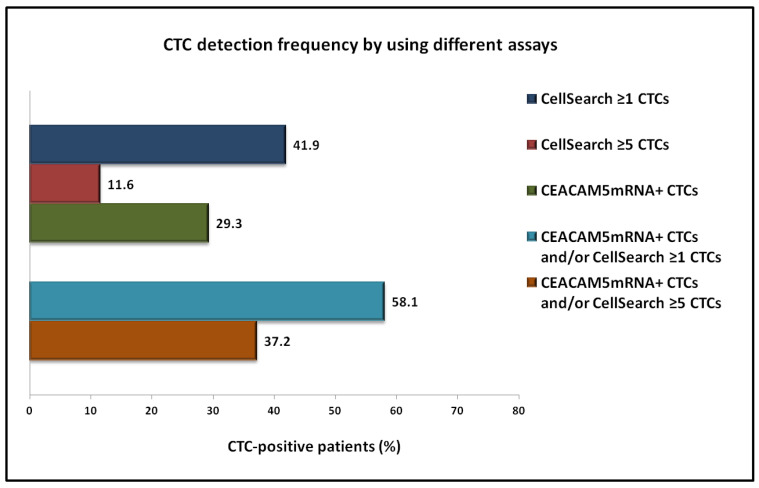
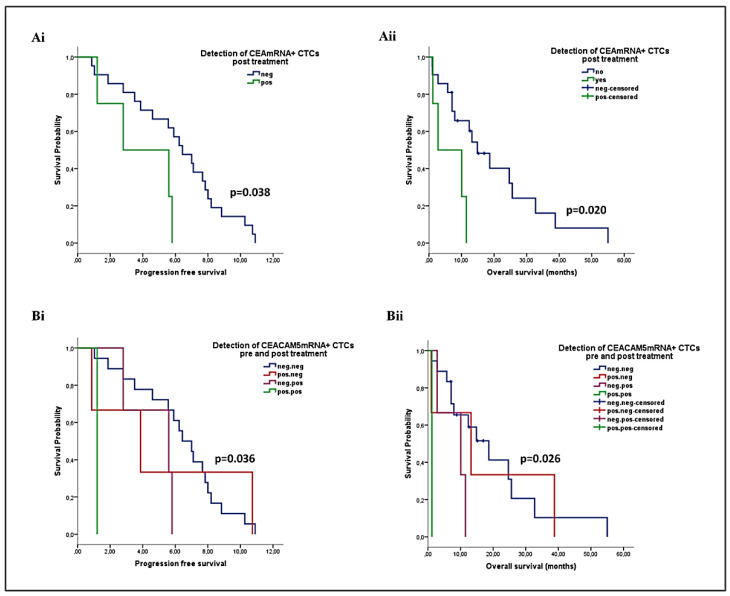
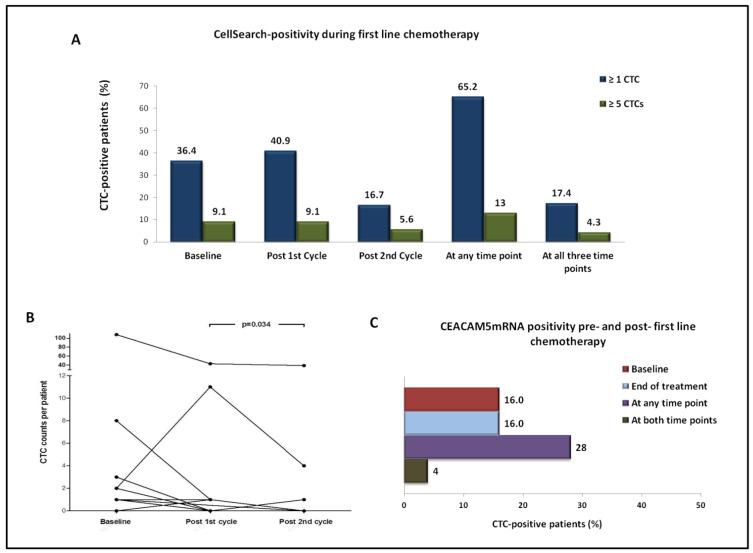
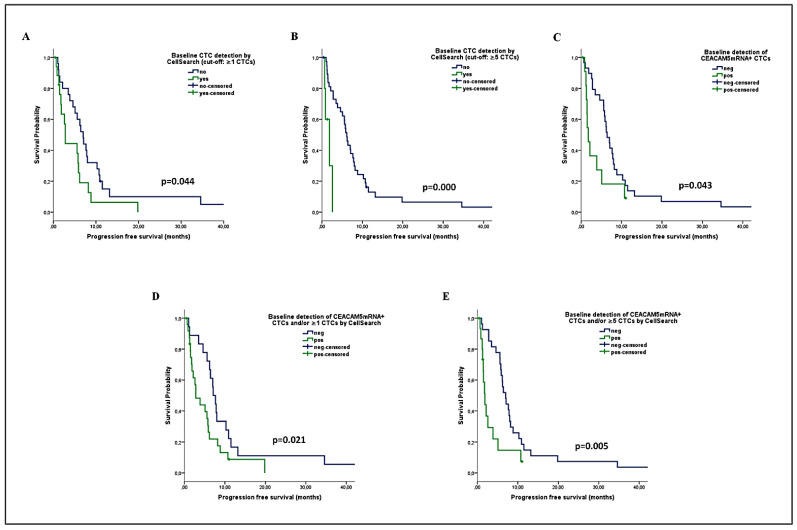
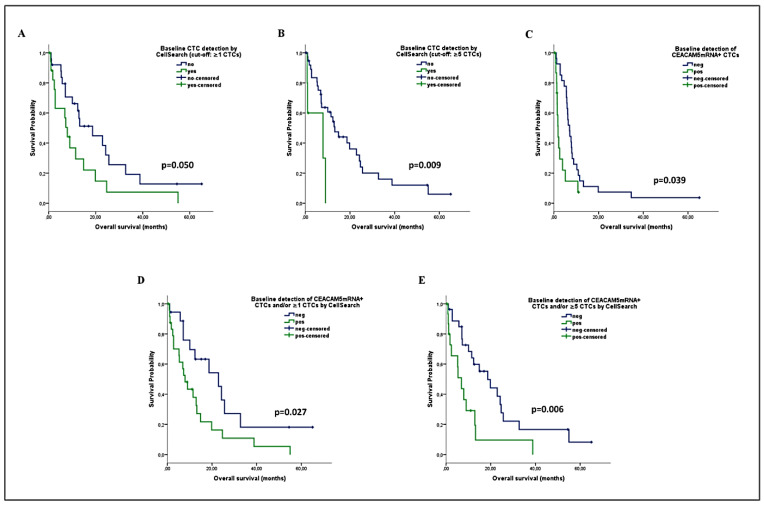
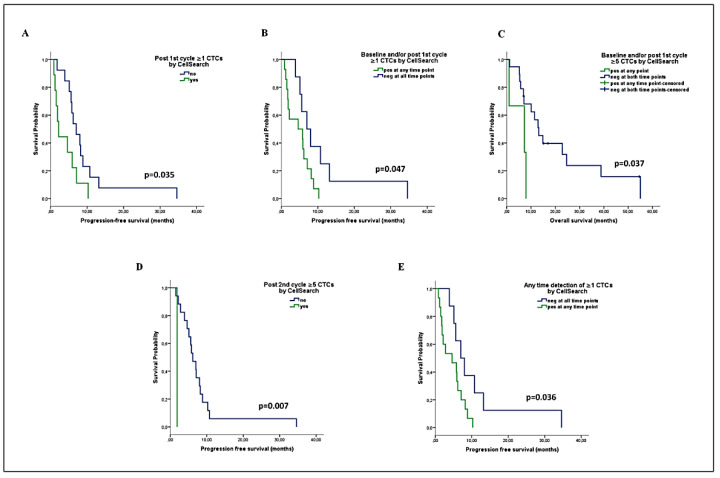
We herein investigated the detection frequency and clinical relevance of circulating tumor cells (CTCs) in chemotherapy-naïve stage IIIB/IV non-small cell lung cancer (NSCLC), by using the CellSearch and real-time CEACAM5mRNA assays. Blood samples from 43 patients were obtained at different time points during first-line chemotherapy. CellSearch revealed the detection of ≥1 CTCs in 41.9%, 40.9%, and 16.7% of patients at baseline, post-1st, and post-2nd treatment cycle, respectively, and of ≥5 CTCs in 11.6%, 9.1%, and 5.6%, respectively. CEACAM5mRNA+ CTCs were detected in 29.3% and 16% of patients pre- and post-treatment, respectively. The positivity concordance between the two assays was 2.2%. CTC-detection by CellSearch (≥5 CTCs: = 0.004), CEACAM5mRNA ( = 0.010), or by any assay ( = 0.000) was associated with disease progression. Reduced survival was demonstrated for patients harboring ≥5 CTCs (progression-free survival; PFS: = 0.000; overall survival; OS: = 0.009), CEACAM5mRNA+ CTCs (PFS: = 0.043; OS: = 0.039), and CTCs by any assay (PFS: = 0.005; OS: = 0.006, respectively). CTC-detection by any assay independently predicted for increased risk of relapse (hazard ratio; HR: 3.496; = 0.001) and death (HR: 2.866; = 0.008). CellSearch-positivity either pre-, post-1st, or post-2nd cycle, was predictive for shorter PFS ( = 0.036) compared to negativity in all time points. Persistent CEACAM5mRNA-positivity pre- and post-treatment was associated with reduced PFS ( = 0.036) and OS ( = 0.026). In conclusion, CTC detection and monitoring using the CellSearch and CEACAM5mRNA assays provides valuable and complementary clinical information for chemo-naïve advanced or metastatic NSCLC.
我们通过使用 CellSearch 和实时 CEACAM5mRNA 检测法,研究了化疗初治 IIIB/IV 期非小细胞肺癌(NSCLC)患者循环肿瘤细胞(CTC)的检测频率及其临床相关性。43 例患者在一线化疗的不同时间点采集血液样本。CellSearch 显示,基线、第 1 个治疗周期后和第 2 个治疗周期后分别有 41.9%、40.9%和 16.7%的患者检测到≥1 个 CTC,分别有 11.6%、9.1%和 5.6%的患者检测到≥5 个 CTC。治疗前后分别有 29.3%和 16%的患者检测到 CEACAM5mRNA+CTC。两种检测方法的阳性一致性为 2.2%。CellSearch(≥5 CTCs: = 0.004)、CEACAM5mRNA( = 0.010)或任何检测方法( = 0.000)检测到 CTC 与疾病进展相关。携带≥5 个 CTCs 的患者的生存率降低(无进展生存期;PFS: = 0.000;总生存期;OS: = 0.009),CEACAM5mRNA+CTC(PFS: = 0.043;OS: = 0.039),以及任何检测方法(PFS: = 0.005;OS: = 0.006)。任何检测方法检测到的 CTC 均可独立预测复发风险增加(危险比;HR:3.496; = 0.001)和死亡风险增加(HR:2.866; = 0.008)。CellSearch 检测阳性(无论是在第 1 个周期前、第 1 个周期后还是第 2 个周期后)与所有时间点的阴性相比,均提示 PFS 更短( = 0.036)。治疗前后持续的 CEACAM5mRNA 阳性与 PFS 缩短( = 0.036)和 OS 缩短( = 0.026)相关。总之,使用 CellSearch 和 CEACAM5mRNA 检测法检测和监测 CTC 可为化疗初治的晚期或转移性 NSCLC 患者提供有价值的、互补的临床信息。