Beresniewicz Justyna, Craven Alexander R, Hugdahl Kenneth, Løberg Else-Marie, Kroken Rune Andreas, Johnsen Erik, Grüner Renate
Department of Biological and Medical Psychology, University of Bergen, 5009 Bergen, Norway.
NORMENT Center of Excellence, Haukeland University Hospital, 5021 Bergen, Norway.
Diagnostics (Basel). 2021 Jan 19;11(1):139. doi: 10.3390/diagnostics11010139.
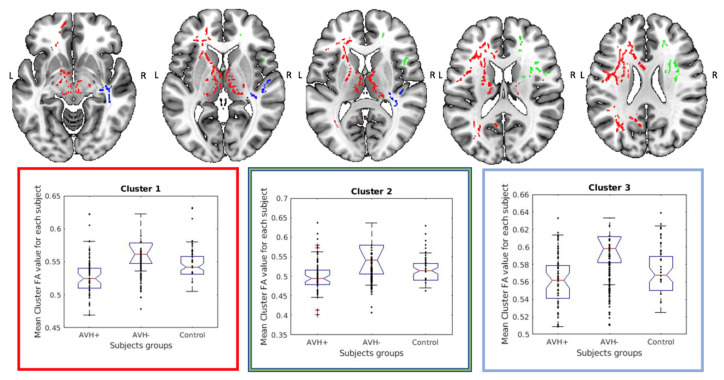
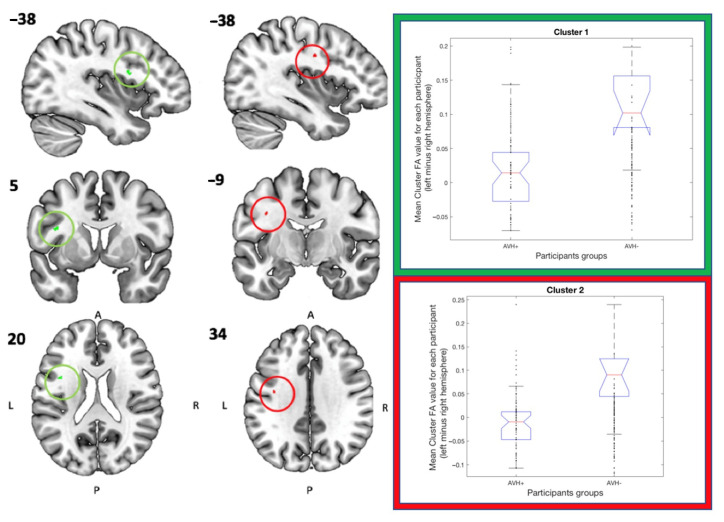
The relation between auditory verbal hallucinations (AVH) and white matter has been studied, but results are still inconsistent. This inconsistency may be related to having only a single time-point of AVH assessment in many studies, not capturing that AVH severity fluctuates over time. In the current study, AVH fluctuations were captured by utilizing a longitudinal design and using repeated (Positive and Negative Symptoms Scale) PANSS questionnaire interviews over a 12 month period. We used a Magnetic Resonance Diffusion Tensor Imaging (MR DTI) sequence and tract-based spatial statistics (TBSS) to explore white matter differences between two subtypes of schizophrenia patients; 44 hallucinating (AVH+) and 13 non-hallucinating (AVH-), compared to 13 AVH- matched controls and 44 AVH+ matched controls. Additionally, we tested for hemispheric fractional anisotropy (FA) asymmetry between the groups. Significant widespread FA-value reduction was found in the AVH+ group in comparison to the AVH- group. Although not significant, the extracted FA-values for the control group were in between the two patient groups, for all clusters. We also found a significant difference in FA-asymmetry between the AVH+ and AVH- groups in two clusters, with significantly higher leftward asymmetry in the AVH- group. The current findings suggest a possible qualitative difference in white matter integrity between AVH+ and AVH- patients. Strengths and limitations of the study are discussed.
听觉言语幻觉(AVH)与白质之间的关系已得到研究,但结果仍不一致。这种不一致可能与许多研究中仅在单一时间点评估AVH有关,未捕捉到AVH严重程度随时间波动的情况。在本研究中,通过采用纵向设计并在12个月期间使用重复的(阳性和阴性症状量表)PANSS问卷访谈来捕捉AVH波动情况。我们使用磁共振扩散张量成像(MR DTI)序列和基于纤维束的空间统计学(TBSS)来探究精神分裂症患者两种亚型之间的白质差异;44名有幻觉的(AVH+)和13名无幻觉的(AVH-),并与13名AVH-匹配对照和44名AVH+匹配对照进行比较。此外,我们还测试了各组之间的半球分数各向异性(FA)不对称性。与AVH-组相比,AVH+组发现广泛的FA值显著降低。虽然不显著,但对照组提取的FA值在所有簇中均介于两个患者组之间。我们还发现AVH+组和AVH-组在两个簇中的FA不对称性存在显著差异,AVH-组的向左不对称性显著更高。目前的研究结果表明AVH+和AVH-患者在白质完整性方面可能存在质的差异。讨论了该研究的优点和局限性。