Durkin Luke A, Childs Caroline E, Calder Philip C
School of Human Development and Health, Faculty of Medicine, University of Southampton, Southampton SO16 6YD, UK.
Institute of Life Sciences, University of Southampton, Southampton SO17 1BJ, UK.
Foods. 2021 Jan 19;10(1):199. doi: 10.3390/foods10010199.
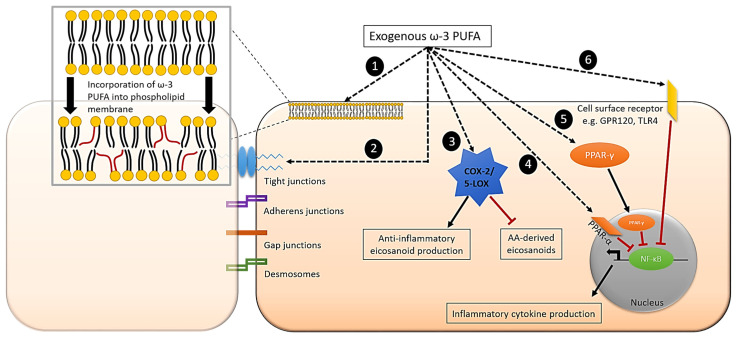
Epithelial cells (enterocytes) form part of the intestinal barrier, the largest human interface between the internal and external environments, and responsible for maintaining regulated intestinal absorption and immunological control. Under inflammatory conditions, the intestinal barrier and its component enterocytes become inflamed, leading to changes in barrier histology, permeability, and chemical mediator production. Omega-3 (ω-3) polyunsaturated fatty acids (PUFAs) can influence the inflammatory state of a range of cell types, including endothelial cells, monocytes, and macrophages. This review aims to assess the current literature detailing the effects of ω-3 PUFAs on epithelial cells. Marine-derived ω-3 PUFAs, eicosapentaenoic acid and docosahexaenoic acid, as well as plant-derived alpha-linolenic acid, are incorporated into intestinal epithelial cell membranes, prevent changes to epithelial permeability, inhibit the production of pro-inflammatory cytokines and eicosanoids and induce the production of anti-inflammatory eicosanoids and docosanoids. Altered inflammatory markers have been attributed to changes in activity and/or expression of proteins involved in inflammatory signalling including nuclear factor kappa-light-chain-enhancer of activated B cells (NF-κB), peroxisome proliferator activated receptor (PPAR) α and γ, G-protein coupled receptor (GPR) 120 and cyclooxygenase (COX)-2. Effective doses for each ω-3 PUFA are difficult to determine due to inconsistencies in dose and time of exposure between different in vitro models and between in vivo and in vitro models. Further research is needed to determine the anti-inflammatory potential of less-studied ω-3 PUFAs, including docosapentaenoic acid and stearidonic acid.
上皮细胞(肠上皮细胞)构成肠道屏障的一部分,肠道屏障是人体内部与外部环境之间最大的界面,负责维持有调节的肠道吸收和免疫控制。在炎症条件下,肠道屏障及其组成部分肠上皮细胞会发炎,导致屏障组织学、通透性和化学介质产生发生变化。ω-3多不饱和脂肪酸(PUFA)可影响一系列细胞类型的炎症状态,包括内皮细胞、单核细胞和巨噬细胞。本综述旨在评估详述ω-3多不饱和脂肪酸对上皮细胞影响的现有文献。海洋来源的ω-3多不饱和脂肪酸、二十碳五烯酸和二十二碳六烯酸,以及植物来源的α-亚麻酸,被整合到肠道上皮细胞膜中,防止上皮通透性改变,抑制促炎细胞因子和类花生酸的产生,并诱导抗炎类花生酸和二十二碳类化合物的产生。炎症标志物的改变归因于参与炎症信号传导的蛋白质的活性和/或表达变化,包括活化B细胞的核因子κB轻链增强子(NF-κB)、过氧化物酶体增殖物激活受体(PPAR)α和γ、G蛋白偶联受体(GPR)120和环氧化酶(COX)-2。由于不同体外模型之间以及体内和体外模型之间在暴露剂量和时间上存在不一致,每种ω-3多不饱和脂肪酸的有效剂量难以确定。需要进一步研究以确定研究较少的ω-3多不饱和脂肪酸(包括二十二碳五烯酸和硬脂酸)的抗炎潜力。