• 文献检索
  • 文档翻译
  • 深度研究
  • 学术资讯
  • Suppr Zotero 插件Zotero 插件
  • 邀请有礼
  • 套餐&价格
  • 历史记录
应用&插件
Suppr Zotero 插件Zotero 插件浏览器插件Mac 客户端Windows 客户端微信小程序
定价
高级版会员购买积分包购买API积分包
服务
文献检索文档翻译深度研究API 文档MCP 服务
关于我们
关于 Suppr公司介绍联系我们用户协议隐私条款
关注我们

Suppr 超能文献

核心技术专利:CN118964589B侵权必究
粤ICP备2023148730 号-1Suppr @ 2026

文献检索

告别复杂PubMed语法,用中文像聊天一样搜索,搜遍4000万医学文献。AI智能推荐,让科研检索更轻松。

立即免费搜索

文件翻译

保留排版,准确专业,支持PDF/Word/PPT等文件格式,支持 12+语言互译。

免费翻译文档

深度研究

AI帮你快速写综述,25分钟生成高质量综述,智能提取关键信息,辅助科研写作。

立即免费体验

妊娠体重增加超出 2009 年美国医学研究所建议范围:前瞻性队列研究中与体重不足或超重相关的新的心理和行为因素。

Gestational weight gain outside the 2009 Institute of Medicine recommendations: novel psychological and behavioural factors associated with inadequate or excess weight gain in a prospective cohort study.

机构信息

Department of Obstetrics and Gynecology, McMaster University, Hamilton, Ontario, Canada.

Eating Disorders Program at Homewood Health Centre, Guelph, Ontario, Canada.

出版信息

BMC Pregnancy Childbirth. 2021 Jan 21;21(1):70. doi: 10.1186/s12884-021-03555-5.

DOI:10.1186/s12884-021-03555-5
PMID:33478410
原文链接:https://pmc.ncbi.nlm.nih.gov/articles/PMC7818557/
Abstract

BACKGROUND

Previous studies have noted traditional physical, demographic, and obstetrical predictors of inadequate or excess gestational weight gain, but the roles of psychological and behavioral factors are not well established. Few interventions targeting traditional factors of gestational weight gain have been successful, necessitating exploration of new domains. The objective of this study was to identify novel psychological and behavioral factors, along with physical, demographic, and obstetrical factors, associated with gestational weight gain that is discordant with the 2009 Institute of Medicine guidelines (inadequate or excess gain).

METHODS

We recruited English-speaking women with a live singleton fetus at 8 to 20 weeks of gestation who received antenatal care from 12 obstetrical, family medicine, and midwifery clinics. A questionnaire was used to collect information related to demographic, physical, obstetrical, psychological, and behavioural factors anticipated to be related to weight gain. The association between these factors and total gestational weight gain, classified as inadequate, appropriate, and excess, was examined using stepwise multinomial logistic regression.

RESULTS

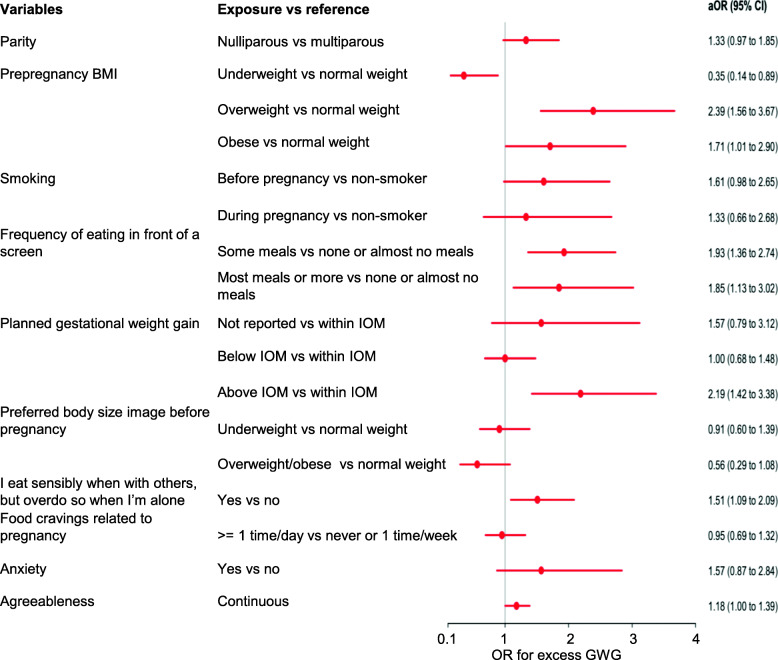
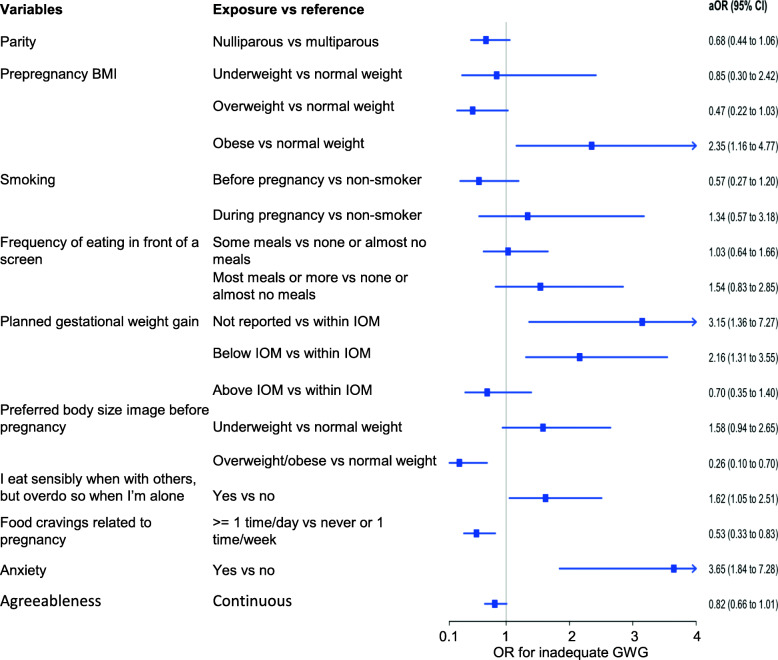
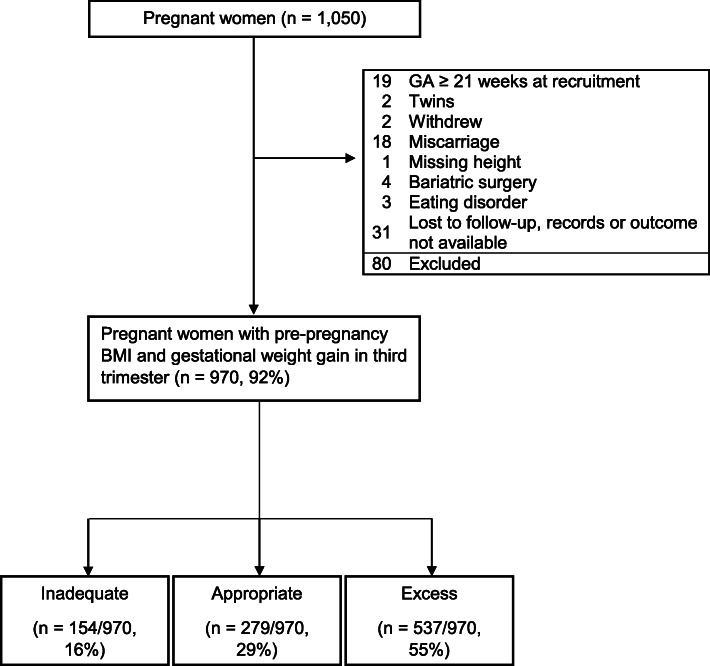
Our study population comprised 970 women whose baseline data were obtained at a mean of 14.8 weeks of gestation ±3.4 weeks (standard deviation). Inadequate gestational weight gain was associated with obesity, planned gestational weight gain (below the guidelines or not reported), anxiety, and eating sensibly when with others but overeating when alone, while protective factors were frequent pregnancy-related food cravings and preferring an overweight or obese body size image. Excess gestational weight gain was associated with pre-pregnancy overweight or obese body mass index, planned gestational weight gain (above guidelines), frequent eating in front of a screen, and eating sensibly when with others but overeating when alone, while a protective factor was being underweight pre-pregnancy.

CONCLUSIONS

In addition to commonly studied predictors, this study identified psychological and behavioral factors associated with inadequate or excess gestational weight gain. Factors common to both inadequate and excessive gestational weight gain were also identified, emphasizing the multidimensional nature of the contributors to guideline-discordant weight gain.

摘要

背景

既往研究已经注意到传统的体格、人口统计学和产科预测因素与不足或过多的妊娠期体重增加有关,但心理和行为因素的作用尚未明确。针对妊娠期体重增加的传统因素的干预措施收效甚微,因此需要探索新的领域。本研究旨在确定与 2009 年美国医学研究所指南(不足或过多增加)不一致的妊娠期体重增加相关的新的心理和行为因素,以及体格、人口统计学和产科因素。

方法

我们招募了在妊娠 8 至 20 周期间接受 12 个产科、家庭医学和助产士诊所产前保健的英语为母语的单胎活产妇女。使用问卷收集与预期与体重增加相关的人口统计学、体格、产科、心理和行为因素的信息。使用逐步多变量逻辑回归检查这些因素与总妊娠期体重增加(不足、适当和过多)之间的关联。

结果

我们的研究人群包括 970 名妇女,其基线数据在妊娠 14.8 周±3.4 周(标准差)时获得。妊娠期体重增加不足与肥胖、计划的妊娠期体重增加(低于指南或未报告)、焦虑以及与他人一起时饮食合理但独自时暴饮暴食有关,而保护因素是频繁的妊娠相关食物渴望和偏爱超重或肥胖体型。妊娠期体重增加过多与妊娠前超重或肥胖的体重指数、计划的妊娠期体重增加(高于指南)、经常在屏幕前进食以及与他人一起时饮食合理但独自时暴饮暴食有关,而保护因素是妊娠前体重不足。

结论

除了常见的预测因素外,本研究还确定了与不足或过多妊娠期体重增加相关的心理和行为因素。还确定了与不足和过多妊娠期体重增加都相关的因素,强调了与指南不符的体重增加的多种贡献因素。
https://cdn.ncbi.nlm.nih.gov/pmc/blobs/bd38/7818557/fc32f31ad185/12884_2021_3555_Fig3_HTML.jpg
https://cdn.ncbi.nlm.nih.gov/pmc/blobs/bd38/7818557/e0bebc06822c/12884_2021_3555_Fig1_HTML.jpg
https://cdn.ncbi.nlm.nih.gov/pmc/blobs/bd38/7818557/785e8e3ae2a8/12884_2021_3555_Fig2_HTML.jpg
https://cdn.ncbi.nlm.nih.gov/pmc/blobs/bd38/7818557/fc32f31ad185/12884_2021_3555_Fig3_HTML.jpg
https://cdn.ncbi.nlm.nih.gov/pmc/blobs/bd38/7818557/e0bebc06822c/12884_2021_3555_Fig1_HTML.jpg
https://cdn.ncbi.nlm.nih.gov/pmc/blobs/bd38/7818557/785e8e3ae2a8/12884_2021_3555_Fig2_HTML.jpg
https://cdn.ncbi.nlm.nih.gov/pmc/blobs/bd38/7818557/fc32f31ad185/12884_2021_3555_Fig3_HTML.jpg

相似文献

1
Gestational weight gain outside the 2009 Institute of Medicine recommendations: novel psychological and behavioural factors associated with inadequate or excess weight gain in a prospective cohort study.妊娠体重增加超出 2009 年美国医学研究所建议范围:前瞻性队列研究中与体重不足或超重相关的新的心理和行为因素。
BMC Pregnancy Childbirth. 2021 Jan 21;21(1):70. doi: 10.1186/s12884-021-03555-5.
2
Patterns and predictors of gestational weight gain in Addis Ababa, Central Ethiopia: a prospective cohort study.埃塞俄比亚亚的斯亚贝巴妊娠增重模式和预测因素:一项前瞻性队列研究。
Reprod Health. 2021 Jul 28;18(1):159. doi: 10.1186/s12978-021-01202-y.
3
The association between personal weight gain goals, provider recommendations, and appropriate gestational weight gain.个人体重增加目标、提供者建议与适当的妊娠体重增加之间的关联。
Am J Obstet Gynecol MFM. 2020 Nov;2(4):100231. doi: 10.1016/j.ajogmf.2020.100231. Epub 2020 Sep 22.
4
Prevalence and characteristics associated with gestational weight gain adequacy.与孕期体重增加充足相关的患病率及特征。
Obstet Gynecol. 2015 Apr;125(4):773-781. doi: 10.1097/AOG.0000000000000739.
5
Evaluating the application of the 2009 Institute of Medicine gestational weight gain guidelines on pregnant Chinese women.评估 2009 年美国医学研究所孕期体重增加指南在中国孕妇中的应用。
Glob Health Action. 2023 Dec 31;16(1):2213494. doi: 10.1080/16549716.2023.2213494.
6
[Relationship between the risk of emergency cesarean section for nullipara with the prepregnancy body mass index or gestational weight gain].初产妇急诊剖宫产风险与孕前体重指数或孕期体重增加的关系
Zhonghua Fu Chan Ke Za Zhi. 2017 Nov 25;52(11):757-764. doi: 10.3760/cma.j.issn.0529-567X.2017.11.008.
7
A goal set too high: factors associated with planning excess gestational weight gain in a prospective cohort study.目标设定过高:一项前瞻性队列研究中与计划过多妊娠体重增加相关的因素。
J Matern Fetal Neonatal Med. 2022 Dec;35(25):7865-7873. doi: 10.1080/14767058.2021.1937988. Epub 2021 Jun 17.
8
Do trimester-specific cutoffs predict whether women ultimately stay within the Institute of Medicine/National Research Council guidelines for gestational weight gain? Findings of a retrospective cohort study.孕期体重增长的医学研究所/国家研究委员会指南的特定孕期切点能否预测女性最终是否符合该指南?一项回顾性队列研究的结果。
Am J Clin Nutr. 2012 Jun;95(6):1432-7. doi: 10.3945/ajcn.111.033704. Epub 2012 May 2.
9
Prediction of excess pregnancy weight gain using psychological, physical, and social predictors: A validated model in a prospective cohort study.利用心理、生理和社会预测因素预测孕期体重增加过多:前瞻性队列研究中验证的模型。
PLoS One. 2020 Jun 2;15(6):e0233774. doi: 10.1371/journal.pone.0233774. eCollection 2020.
10
Factors associated with gestational weight gain: a cross-sectional survey.与妊娠体重增加相关的因素:一项横断面调查。
BMC Pregnancy Childbirth. 2018 Dec 3;18(1):465. doi: 10.1186/s12884-018-2112-7.

引用本文的文献

1
Determinants of gestational weight gain during pregnancy in a multiethnic UK-based population: Findings from the Born in Bradford cohort study.英国多民族人群孕期体重增加的决定因素:来自布拉德福德出生队列研究的结果。
PLoS One. 2025 May 23;20(5):e0323278. doi: 10.1371/journal.pone.0323278. eCollection 2025.
2
Effects of a Mobile Health Intervention Based on Behavioral Integrated Model on Cognitive and Behavioral Changes in Gestational Weight Management: Randomized Controlled Trial.基于行为整合模型的移动健康干预对妊娠期体重管理中认知和行为变化的影响:随机对照试验
J Med Internet Res. 2025 Mar 10;27:e55844. doi: 10.2196/55844.
3

本文引用的文献

1
Stress and Anxiety are Associated with Lower Gestational Weight Gain in Hispanic Women.压力和焦虑与西班牙裔女性较低的孕期体重增加有关。
Womens Health Issues. 2020 Nov-Dec;30(6):409-415. doi: 10.1016/j.whi.2020.08.003. Epub 2020 Sep 28.
2
Prediction of excess pregnancy weight gain using psychological, physical, and social predictors: A validated model in a prospective cohort study.利用心理、生理和社会预测因素预测孕期体重增加过多:前瞻性队列研究中验证的模型。
PLoS One. 2020 Jun 2;15(6):e0233774. doi: 10.1371/journal.pone.0233774. eCollection 2020.
3
Psychosocial stress and longitudinally measured gestational weight gain throughout pregnancy: The Ulm SPATZ Health Study.
Perceptual Factors Associated with Gestational Weight Gain: A Cross-Sectional Survey.
与孕期体重增加相关的感知因素:一项横断面调查
J Korean Acad Nurs. 2024 Nov;54(4):495-508. doi: 10.4040/jkan.24052.
4
Excessive Gestational Weight Gain, Independent of Body Mass Index, Is Associated With Child Fat Mass Index at Age 2 Years in the Growing life, Optimizing Wellness Study.在“成长生活,优化健康”研究中,孕期体重过度增加(独立于体重指数)与2岁儿童的脂肪量指数相关。
J Acad Nutr Diet. 2024 Oct 18. doi: 10.1016/j.jand.2024.10.011.
5
Association Between Body Image Before and During Pregnancy and Gestational Weight Gain in Japanese Women: A Prospective Cohort Study.日本女性妊娠前后体像与妊娠期体重增加的关系:一项前瞻性队列研究。
Matern Child Health J. 2024 Apr;28(4):708-718. doi: 10.1007/s10995-023-03854-7. Epub 2023 Dec 5.
6
Dietitian-led cluster randomised controlled trial on the effectiveness of mHealth education on health outcomes among pregnant women: a protocol paper.基于移动医疗教育的营养师主导群组随机对照试验对孕妇健康结局的有效性:研究方案。
BMJ Open. 2023 Nov 20;13(11):e075937. doi: 10.1136/bmjopen-2023-075937.
7
Physical activity during pregnancy and its relationship with gestational weight gain.孕期身体活动及其与妊娠期体重增加的关系。
Rev Lat Am Enfermagem. 2023 Mar 27;31:e3875. doi: 10.1590/1518-8345.6488.3875.
8
The Association of Avoidance Coping with Gestational Weight Gain among Pregnant Black Women.孕期黑人女性中回避应对方式与孕期体重增加的关联
West J Nurs Res. 2023 Mar;45(3):226-233. doi: 10.1177/01939459221127800. Epub 2022 Oct 4.
9
Analysis of the Weight Management Behavior of Chinese Pregnant Women: An Integration of the Protection Motivation Theory and the Information-Motivation-Behavioral Skills Model.分析中国孕妇的体重管理行为:保护动机理论与信息动机行为技能模型的整合。
Front Public Health. 2022 Feb 4;10:759946. doi: 10.3389/fpubh.2022.759946. eCollection 2022.
10
Behaviour model integrated by protection motivation theory and information-motivation-behavioural skills model applying in pregnancy weight management (PrInMAMa): a study protocol for a randomised controlled trial in China.保护动机理论和信息动机行为技能模型整合的行为模型在妊娠体重管理中的应用(PrInMAMa):在中国进行的一项随机对照试验研究方案。
BMJ Open. 2022 Jan 12;12(1):e051275. doi: 10.1136/bmjopen-2021-051275.
精神社会压力与整个孕期纵向测量的体重增长:乌尔姆 SPATZ 健康研究。
Sci Rep. 2020 Feb 6;10(1):1996. doi: 10.1038/s41598-020-58808-8.
4
Psychological Distress and Weight Gain in Pregnancy: a Population-Based Study.孕期心理困扰与体重增加:一项基于人群的研究。
Int J Behav Med. 2020 Feb;27(1):30-38. doi: 10.1007/s12529-019-09832-0.
5
Interprovincial variation in pre-pregnancy body mass index and gestational weight gain and their impact on neonatal birth weight with respect to small and large for gestational age.省际间孕前体重指数和孕期体重增加的差异及其对小于胎龄儿和大于胎龄儿新生儿出生体重的影响。
Can J Public Health. 2018 Aug;109(4):527-538. doi: 10.17269/s41997-018-0086-x. Epub 2018 Sep 6.
6
Gestational weight gain across continents and ethnicity: systematic review and meta-analysis of maternal and infant outcomes in more than one million women.跨大陆和种族的妊娠体重增加:对超过 100 万妇女的母婴结局进行的系统评价和荟萃分析。
BMC Med. 2018 Aug 31;16(1):153. doi: 10.1186/s12916-018-1128-1.
7
Achieving Appropriate Gestational Weight Gain: The Role of Healthcare Provider Advice.实现适当的妊娠体重增加:医疗保健提供者建议的作用。
J Womens Health (Larchmt). 2018 May;27(5):552-560. doi: 10.1089/jwh.2017.6514. Epub 2018 Jan 10.
8
Predictors and outcomes of excess gestational weight gain among low-income pregnant women.低收入孕妇孕期体重过度增加的预测因素及结局
Health Care Women Int. 2018 Jan;39(1):19-33. doi: 10.1080/07399332.2017.1391263. Epub 2017 Dec 6.
9
Association of Gestational Weight Gain With Maternal and Infant Outcomes: A Systematic Review and Meta-analysis.孕期体重增加与母婴结局的关联:一项系统评价和荟萃分析。
JAMA. 2017 Jun 6;317(21):2207-2225. doi: 10.1001/jama.2017.3635.
10
Patterns and trajectories of gestational weight gain: a prospective cohort study.孕期体重增加的模式与轨迹:一项前瞻性队列研究。
CMAJ Open. 2016 Jun 23;4(2):E338-45. doi: 10.9778/cmajo.20150132. eCollection 2016 Apr-Jun.