Assistance Publique Hôpitaux de Marseille, Department of Anesthesiology and Intensive Care, Hôpital Nord, Aix Marseille University, 13015, Marseille, France.
Center for Cardiovascular and Nutrition Research (C2VN), INSERM, INRA, Aix Marseille Université, 13005, Marseille, France.
Crit Care. 2021 Jan 22;25(1):34. doi: 10.1186/s13054-021-03466-z.
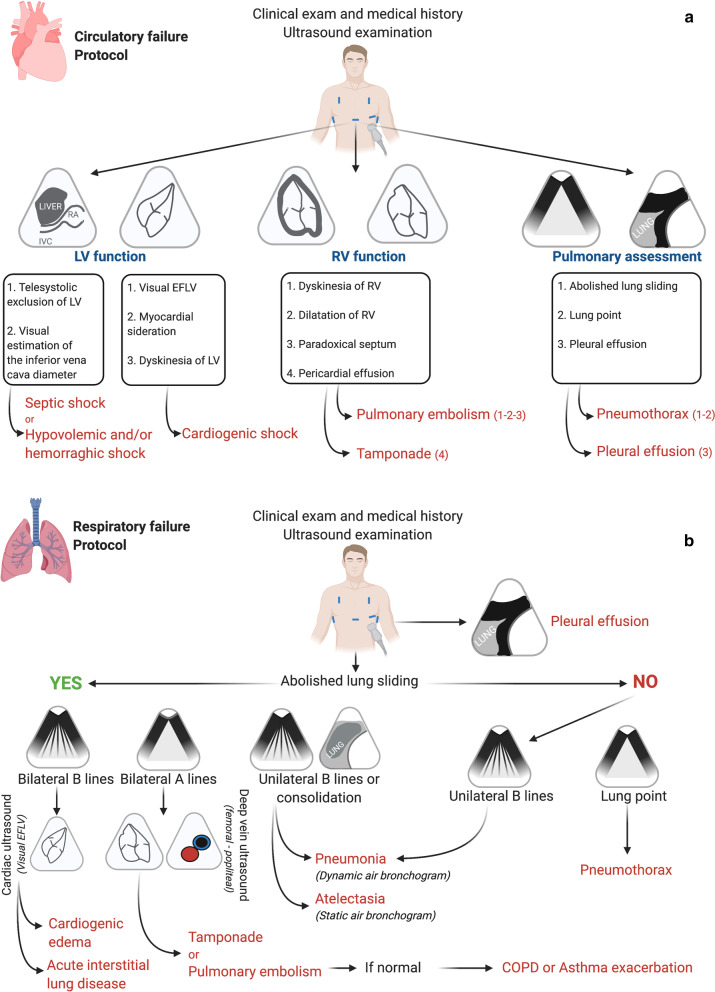
Rapid response teams are intended to improve early diagnosis and intervention in ward patients who develop acute respiratory or circulatory failure. A management protocol including the use of a handheld ultrasound device for immediate point-of-care ultrasound (POCUS) examination at the bedside may improve team performance. The main objective of the study was to assess the impact of implementing such a POCUS-guided management on the proportion of adequate immediate diagnoses in two groups. Secondary endpoints included time to treatment and patient outcomes.
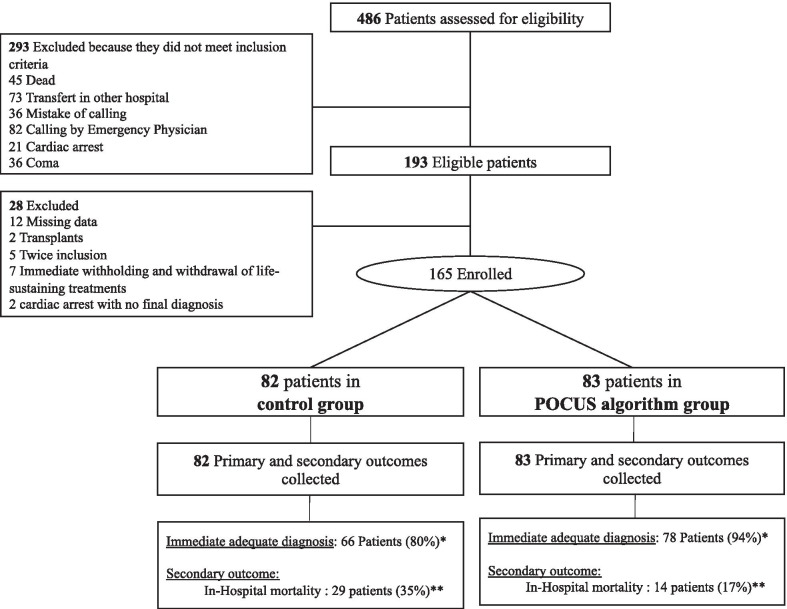
A prospective, observational, controlled study was conducted in a single university hospital. Two teams alternated every other day for managing in-hospital ward patients developing acute respiratory and/or circulatory failures. Only one of the team used an ultrasound device (POCUS group).
We included 165 patients (POCUS group 83, control group 82). Proportion of adequate immediate diagnoses was 94% in the POCUS group and 80% in the control group (p = 0.009). Time to first treatment/intervention was shorter in the POCUS group (15 [10-25] min vs. 34 [15-40] min, p < 0.001). In-hospital mortality rates were 17% in the POCUS group and 35% in the control group (p = 0.007), but this difference was not confirmed in the propensity score sample (29% vs. 34%, p = 0.53).
Our study suggests that protocolized use of a handheld POCUS device at the bedside in the ward may improve the proportion of adequate diagnosis, the time to initial treatment and perhaps also survival of ward patients developing acute respiratory or circulatory failure. Clinical Trial Registration NCT02967809. Registered 18 November 2016, https://clinicaltrials.gov/ct2/show/NCT02967809 .
快速反应团队旨在改善在病房中出现急性呼吸或循环衰竭的患者的早期诊断和干预。管理方案包括在床边使用手持式超声设备进行即时床旁超声(POCUS)检查,这可能会提高团队的表现。本研究的主要目的是评估实施这种基于 POCUS 的管理对两组中适当即时诊断比例的影响。次要终点包括治疗时间和患者结局。
这是一项在一家大学医院进行的前瞻性、观察性、对照研究。两个团队每隔一天交替管理在医院病房中出现急性呼吸和/或循环衰竭的患者。只有一个团队使用超声设备(POCUS 组)。
我们纳入了 165 名患者(POCUS 组 83 名,对照组 82 名)。POCUS 组的适当即时诊断比例为 94%,对照组为 80%(p=0.009)。POCUS 组的首次治疗/干预时间更短(15 [10-25] min 比 34 [15-40] min,p<0.001)。POCUS 组的院内死亡率为 17%,对照组为 35%(p=0.007),但在倾向评分样本中未得到证实(29%比 34%,p=0.53)。
我们的研究表明,在病房床边使用手持式 POCUS 设备可能会提高适当诊断的比例、初始治疗的时间,并且可能提高出现急性呼吸或循环衰竭的病房患者的生存率。临床试验注册 NCT02967809。注册于 2016 年 11 月 18 日,https://clinicaltrials.gov/ct2/show/NCT02967809。