Higgins Victoria, Fabros Anselmo, Kulasingam Vathany
Department of Laboratory Medicine and Pathobiology, University of Toronto, Toronto, Ontario, Canada.
Division of Clinical Biochemistry, Laboratory Medicine Program, University Health Network, Toronto, Ontario, Canada.
J Clin Microbiol. 2021 Mar 19;59(4). doi: 10.1128/JCM.03149-20.
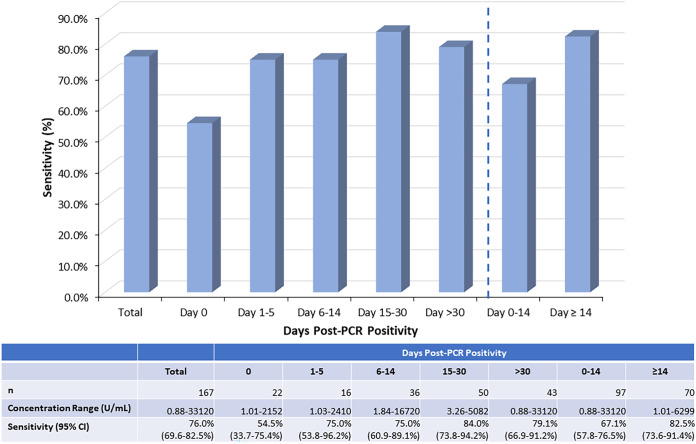
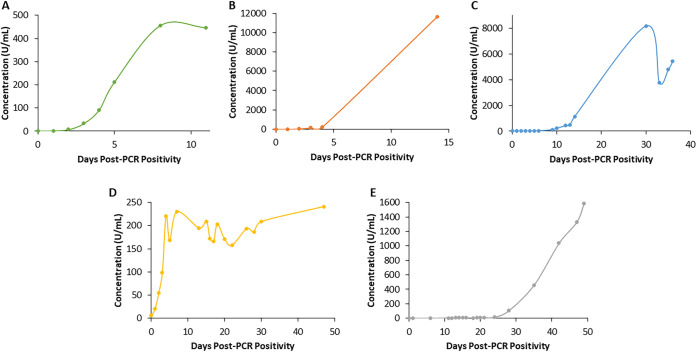
The severe acute respiratory syndrome coronavirus 2 (SARS-CoV-2) is the causative agent of coronavirus disease 2019 (COVID-19). Molecular-based testing is used to diagnose COVID-19, and serologic testing of antibodies specific to SARS-CoV-2 is used to detect past infection. While most serologic assays are qualitative, a quantitative serologic assay was recently developed that measures antibodies against the S protein, the target of vaccines. Quantitative antibody determination may help determine antibody titer and facilitate longitudinal monitoring of the antibody response, including antibody response to vaccines. We evaluated the quantitative Roche Elecsys anti-SARS-CoV-2 S assay. Specimens from 167 PCR-positive patients and 103 control specimens were analyzed using the Elecsys anti-SARS-CoV-2 S assay on the cobas e411 (Roche Diagnostics). Analytical evaluation included assessing linearity, imprecision, and analytical sensitivity. Clinical evaluation included assessing clinical sensitivity, specificity, cross-reactivity, positive predictive value (PPV), negative predictive value (NPV), and serial sampling from the same patient. The Elecsys anti-SARS-CoV-2 S assay exhibited its highest sensitivity (84.0%) at 15 to 30 days post-PCR positivity and exhibited no cross-reactivity, a specificity and PPV of 100%, and an NPV between 98.3% and 99.8% at ≥14 days post-PCR positivity, depending on the seroprevalence estimate. Imprecision was <2% at 9.06 U/ml across 6 days, the negative quality control (QC) was consistently negative (<0.40 U/ml), the manufacturer's claimed limit of quantitation of 0.40 U/ml was verified, and linearity across the analytical measuring range was observed, except at the low end (<20 U/ml). Lastly, antibody response showed high interindividual variation in level and time of peak antibody titer and trends over time.
严重急性呼吸综合征冠状病毒2(SARS-CoV-2)是2019冠状病毒病(COVID-19)的病原体。基于分子的检测用于诊断COVID-19,而针对SARS-CoV-2特异性抗体的血清学检测用于检测既往感染。虽然大多数血清学检测是定性的,但最近开发了一种定量血清学检测方法,可测量针对S蛋白(疫苗的靶点)的抗体。定量抗体测定有助于确定抗体滴度,并便于对抗体反应进行纵向监测,包括对疫苗的抗体反应。我们评估了罗氏Elecsys抗SARS-CoV-2 S定量检测方法。使用cobas e411(罗氏诊断公司)上的Elecsys抗SARS-CoV-2 S检测方法对167例PCR阳性患者的样本和103例对照样本进行了分析。分析评估包括评估线性、不精密度和分析灵敏度。临床评估包括评估临床灵敏度、特异性、交叉反应性、阳性预测值(PPV)、阴性预测值(NPV)以及对同一患者的连续采样。Elecsys抗SARS-CoV-2 S检测方法在PCR阳性后15至30天表现出最高灵敏度(84.0%),且无交叉反应性,特异性和PPV为100%,在PCR阳性后≥14天,NPV在98.3%至99.8%之间,具体取决于血清流行率估计值。在6天内,9.06 U/ml时的不精密度<2%,阴性质量控制(QC)始终为阴性(<0.40 U/ml),验证了制造商声称的0.40 U/ml定量下限,并且观察到在分析测量范围内的线性,除了在低端(<20 U/ml)。最后,抗体反应在抗体滴度峰值水平和时间以及随时间的趋势方面表现出高度的个体间差异。