Department of Microbiology & Immunology, Columbia University Irving Medical Center, New York, NY, USA.
Laboratory of Malaria and Vector Research, National Institute of Allergy and Infectious Diseases, National Institutes of Health, Bethesda, MD, USA.
Nat Commun. 2021 Jan 22;12(1):530. doi: 10.1038/s41467-020-20805-w.
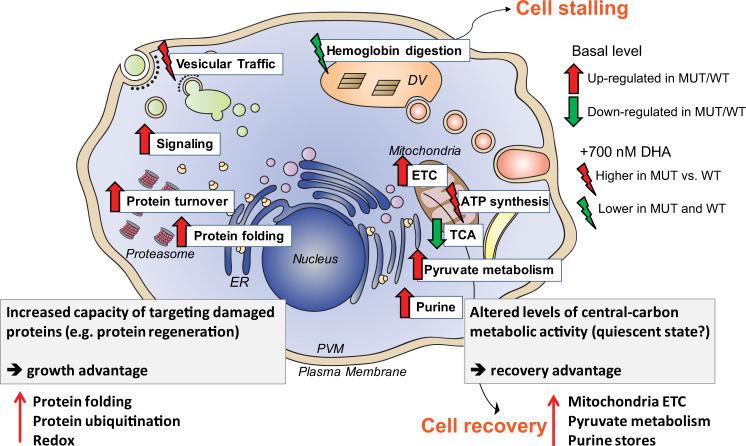
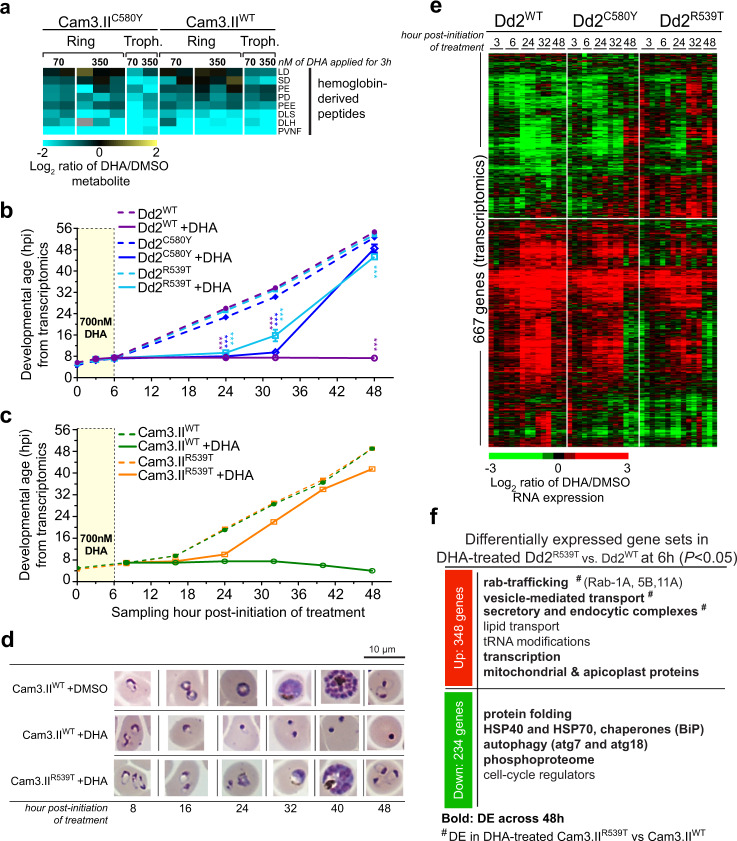
The emergence and spread of artemisinin resistance, driven by mutations in Plasmodium falciparum K13, has compromised antimalarial efficacy and threatens the global malaria elimination campaign. By applying systems-based quantitative transcriptomics, proteomics, and metabolomics to a panel of isogenic K13 mutant or wild-type P. falciparum lines, we provide evidence that K13 mutations alter multiple aspects of the parasite's intra-erythrocytic developmental program. These changes impact cell-cycle periodicity, the unfolded protein response, protein degradation, vesicular trafficking, and mitochondrial metabolism. K13-mediated artemisinin resistance in the Cambodian Cam3.II line was reversed by atovaquone, a mitochondrial electron transport chain inhibitor. These results suggest that mitochondrial processes including damage sensing and anti-oxidant properties might augment the ability of mutant K13 to protect P. falciparum against artemisinin action by helping these parasites undergo temporary quiescence and accelerated growth recovery post drug elimination.
疟原虫 K13 突变驱动的青蒿素耐药性的出现和传播,已经损害了抗疟药物的疗效,并威胁到全球消除疟疾运动。通过对一组同源 K13 突变体或野生型疟原虫系进行基于系统的定量转录组学、蛋白质组学和代谢组学研究,我们提供了证据表明 K13 突变改变了寄生虫在红细胞内发育计划的多个方面。这些变化影响细胞周期周期性、未折叠蛋白反应、蛋白质降解、囊泡运输和线粒体代谢。在柬埔寨 Cam3.II 系中,K13 介导的青蒿素耐药性可以被线粒体电子传递链抑制剂阿托伐醌逆转。这些结果表明,包括损伤感应和抗氧化特性在内的线粒体过程可能通过帮助这些寄生虫在药物消除后暂时静止和加速生长恢复,增强突变型 K13 保护疟原虫免受青蒿素作用的能力。