Mahmassani Hiya A, Switkowski Karen M, Scott Tammy M, Johnson Elizabeth J, Rifas-Shiman Sheryl L, Oken Emily, Jacques Paul F
Dorothy J and Gerald R Friedman School of Nutrition and Science Policy at Tufts University, Boston, MA, USA.
Department of Population Medicine, Harvard Medical School and Harvard Pilgrim Health Care Institute, Boston, MA, USA.
J Nutr. 2021 Mar 11;151(3):615-627. doi: 10.1093/jn/nxaa348.
Lutein and zeaxanthin are carotenoids associated with better cognition at older age. To our knowledge, no previous study has evaluated their cognitive implications in the prenatal period, when the brain undergoes its most rapid development.
The objective of this study was to examine associations of maternal lutein and zeaxanthin (L/Z) intake during pregnancy with child cognition.
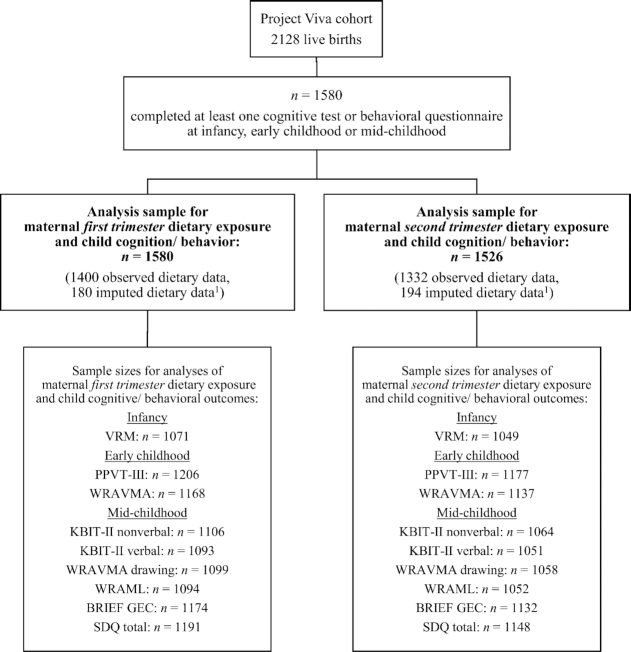
Among 1580 mother-child pairs in Project Viva, a prospective cohort, we assessed maternal intake of L/Z during pregnancy using food frequency questionnaires and offspring cognition by the Visual Recognition Memory paradigm in infancy, the Peabody Picture Vocabulary Test and the Wide Range Assessment of Visual Motor Abilities (WRAVMA) in early childhood, and the Kaufman Brief Intelligence Test (KBIT-II), the WRAVMA drawing subtest, and the Wide Range Assessment of Memory and Learning in mid-childhood. Parents completed the Behavior Rating Inventory of Executive Function (BRIEF) and Strengths and Difficulties Questionnaire.
Mothers consumed a daily mean (SD) of 2.6 (2.0) mg L/Z in the first and second trimesters of pregnancy. Mean mid-childhood KBIT-II verbal scores were higher with greater maternal L/Z intake [difference of Q4-Q1 means for first trimester: 2.67 (95% CI: 0.13, 5.20) and for second trimester: 3.55 (95% CI: 0.81, 6.28)], indicating better verbal intelligence. Secondary analyses on cognitive subtests showed that mean mid-childhood BRIEF Behavioral Regulation Index scores were lower with greater maternal L/Z intake [difference of Q4-Q1 means for first trimester: -1.63 (95% CI: -3.22, -0.04) and for second trimester: -1.89 (95% CI: -3.58, -0.21)], indicating better behavior regulation ability.
Higher maternal L/Z intake during pregnancy was associated with better offspring verbal intelligence and behavior regulation ability in mid-childhood, suggesting a potential benefit during prenatal development. We did not find a benefit of higher maternal L/Z intake on other child cognitive or behavioral outcomes. Project Viva is registered at clinicaltrials.gov as NCT02820402.
叶黄素和玉米黄质是与老年人更好认知功能相关的类胡萝卜素。据我们所知,此前尚无研究评估它们在大脑发育最迅速的孕期对认知功能的影响。
本研究旨在探讨孕期母亲叶黄素和玉米黄质(L/Z)摄入量与儿童认知功能之间的关联。
在一项前瞻性队列研究“活力项目”的1580对母婴中,我们使用食物频率问卷评估孕期母亲L/Z的摄入量,并通过婴儿期视觉识别记忆范式、幼儿期皮博迪图片词汇测试和视觉运动能力广泛评估(WRAVMA)以及童年中期考夫曼简短智力测验(KBIT-II)、WRAVMA绘画子测验和记忆与学习广泛评估来评估后代的认知功能。父母完成执行功能行为评定量表(BRIEF)和长处与困难问卷。
母亲在孕期头三个月和第二个三个月的L/Z日均摄入量平均(标准差)为2.6(2.0)毫克。母亲L/Z摄入量越高,童年中期KBIT-II语言平均得分越高[头三个月第四分位数与第一分位数均值之差:2.67(95%置信区间:0.13,5.20);第二个三个月:3.55(95%置信区间:0.81,6.28)],表明语言智力更好。对认知子测验的二次分析表明,母亲L/Z摄入量越高,童年中期BRIEF行为调节指数平均得分越低[头三个月第四分位数与第一分位数均值之差:-1.63(95%置信区间:-3.22,-0.04);第二个三个月:-1.89(95%置信区间:-3.58,-0.21)],表明行为调节能力更好。
孕期母亲较高的L/Z摄入量与童年中期后代更好的语言智力和行为调节能力相关,提示在产前发育期间有潜在益处。我们未发现母亲较高的L/Z摄入量对其他儿童认知或行为结局有好处。“活力项目”在clinicaltrials.gov上注册,注册号为NCT02820402。