Department of Psychology, Durham University, Science Laboratories, Durham, UK.
Department of English Studies, Durham University, Durham, UK.
Schizophr Bull. 2021 Jan 23;47(1):228-236. doi: 10.1093/schbul/sbaa095.
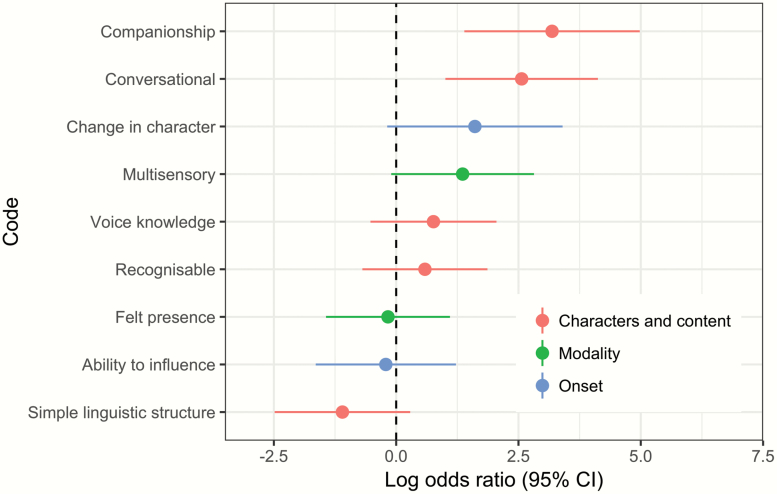
Recent therapeutic approaches to auditory verbal hallucinations (AVH) exploit the person-like qualities of voices. Little is known, however, about how, why, and when AVH become personified. We aimed to investigate personification in individuals' early voice-hearing experiences. We invited Early Intervention in Psychosis (EIP) service users aged 16-65 to participate in a semistructured interview on AVH phenomenology. Forty voice-hearers (M = 114.13 days in EIP) were recruited through 2 National Health Service trusts in northern England. We used content and thematic analysis to code the interviews and then statistically examined key associations with personification. Some participants had heard voices intermittently for multiple years prior to clinical involvement (M = 74.38 months), although distressing voice onset was typically more recent (median = 12 months). Participants reported a range of negative emotions (predominantly fear, 60%, 24/40, and anxiety, 62.5%, 26/40), visual hallucinations (75%, 30/40), bodily states (65%, 25/40), and "felt presences" (52.5%, 21/40) in relation to voices. Complex personification, reported by a sizeable minority (16/40, 40%), was associated with experiencing voices as conversational (odds ratio [OR] = 2.56) and companionable (OR = 3.19) but not as commanding or trauma-related. Neither age of AVH onset nor time since onset related to personification. Our findings highlight significant personification of AVH even at first clinical presentation. Personified voices appear to be distinguished less by their intrinsic properties, commanding qualities, or connection with trauma than by their affordances for conversation and companionship.
最近针对听觉言语幻觉(AVH)的治疗方法利用了声音的拟人化特征。然而,对于 AVH 如何、为何以及何时被人格化知之甚少。我们旨在研究个体早期听到声音的经历中的人格化现象。我们邀请了年龄在 16-65 岁的早期精神病干预(EIP)服务使用者参加关于 AVH 现象学的半结构化访谈。通过英格兰北部的 2 家国家卫生服务信托,我们招募了 40 名有幻听的人(M = EIP 中 114.13 天)。我们使用内容和主题分析对访谈进行编码,然后对人格化的关键关联进行统计检验。一些参与者在临床参与之前已经间歇性地听到声音多年(M = 74.38 个月),尽管痛苦的声音开始通常更近(中位数 = 12 个月)。参与者报告了一系列负面情绪(主要是恐惧,60%,24/40,和焦虑,62.5%,26/40),视觉幻觉(75%,30/40),身体状态(65%,25/40)和与声音有关的“感觉存在”(52.5%,21/40)。相当一部分人(16/40,40%)报告了复杂的人格化,与将声音视为对话(优势比[OR] = 2.56)和陪伴(OR = 3.19)有关,但与命令或与创伤有关的无关。AVH 发病年龄和发病后时间均与人格化无关。我们的发现强调了即使在首次临床出现时,AVH 也会出现显著的人格化。人格化的声音似乎与其内在属性、命令性特征或与创伤的联系不如其对话和陪伴的功能更具区别性。