Juul Labs, Inc., Washington, DC, USA.
whatIF? Consulting Ltd., Harwell, U.K.
Nicotine Tob Res. 2021 May 24;23(6):947-955. doi: 10.1093/ntr/ntab001.
This randomized, open-label, crossover clinical study evaluated nicotine pharmacokinetics (PK) and subjective effects of the JUUL System (JS; Juul Labs, Inc.) with three nicotine concentrations compared to the usual brand (UB) cigarettes in 24 adult smokers.
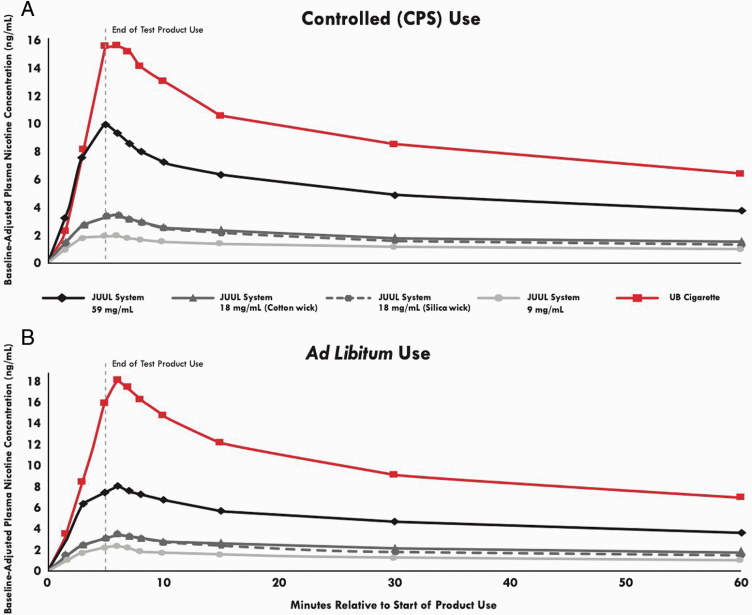
At five study visits, subjects used either the JS in 59 mg/mL, JS 18 mg/mL (two visits), and JS 9 mg/mL (all tobacco-flavored) or smoked their UB cigarette first during a controlled puffing sequence (CPS) and then ad libitum (5 min) use sessions. Blood samples were taken at specified timepoints for 60 min in each session. The modified Product Evaluation Scale assessed subjective effects 30-min post-use in the CPS session.
Maximum plasma nicotine concentration (Cmax-BL), total nicotine exposure (AUC0-60-BL), and rate of plasma nicotine rise were significantly lower for all JS products compared to subjects' UB cigarette in CPS and ad libitum use sessions. In both use sessions these PK parameters were significantly higher for JS 59 mg/mL compared to 18 and 9 mg/mL. Subjective measures of cigarette craving relief and "Enough Nicotine" for JS 59 mg/mL did not differ significantly from UB cigarettes, but JS 18 and 9 mg/mL were rated significantly lower than JS 59 mg/mL and UB cigarettes.
Nicotine exposure and subjective relief were directly related to JS nicotine concentration: higher nicotine concentrations gave rise to significantly greater plasma nicotine levels and relief from craving. Heavier and more dependent smokers may require the greater nicotine delivery of JS 59 mg/mL to successfully transition away from cigarettes.
It has been suggested that electronic nicotine delivery systems (ENDS) and other alternative nicotine delivery products that more closely mimic the nicotine pharmacokinetics (PK) of cigarettes may facilitate smokers transitioning away from cigarettes. We examined nicotine PK and subjective effects of JUUL System (JS) ENDS with three nicotine concentrations (59, 18 and 9 mg/mL) compared to combustible cigarettes. Nicotine delivery from JS ENDS was nicotine concentration dependent, with higher nicotine concentrations giving rise to higher nicotine exposure. These findings suggest that heavier and more dependent smokers may require ENDS with nicotine concentrations greater than 20 mg/mL to successfully transition away from cigarettes.
这项随机、开放标签、交叉临床研究评估了尼古丁药代动力学(PK)和主观效应的 JUUL 系统(JS; Juul 实验室公司)与三种尼古丁浓度相比,在 24 名成年吸烟者中,通常的品牌(UB)香烟。
在五次研究访问中,受试者使用的是 59mg/ml 的 JS、18mg/ml 的 JS(两次访问)和 9mg/ml 的 JS(所有烟草口味),或者在控制抽吸序列(CPS)中先吸烟 UB 香烟,然后在 5 分钟的自由使用期内吸烟。在每个会话的特定时间点采集血液样本 60 分钟。在 CPS 会话中,使用改良后的产品评估量表在使用后 30 分钟评估主观效应。
在 CPS 和自由使用期间,所有 JS 产品的最大血浆尼古丁浓度(Cmax-BL)、总尼古丁暴露(AUC0-60-BL)和血浆尼古丁上升率均明显低于受试者的 UB 香烟。在这两种使用情况下,JS 59mg/ml 的这些 PK 参数明显高于 18mg/ml 和 9mg/ml。JS 59mg/ml 对缓解香烟渴望和“足够尼古丁”的主观措施与 UB 香烟无显著差异,但 JS 18mg/ml 和 9mg/ml 的评分明显低于 JS 59mg/ml 和 UB 香烟。
尼古丁暴露和主观缓解与 JS 尼古丁浓度直接相关:更高的尼古丁浓度会导致明显更高的血浆尼古丁水平和缓解渴望。更重和更依赖的吸烟者可能需要更大的尼古丁输送量的 JS 59mg/ml 才能成功地从香烟过渡。
有人认为,电子尼古丁输送系统(ENDS)和其他更能模拟香烟尼古丁药代动力学(PK)的替代尼古丁输送产品可能有助于吸烟者从香烟过渡。我们检查了 JUUL 系统(JS)ENDS 的三种尼古丁浓度(59、18 和 9mg/ml)与可燃香烟相比的尼古丁 PK 和主观效应。JS ENDS 的尼古丁输送与尼古丁浓度有关,较高的尼古丁浓度会导致较高的尼古丁暴露。这些发现表明,更重和更依赖的吸烟者可能需要大于 20mg/ml 的尼古丁浓度的 ENDS 才能成功地从香烟过渡。