University of Minnesota, Department of Psychology, 75 E. River Road, Minneapolis, MN, 55454, United States.
University of Minnesota, School of Public Health Division of Biostatistics, 420 Delaware St. SE, Minneapolis, MN, 55455, United States.
Drug Alcohol Depend. 2020 Jul 1;212:107999. doi: 10.1016/j.drugalcdep.2020.107999. Epub 2020 Apr 25.
While a majority of cigarette smokers who use electronic cigarettes (e-cigarettes) choose to continue using cigarettes, completely switching to e-cigarettes is necessary to reduce tobacco-related harm. Whether specific subjective responses to e-cigarettes are associated with extent of smoking reduction and complete switching from cigarettes to e-cigarettes is unclear. This study determined whether initial subjective responses to e-cigarettes related to the successful substitution of e-cigarettes for cigarettes and extent of cigarette and e-cigarette use.
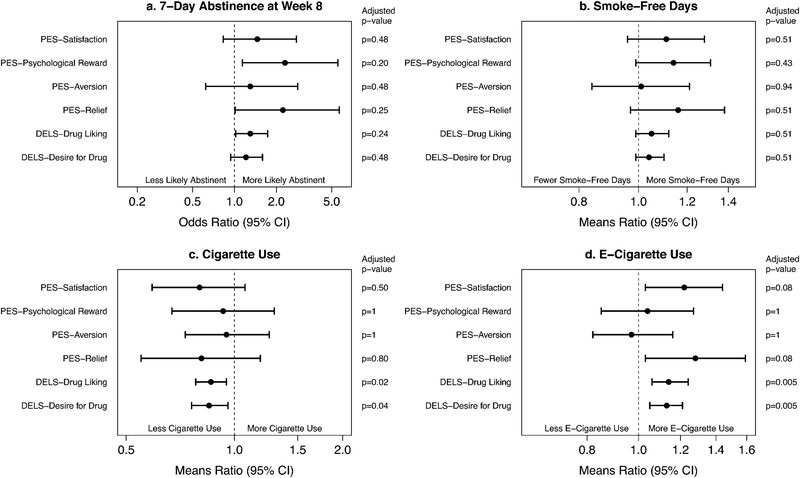
Adult cigarette smokers (N = 58) uninterested in quitting were asked to completely substitute their cigarettes with an e-cigarette (Vuse Solo) for 8 weeks. At week 1, subjective responses to e-cigarettes were measured using the Product Evaluation Scale and Drug Effects/Liking Survey. A Poisson regression examined whether any of these initial subjective responses were associated with smoke-free days, e-cigarette puffs, and cigarettes smoked between weeks 6 and 8 after adjustment for potential confounders. A logistic regression examined the relationship between subjective measures and exhaled carbon monoxide (CO) verified 7-day abstinence at week 8 after adjustment for potential confounders.
Following Holm's p-value adjustment, e-cigarette liking and desire were associated with increased e-cigarette use (adjusted p < 0.01) and decreased cigarette use (adjusted p < 0.05). Measures of psychological reward and drug liking were associated with 7-day abstinence, however this association was no longer significant following p-value adjustment.
Initial subjective responses were related to cigarette and e-cigarette use at weeks 6-8, but not smoke-free days or CO-verified 7-day abstinence.
虽然大多数使用电子烟(e-cigarettes)的烟民选择继续使用香烟,但完全改用电子烟是减少与烟草相关危害的必要条件。目前尚不清楚电子烟的特定主观反应是否与减少吸烟量以及从香烟完全转换为电子烟的程度有关。本研究旨在确定电子烟的初始主观反应是否与电子烟成功替代香烟以及香烟和电子烟使用量的关系。
对不打算戒烟的成年香烟吸烟者(N=58),要求他们用电子烟(Vuse Solo)完全替代香烟 8 周。在第 1 周,使用产品评估量表和药物效应/喜好调查来测量对电子烟的主观反应。使用泊松回归检验在调整潜在混杂因素后,这些初始主观反应中的任何一个是否与无烟日、电子烟吸数和第 6-8 周的香烟吸烟量有关。使用逻辑回归检验在调整潜在混杂因素后,主观测量值与呼气一氧化碳(CO)之间的关系与第 8 周时经证实的 7 天戒烟。
经 Holm 调整后,电子烟喜好和渴望与电子烟使用量增加(调整后 p<0.01)和香烟使用量减少(调整后 p<0.05)有关。心理奖励和药物喜好的测量值与 7 天戒烟有关,但在调整后 p 值调整后,这种关联不再显著。
最初的主观反应与第 6-8 周的香烟和电子烟使用量有关,但与无烟日或 CO 验证的 7 天戒烟无关。