Chatterjee Mitali, Sengupta Ritika, Mukhopadhyay Debanjan, Mukherjee Shibabrata, Dighal Aishwarya, Moulik Srija, Sengupta Shilpa
Department of Pharmacology, Institute of Postgraduate Medical Education and Research, Kolkata, West Bengal, India.
Indian J Dermatol. 2020 Nov-Dec;65(6):452-460. doi: 10.4103/ijd.IJD_258_20.
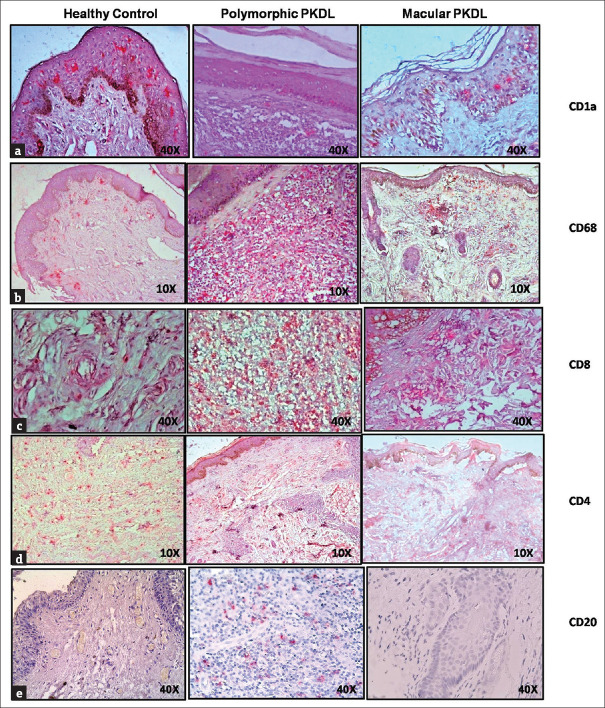
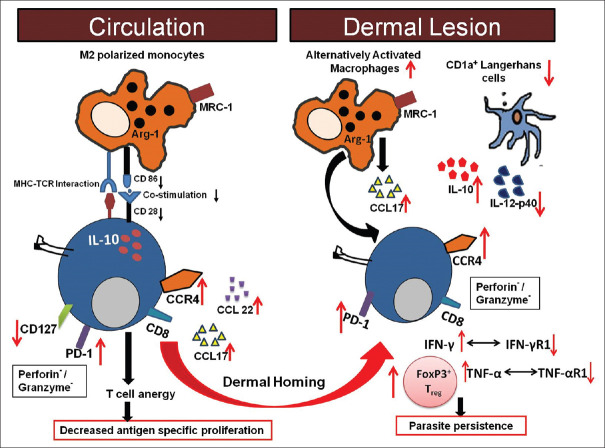
Kala-azar, commonly known as visceral leishmaniasis (VL), is a neglected tropical disease that has been targeted in South Asia for elimination by 2020. Presently, the Kala-azar Elimination Programme is aimed at identifying new low-endemic foci by active case detection, consolidating vector control measures, and decreasing potential reservoirs, of which Post Kala-azar Dermal Leishmaniasis (PKDL) is considered as the most important. PKDL is a skin condition that occurs after apparently successful treatment of VL and is characterized by hypopigmented patches (macular) or a mixture of papules, nodules, and/or macules (polymorphic). To achieve this goal of elimination, it is important to delineate the pathophysiology so that informed decisions can be made regarding the most appropriate and cost-effective approach. We reviewed the literature with regard to PKDL in Asia and Africa and interpreted the findings in establishing a potential correlation between the immune responses and pathophysiology. The overall histopathology indicated the presence of a dense, inflammatory cellular infiltrate, characterized by increased expression of alternatively activated CD68+ macrophages, CD8+ T cells showing features of exhaustion, CD20+ B cells, along with decreased CD1a+ dendritic cells. Accordingly, this review is an update on the overall immunopathology of PKDL, so as to provide a better understanding of host-parasite interactions and the immune responses generated which could translate into availability of markers that can be harnessed for assessment of disease progression and improvement of existing treatment modalities.
黑热病,通常称为内脏利什曼病(VL),是一种被忽视的热带疾病,南亚已将其作为到2020年消除的目标。目前,黑热病消除计划旨在通过主动病例检测来识别新的低流行病灶,巩固病媒控制措施,并减少潜在的储存宿主,其中黑热病后皮肤利什曼病(PKDL)被认为是最重要的。PKDL是一种在VL明显成功治疗后出现的皮肤疾病,其特征为色素减退斑(斑疹)或丘疹、结节和/或斑疹的混合(多形性)。为实现这一消除目标,明确病理生理学很重要,以便能就最适当且具成本效益的方法做出明智决策。我们回顾了亚洲和非洲关于PKDL的文献,并解读了这些发现在建立免疫反应与病理生理学之间潜在关联方面的意义。总体组织病理学显示存在密集的炎症细胞浸润,其特征为交替活化的CD68 +巨噬细胞表达增加、表现出耗竭特征的CD8 + T细胞、CD20 + B细胞,以及CD1a +树突状细胞减少。因此,本综述是对PKDL整体免疫病理学的更新,以便更好地理解宿主 - 寄生虫相互作用以及所产生的免疫反应,这可能转化为可用于评估疾病进展和改进现有治疗方式的标志物的可用性。