Dinkin Marc, Johnson Editha
Department of Neurology, Weill Cornell Medical College, 1305 York Ave #2F, New York, NY USA.
Department of Ophthalmology, Weill Cornell Medical College, 1305 York Avenue, 11th Floor, New York, NY 10065 USA.
Curr Treat Options Neurol. 2021;23(2):6. doi: 10.1007/s11940-020-00660-2. Epub 2021 Jan 16.
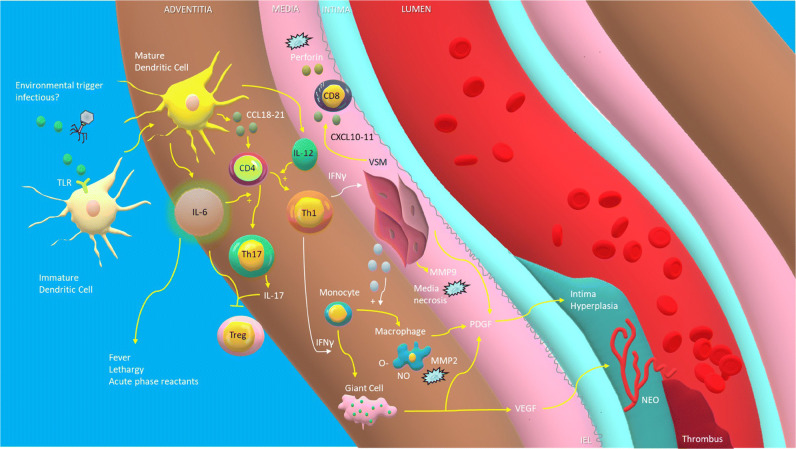
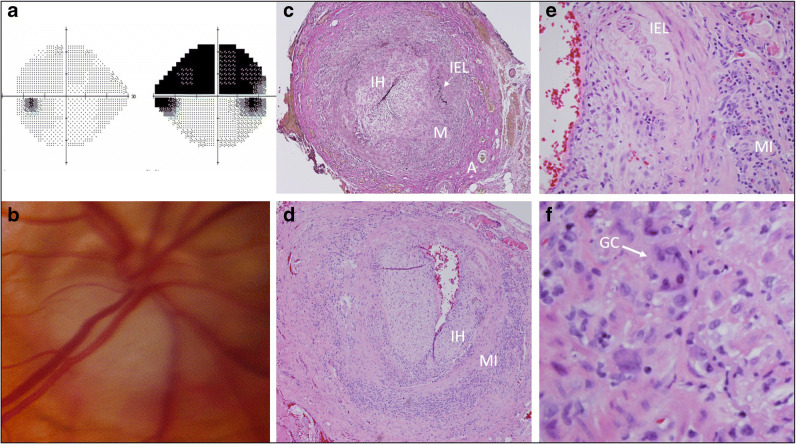
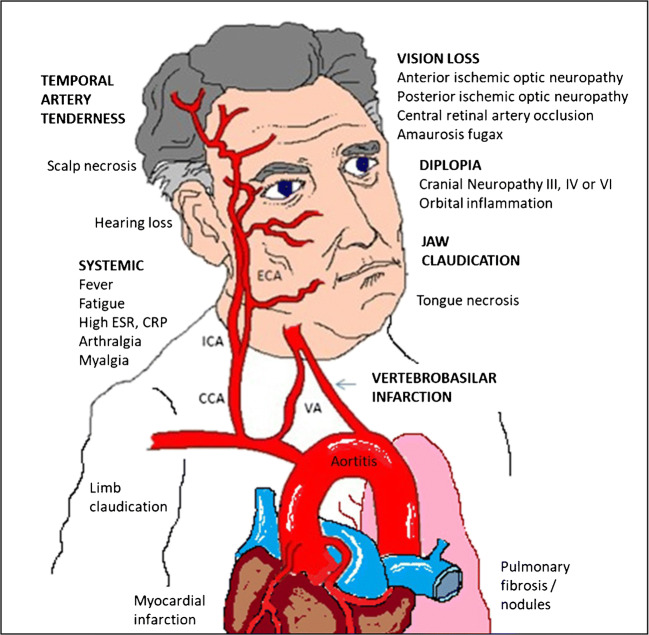
Giant cell arteritis (GCA), a medium and large vessel vasculitis occurring in the aged, remains a formidable disease, capable of taking both vision and life, through a multitude of vascular complications. Our understanding of the spectrum of its manifestations has grown over the years, to include limb claudication, aortitis, and cardiac disease, in addition to the more classic visual complications resulting from of ischemia to branches of the external and internal carotid arteries. While a clinical presentation of headache, jaw claudication, scalp tenderness, fever and other systemic symptoms and serum markers are together highly suggestive of the disease, diagnosis can be challenging in those cases in which classic symptoms are lacking. The purpose of this review is to update the reader on advances in the diagnosis and treatment of giant cell arteritis and to review our evolving understanding of the immunological mechanism underlying the disease, which have helped guide our search for novel therapies.
There is increasing evidence supporting the use of Doppler ultrasound, dedicated post-contrast T1-weighted spin echo MRI of the scalp arteries and PET scan, which can together improve our diagnostic accuracy in cases in which temporal artery biopsy is either inconclusive or not feasible. Advances in our understanding of the immunological cascades underlying the disease have helped guide our search for steroid-sparing treatments for the GCA, the most important of which has been the IL-6 receptor antibody inhibitor tocilizumab, which has been shown to reduce cumulative steroid dose in a large multicenter, placebo-controlled prospective study. Other biologic agents, such as abatacept and ustekinumab have shown promise in smaller studies.
GCA is no longer a disease whose diagnosis is based exclusively on temporal artery biopsy and whose complications are prevented solely with the use of corticosteroids. Modern vascular imaging techniques and targeted immunologic therapies are heralding a new era for the disease, in which practitioners will hopefully be able to diagnosis it with greater accuracy and treat it with less ischemic complications and iatrogenic side effects.
巨细胞动脉炎(GCA)是一种发生于老年人的中大型血管炎,仍然是一种可怕的疾病,通过多种血管并发症可导致失明甚至危及生命。多年来,我们对其临床表现谱的认识不断加深,除了因颈内、外动脉分支缺血导致的更典型视觉并发症外,还包括肢体间歇性跛行、主动脉炎和心脏病。虽然头痛、下颌间歇性跛行、头皮压痛、发热及其他全身症状和血清标志物的临床表现高度提示该病,但在缺乏典型症状的病例中诊断可能具有挑战性。本综述的目的是向读者介绍巨细胞动脉炎诊断和治疗方面的进展,并回顾我们对该疾病潜在免疫机制不断演变的认识,这些认识有助于指导我们寻找新的治疗方法。
越来越多的证据支持使用多普勒超声、专用的头皮动脉对比增强后T1加权自旋回波磁共振成像(MRI)和正电子发射断层扫描(PET),这些检查共同使用可提高我们在颞动脉活检结果不确定或不可行的病例中的诊断准确性。我们对该疾病潜在免疫级联反应认识的进展有助于指导我们寻找GCA的类固醇节省治疗方法,其中最重要的是IL-6受体抗体抑制剂托珠单抗,在一项大型多中心、安慰剂对照的前瞻性研究中已证明其可减少累积类固醇剂量。其他生物制剂,如阿巴西普和乌司奴单抗在较小规模研究中也显示出前景。
GCA不再是一种仅基于颞动脉活检进行诊断且仅通过使用皮质类固醇预防并发症的疾病。现代血管成像技术和靶向免疫疗法正在为该疾病开创一个新时代,在此时代,从业者有望能够更准确地诊断该疾病,并以更少的缺血性并发症和医源性副作用进行治疗。