Plonek Tomasz, Rylski Bartosz, Nawrocki Pawel, Beyersdorf Friedhelm, Jasinski Marek, Kuliczkowski Wiktor
Department of Cardiac Surgery, Wroclaw Medical University, Wroclaw, Poland.
Department of Cardio-vascular Surgery, Heart Centre Freiburg University, Faculty of Medicine, University of Freiburg, Freiburg, Germany.
Arch Med Sci. 2019 Feb 18;17(1):25-30. doi: 10.5114/aoms.2019.82997. eCollection 2021.
Longitudinal stretching of the aorta due to systolic heart motion contributes to the stress in the wall of the ascending aorta. The objective of this study was to assess longitudinal systolic stretching of the aorta and its correlation with the diameters of the ascending aorta and the aortic root.
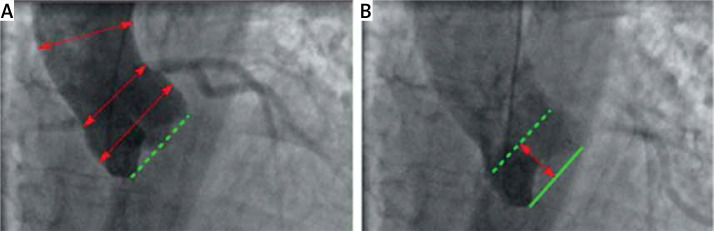
Aortographies of 122 patients were analyzed. The longitudinal systolic stretching of the aorta caused by the contraction of the heart during systole and the maximum dimensions of the aortic root and ascending aorta were measured in all patients.
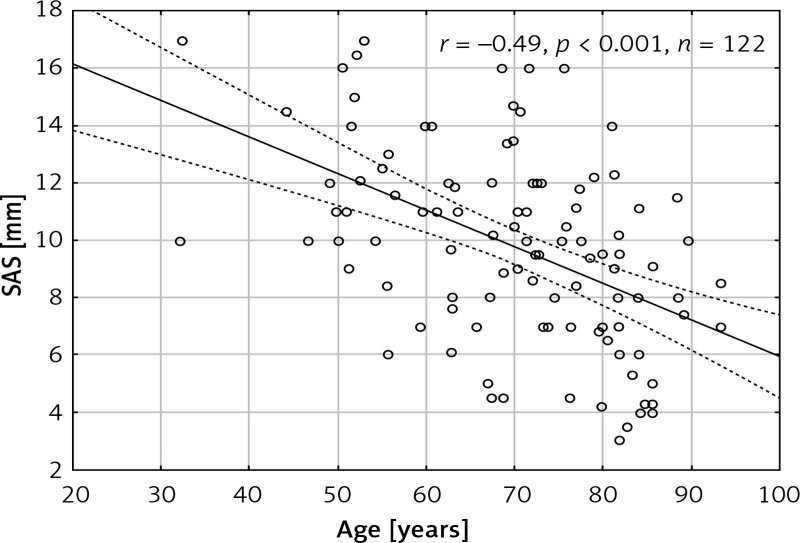
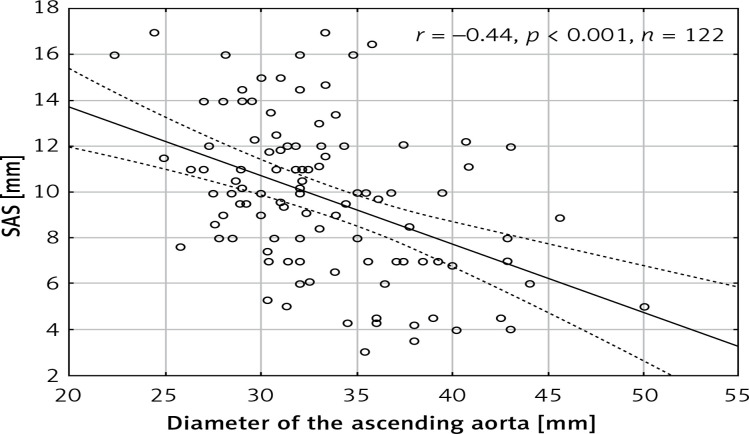
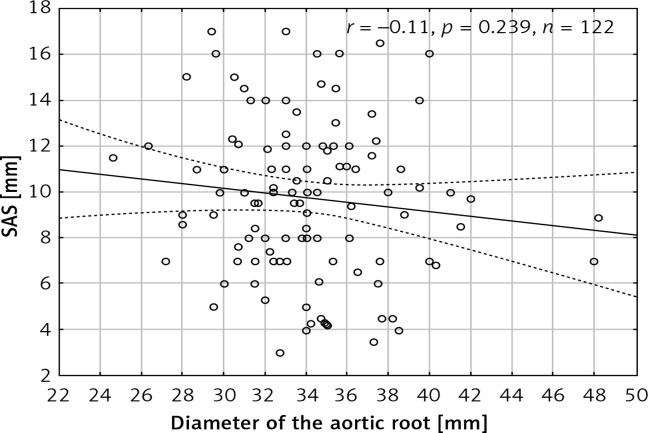
The maximum dimension of the aortic root was on average 34.9 ±4.5 mm and the mean diameter of the ascending aorta was 33.9 ±5.4 mm. The systolic aortic stretching negatively correlated with age ( = -0.49, < 0.001) and the diameter of the tubular ascending aorta ( = -0.44, < 0.001). There was no significant correlation between the stretching and the dimension of the aortic root ( = -0.11, = 0.239). There was a statistically significant ( < 0.001) difference in the longitudinal aortic stretching values between patients with a normal aortic valve (10.6 ±3.1 mm) and an aortic valve pathology (8.0 ±3.2 mm in all patients with an aortic valve pathology; 7.5 ±4.3 mm in isolated aortic stenosis, 8.5 ±2.9 mm in the case of isolated insufficiency, 8.2 ±2.8 mm for valves that were both stenotic and insufficient).
Systolic aortic stretching negatively correlates with the diameter of the tubular ascending aorta and the age of the patients, and does not correlate with the diameter of the aortic root. It is lower in patients with an aortic valve pathology.
由于心脏收缩运动导致的主动脉纵向拉伸会增加升主动脉壁的应力。本研究的目的是评估主动脉的纵向收缩期拉伸及其与升主动脉和主动脉根部直径的相关性。
分析了122例患者的主动脉造影。测量了所有患者在收缩期心脏收缩引起的主动脉纵向收缩期拉伸以及主动脉根部和升主动脉的最大尺寸。
主动脉根部的最大尺寸平均为34.9±4.5mm,升主动脉的平均直径为33.9±5.4mm。收缩期主动脉拉伸与年龄呈负相关(r = -0.49,P < 0.001),与升主动脉管状部分的直径呈负相关(r = -0.44,P < 0.001)。拉伸与主动脉根部尺寸之间无显著相关性(r = -0.11,P = 0.239)。正常主动脉瓣患者(10.6±3.1mm)与主动脉瓣病变患者(所有主动脉瓣病变患者为8.0±3.2mm;孤立性主动脉瓣狭窄为7.5±4.3mm,孤立性主动脉瓣关闭不全为8.5±2.9mm,狭窄并关闭不全的瓣膜为8.2±2.8mm)的主动脉纵向拉伸值存在统计学显著差异(P < 0.001)。
收缩期主动脉拉伸与升主动脉管状部分的直径和患者年龄呈负相关,与主动脉根部直径无关。在主动脉瓣病变患者中较低。