Sujeeun Lakshmi Y, Goonoo Nowsheen, Ramphul Honita, Chummun Itisha, Gimié Fanny, Baichoo Shakuntala, Bhaw-Luximon Archana
Biomaterials, Drug Delivery and Nanotechnology Unit, Centre for Biomedical and Biomaterials Research (CBBR), University of Mauritius, 80837 Réduit, Mauritius.
Department of Digital Technologies, Faculty of Information, Communication and Digital Technologies, University of Mauritius, 80837 Réduit, Mauritius.
R Soc Open Sci. 2020 Dec 23;7(12):201293. doi: 10.1098/rsos.201293. eCollection 2020 Dec.
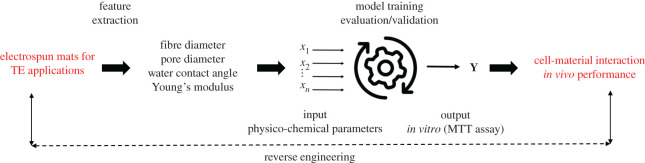
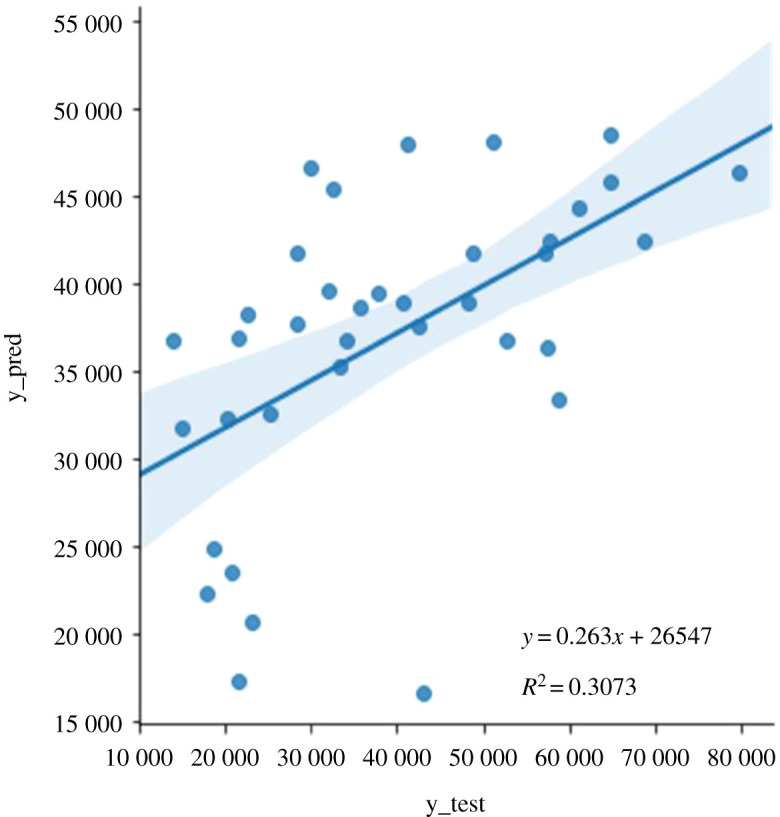
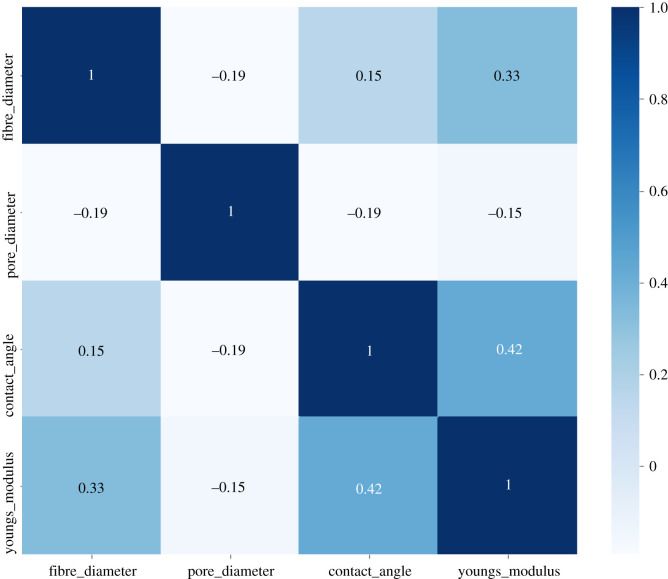
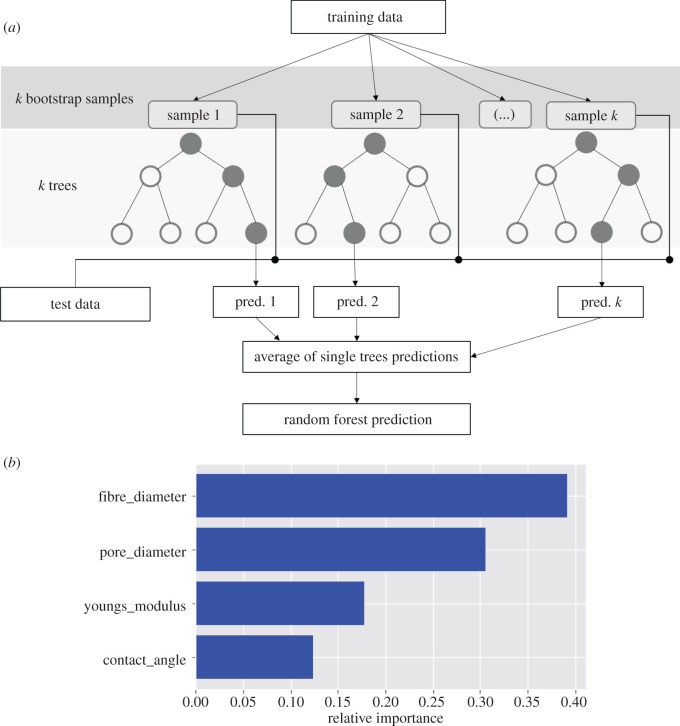
The engineering of polymeric scaffolds for tissue regeneration has known a phenomenal growth during the past decades as materials scientists seek to understand cell biology and cell-material behaviour. Statistical methods are being applied to physico-chemical properties of polymeric scaffolds for tissue engineering (TE) to guide through the complexity of experimental conditions. We have attempted using experimental data and physico-chemical data of electrospun polymeric scaffolds, tested for skin TE, to model scaffold performance using machine learning (ML) approach. Fibre diameter, pore diameter, water contact angle and Young's modulus were used to find a correlation with 3-(4,5-dimethylthiazol-2-yl)-2,5-diphenyltetrazolium bromide (MTT) assay of L929 fibroblasts cells on the scaffolds after 7 days. Six supervised learning algorithms were trained on the data using Seaborn/Scikit-learn Python libraries. After hyperparameter tuning, random forest regression yielded the highest accuracy of 62.74%. The predictive model was also correlated with data. This is a first preliminary study on ML methods for the prediction of cell-material interactions on nanofibrous scaffolds.
在过去几十年中,随着材料科学家试图理解细胞生物学和细胞与材料的相互作用行为,用于组织再生的聚合物支架工程取得了显著进展。统计方法正被应用于组织工程(TE)聚合物支架的物理化学性质,以应对复杂的实验条件。我们尝试使用经过皮肤TE测试的电纺聚合物支架的实验数据和物理化学数据,采用机器学习(ML)方法对支架性能进行建模。使用纤维直径、孔径、水接触角和杨氏模量来寻找与支架上L929成纤维细胞7天后的3-(4,5-二甲基噻唑-2-基)-2,5-二苯基四氮唑溴盐(MTT)测定结果之间的相关性。使用Seaborn/Scikit-learn Python库对六种监督学习算法进行数据训练。经过超参数调整后,随机森林回归的准确率最高,为62.74%。该预测模型也与数据相关。这是关于使用ML方法预测纳米纤维支架上细胞与材料相互作用的首次初步研究。