Department of Vaccinology and Applied Microbiology, Helmholtz Centre for Infection Research (HZI), Braunschweig, Germany.
German Centre for Infection Research (DZIF), Hannover-Braunschweig Site, Braunschweig, Germany.
Front Cell Infect Microbiol. 2021 Jan 8;10:536150. doi: 10.3389/fcimb.2020.536150. eCollection 2020.
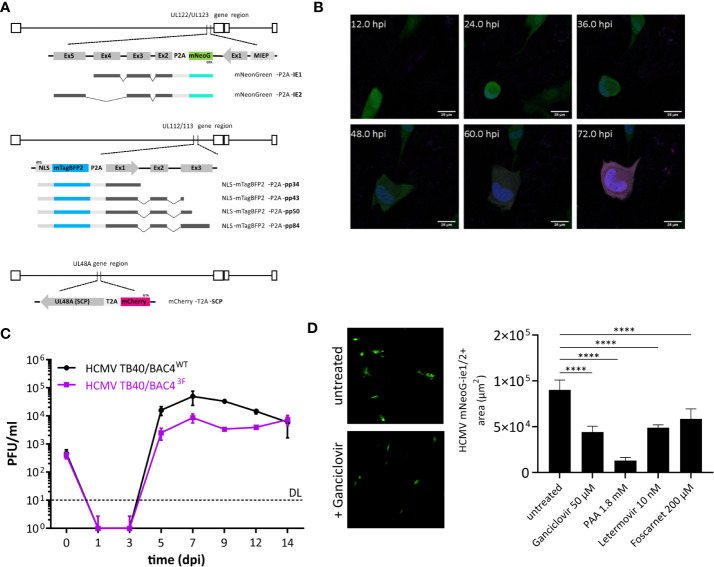
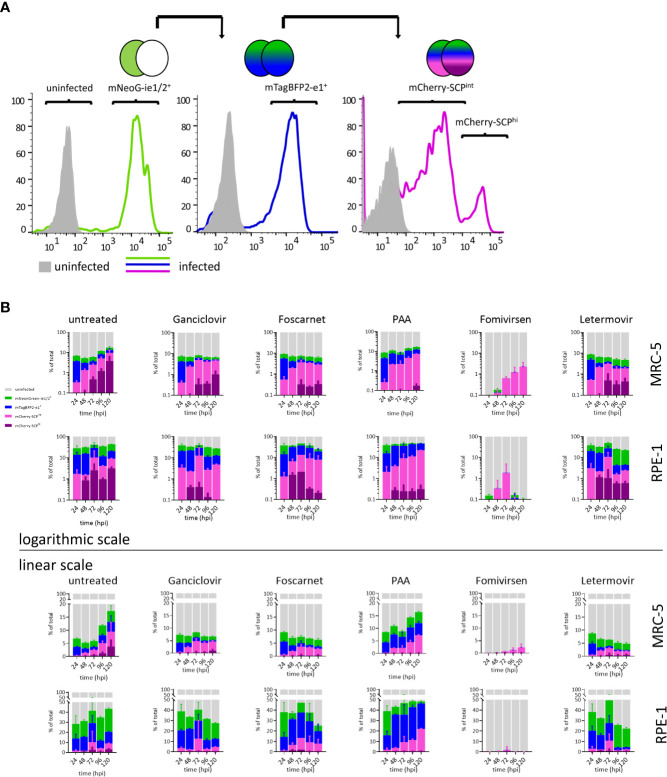
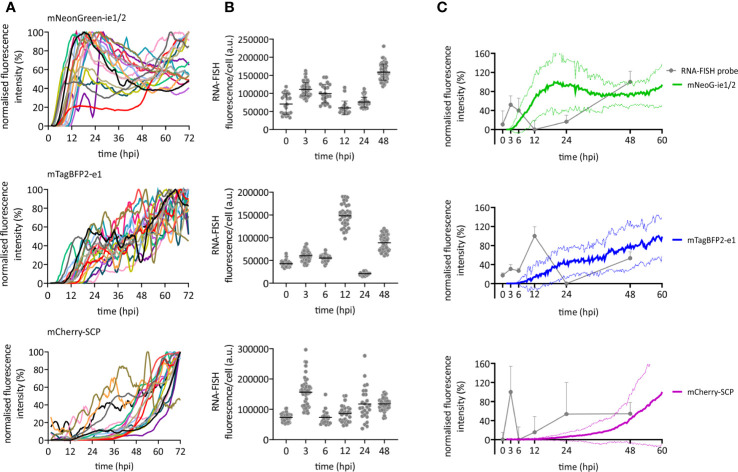
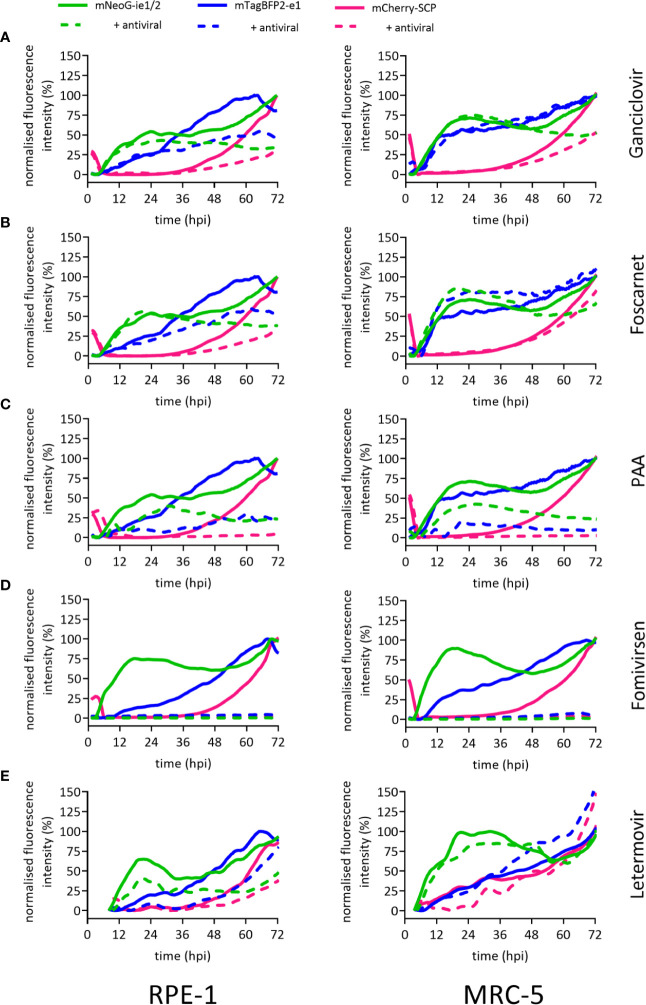
Human Cytomegalovirus (HCMV) infection may result in severe outcomes in immunocompromised individuals such as AIDS patients, transplant recipients, and neonates. To date, no vaccines are available and there are only few drugs for anti-HCMV therapy. Adverse effects and the continuous emergence of drug-resistance strains require the identification of new drug candidates in the near future. Identification and characterization of such compounds and biological factors requires sensitive and reliable detection techniques of HCMV infection, gene expression and spread. In this work, we present and validate a novel concept for multi-reporter herpesviruses, identified through iterative testing of minimally invasive mutations. We integrated up to three fluorescence reporter genes into replication-competent HCMV strains, generating reporter HCMVs that allow the visualization of replication cycle stages of HCMV, namely the immediate early (IE), early (E), and late (L) phase. Fluorescent proteins with clearly distinguishable emission spectra were linked by 2A peptides to essential viral genes, allowing bicistronic expression of the viral and the fluorescent protein without major effects on viral fitness. By using this triple color reporter HCMV, we monitored gene expression dynamics of the IE, E, and L genes by measuring the fluorescent signal of the viral gene-associated fluorophores within infected cell populations and at high temporal resolution. We demonstrate distinct inhibitory profiles of foscarnet, fomivirsen, phosphonoacetic acid, ganciclovir, and letermovir reflecting their mode-of-action. In conclusion, our data argues that this experimental approach allows the identification and characterization of new drug candidates in a single step.
人巨细胞病毒(HCMV)感染可能导致免疫功能低下的个体出现严重后果,如艾滋病患者、移植受者和新生儿。迄今为止,尚无疫苗可用,抗 HCMV 治疗的药物也很少。不良反应和耐药株的不断出现要求在不久的将来确定新的候选药物。此类化合物和生物因素的鉴定和表征需要 HCMV 感染、基因表达和传播的敏感和可靠的检测技术。在这项工作中,我们提出并验证了一种通过反复测试微创突变来识别多报告疱疹病毒的新方法。我们将多达三个荧光报告基因整合到复制型 HCMV 株中,生成报告型 HCMV,允许可视化 HCMV 的复制周期阶段,即即刻早期(IE)、早期(E)和晚期(L)阶段。具有明显可区分发射光谱的荧光蛋白通过 2A 肽连接到必需的病毒基因上,允许病毒和荧光蛋白的双顺反子表达,而对病毒适应性没有重大影响。通过使用这种三重颜色报告 HCMV,我们通过测量感染细胞群体中与病毒基因相关的荧光团的荧光信号,以高时间分辨率监测 IE、E 和 L 基因的基因表达动态。我们证明了膦甲酸、福米韦森、膦酸、更昔洛韦和勒特莫韦的抑制谱不同,反映了它们的作用模式。总之,我们的数据表明,这种实验方法允许在单个步骤中鉴定和表征新的候选药物。