Jiang Minlin, Jia Keyi, Wang Lei, Li Wei, Chen Bin, Liu Yu, Wang Hao, Zhao Sha, He Yayi, Zhou Caicun
Department of Medical Oncology, Shanghai Pulmonary Hospital, Tongji University Medical School Cancer Institute, Tongji University School of Medicine, Shanghai, China.
Tongji University, Shanghai, China.
Ann Transl Med. 2020 Dec;8(24):1685. doi: 10.21037/atm-20-2920.
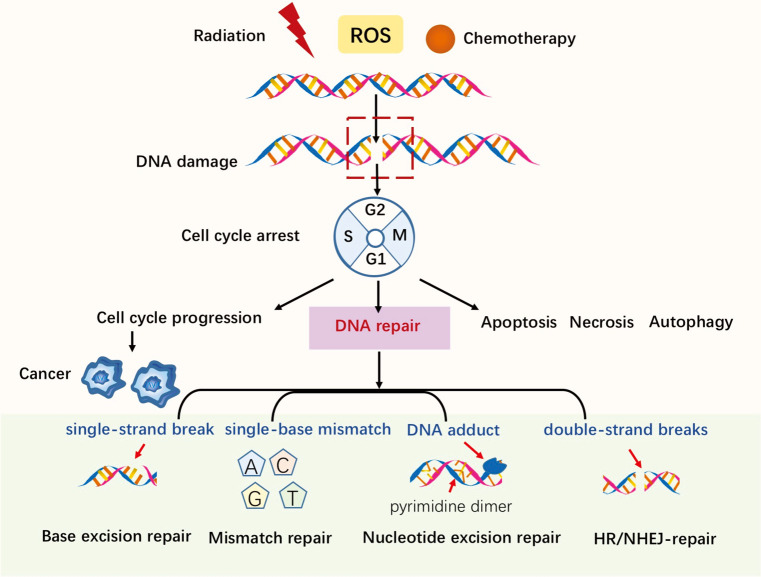
DNA damage repair (DDR) pathways are essential to ensure the accurate transmission of genetic material. However, different endogenous and exogenous factors challenge genomic integrity. Mechanisms involved in the alterations of DDR pathways mainly include genetic inactivation and epigenetic mechanisms. The development and progression of carcinomas are closely associated with DDR pathway aberrations, including the epigenetic silencing of gene O6-alkylguanine-DNA methyltransferase (); deficiencies of mismatch repair (MMR) genes, including MutL homolog 1 (), MutS protein homologue (MSH)-2 (), , and PMS1 homolog 2; the mismatch repair system component (); and mutations of homologous recombination repair (HRR) genes, such as the breast cancer susceptibility gene 1/2 (). Understanding the underlying mechanisms and the correlations between alterations to DDR pathways and cancer could improve the efficacy of antitumor therapies. Emerging evidence suggests that survival is higher in patients with DDR-deficient tumors than in those with DDR-proficient tumors. Thus, DDR alterations play a predictive and prognostic role in anticancer therapies. Theoretical studies on the co-administration of DDR inhibitors and other anticancer therapies, including chemotherapy, radiotherapy, immunotherapy, endocrine therapy, and epigenetic drugs, hold promise for cancer treatments. In this review, we focus on the basic mechanisms, characteristics, current applications, and combination strategies of DDR pathways in the anticancer field.
DNA损伤修复(DDR)途径对于确保遗传物质的准确传递至关重要。然而,不同的内源性和外源性因素会挑战基因组完整性。DDR途径改变所涉及的机制主要包括基因失活和表观遗传机制。癌症的发生和发展与DDR途径异常密切相关,包括O6-烷基鸟嘌呤-DNA甲基转移酶基因的表观遗传沉默;错配修复(MMR)基因缺陷,包括MutL同源物1、MutS蛋白同源物(MSH)-2、PMS1同源物2;错配修复系统成分;以及同源重组修复(HRR)基因的突变,如乳腺癌易感基因1/2。了解DDR途径改变与癌症之间的潜在机制及相关性,可提高抗肿瘤治疗的疗效。新出现的证据表明,DDR缺陷肿瘤患者的生存率高于DDR功能正常肿瘤患者。因此,DDR改变在抗癌治疗中具有预测和预后作用。关于DDR抑制剂与其他抗癌治疗(包括化疗、放疗、免疫治疗、内分泌治疗和表观遗传药物)联合应用的理论研究,为癌症治疗带来了希望。在本综述中,我们重点关注DDR途径在抗癌领域的基本机制、特点、当前应用及联合策略。