Zhou Jin, Tripathi Madhulika, Sinha Rohit A, Singh Brijesh Kumar, Yen Paul M
Program of Cardiovascular and Metabolic Disorders, Duke-NUS Medical School, Singapore 169857, Singapore.
Department of Endocrinology, Sanjay Gandhi Postgraduate Institute of Medical Sciences, Lucknow 226014, India.
Hepatoma Res. 2021 Jan 13;7:11. doi: 10.20517/2394-5079.2020.134. eCollection 2021.
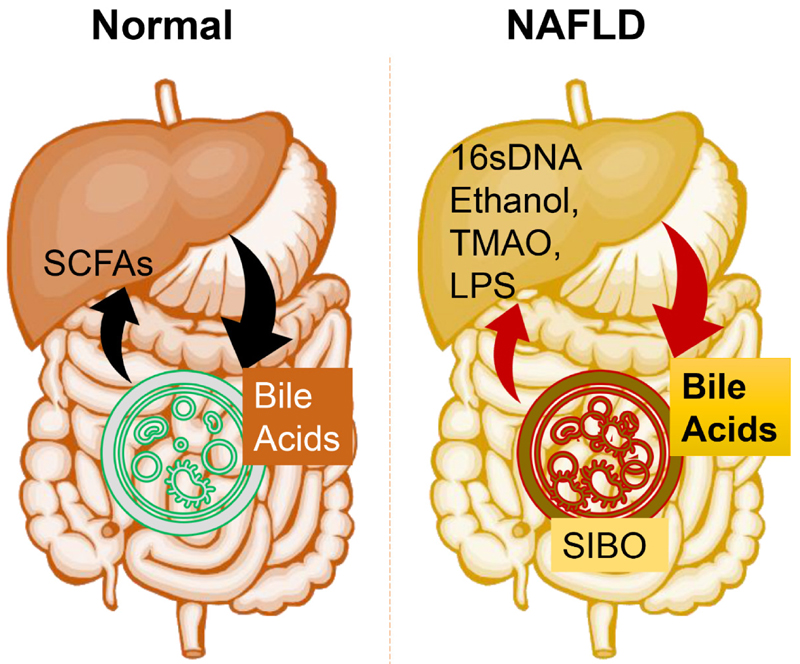
Non-alcoholic fatty liver disease (NAFLD) is the most prevalent liver disorder worldwide. It comprises a spectrum of conditions that range from steatosis to non-alcoholic steatohepatitis, with progression to cirrhosis and hepatocellular carcinoma. Currently, there is no FDA-approved pharmacological treatment for NAFLD. The pathogenesis of NAFLD involves genetic and environmental/host factors, including those that cause changes in intestinal microbiota and their metabolites. In this review, we discuss recent findings on the relationship(s) of microbiota signature with severity of NAFLD and the role(s) microbial metabolites in NAFLD progression. We discuss how metabolites may affect NAFLD progression and their potential to serve as biomarkers for NAFLD diagnosis or therapeutic targets for disease management.
非酒精性脂肪性肝病(NAFLD)是全球最普遍的肝脏疾病。它包括一系列病症,从脂肪变性到非酒精性脂肪性肝炎,进而发展为肝硬化和肝细胞癌。目前,美国食品药品监督管理局(FDA)尚未批准用于治疗NAFLD的药物。NAFLD的发病机制涉及遗传和环境/宿主因素,包括那些导致肠道微生物群及其代谢产物发生变化的因素。在本综述中,我们讨论了关于微生物群特征与NAFLD严重程度之间关系的最新研究结果,以及微生物代谢产物在NAFLD进展中的作用。我们讨论了代谢产物如何影响NAFLD的进展,以及它们作为NAFLD诊断生物标志物或疾病管理治疗靶点的潜力。