Department of Endocrinology and Nutrition, Virgen de la Victoria University Hospital, the Biomedical Research Institute of Malaga and Platform in Nanomedicine (IBIMA-BIONAND Platform), University of Malaga, Malaga, Spain.
CIBER in Physiopathology of Obesity and Nutrition (CIBEROBN), Carlos III Health Institute, Madrid, Spain.
Gut Microbes. 2023 Jan-Dec;15(1):2223339. doi: 10.1080/19490976.2023.2223339.
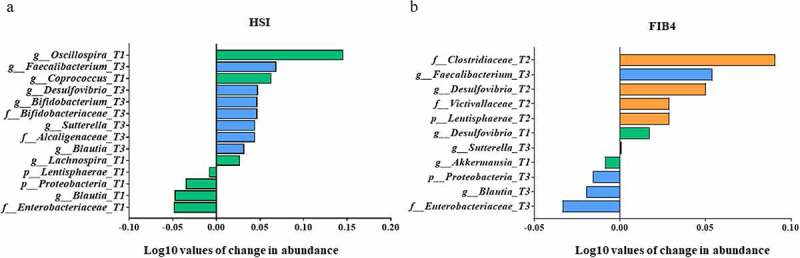
To evaluate the changes in the gut microbiota associated with changes in the biochemical markers of nonalcoholic fatty liver disease (NAFLD) after a lifestyle intervention with the Mediterranean diet. Participants ( = 297) from two centers of PREDIMED-Plus trial (Prevención con Dieta Mediterránea) were divided into three different groups based on the change tertile in the Hepatic Steatosis Index (HSI) or the Fibrosis-4 score (FIB-4) between baseline and one year of intervention. One-year changes in HSI were: tertile 1 (T1) (-24.9 to -7.51), T2 (-7.5 to -1.86), T3 (-1.85 to 13.64). The most significant differences in gut microbiota within the year of intervention were observed in the T1 and T3. According to the FIB-4, participants were categorized in non-suspected fibrosis (NSF) and with indeterminate or suspected fibrosis (SF). NSF participants showed higher abundances of , , , , , , compared to those with SF. Then, participants were divided depending on the FIB-4 tertile of change: T1 (-89.60 to -5.57), T2 (-5.56 to 11.4), and T3 (11.41 to 206.24). FIB-4 T1 showed a decrease in and an increase in . T2 had an increase in , , and . T3 showed a decrease in , and an increase in , , and . A relation between biochemical index changes of NAFLD/NASH (HSI and FIB-4) and gut microbiota changes were found. These observations highlight the importance of lifestyle intervention in the modulation of gut microbiota and the management of metabolic syndrome and its hepatic manifestations.
评估地中海饮食生活方式干预后与非酒精性脂肪性肝病 (NAFLD) 生化标志物变化相关的肠道微生物群变化。来自 PREDIMED-Plus 试验(地中海饮食预防)两个中心的参与者( = 297)根据基线和干预一年时肝脂肪变性指数 (HSI) 或纤维化-4 评分 (FIB-4) 的变化 tertile 分为三组。HSI 在一年内的变化为: tertile 1 (T1) (-24.9 至 -7.51)、T2 (-7.5 至 -1.86)、T3 (-1.85 至 13.64)。在一年内观察到肠道微生物群的最大差异存在于 T1 和 T3 中。根据 FIB-4,参与者被分为无可疑纤维化 (NSF) 和不确定或可疑纤维化 (SF)。与 SF 相比,NSF 参与者的 、 、 、 、 、 丰度更高。然后,根据 FIB-4 的变化 tertile 将参与者分为 T1 (-89.60 至 -5.57)、T2 (-5.56 至 11.4) 和 T3 (11.41 至 206.24)。FIB-4 T1 显示 和 减少, 增加。T2 增加了 、 、 。T3 显示 减少, 和 增加, 和 增加。发现 NAFLD/NASH (HSI 和 FIB-4) 的生化指标变化与肠道微生物群变化之间存在关联。这些观察结果强调了生活方式干预对肠道微生物群调节以及代谢综合征及其肝脏表现的管理的重要性。