Department of Psychology, La Salle University, USA.
Center for Amplified Musculoskeletal Pain Syndrome, Children's Hospital of Philadelphia, USA.
J Pediatr Psychol. 2021 Apr 16;46(4):474-484. doi: 10.1093/jpepsy/jsaa127.
Children with amplified musculoskeletal pain (AMPS) experience significant functional disability, with impairment in their ability to participate in age-appropriate activities of daily living. Parental factors play an important role in a child's pain symptoms and treatment outcomes, with parental pain catastrophizing and protective behaviors linked to several maladaptive outcomes for children. Aims of the current study were to examine how parental pain catastrophizing, child pain catastrophizing, and parental protective behaviors longitudinally impacted functional disability for children with AMPS.
Archival data were examined from parent-child dyads presenting to a tertiary pain clinic for treatment of AMPS. Over 1 year, parents completed measures assessing the level of pain catastrophizing, common behavioral responses to child pain, and child functional disability. Children completed measures of pain catastrophizing and functional disability. Measures were collected at initial evaluation, 6-months, and 12-months. Latent growth models (LGM) were conducted to examine how to study variables longitudinally impacted the rate of change in child functional disability.
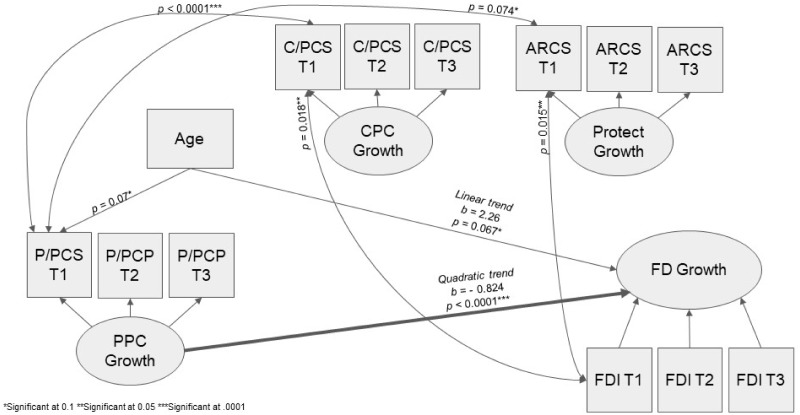
Examining a comprehensive LGM of study variables, parental catastrophizing emerged as the sole contributing factor to slower improvement in functional disability.
The strong influence of parental pain catastrophizing on functional disability may relate to parents limiting behaviors that promote adaptive coping in children with pain. As such, parents who catastrophize may benefit from specific interventions to increase their use of adaptive behavioral responses, such as redirecting children to complete functional activities and encouraging the use of positive coping skills for pain-related distress.
患有肌肉骨骼过度活动(AMPS)的儿童会经历显著的功能障碍,其日常生活活动的参与能力受损。父母因素在儿童的疼痛症状和治疗结果中起着重要作用,父母的疼痛灾难化和保护行为与儿童的几种适应不良结果有关。本研究的目的是探讨父母的疼痛灾难化、儿童的疼痛灾难化和父母的保护行为如何对患有 AMPS 的儿童的功能障碍产生纵向影响。
从到三级疼痛诊所接受 AMPS 治疗的父母-儿童二人组中检查档案数据。在 1 年以上的时间里,父母完成了评估疼痛灾难化水平、对儿童疼痛的常见行为反应以及儿童功能障碍的措施。儿童完成了疼痛灾难化和功能障碍的测量。在初始评估、6 个月和 12 个月时收集了测量值。进行潜在增长模型(LGM)以检查研究变量如何纵向影响儿童功能障碍的变化率。
在检查研究变量的综合 LGM 时,父母的灾难化是功能障碍改善速度较慢的唯一促成因素。
父母的疼痛灾难化对功能障碍的强烈影响可能与父母限制促进儿童疼痛适应性应对的行为有关。因此,父母的灾难化可能受益于特定的干预措施,以增加他们对适应性行为反应的使用,例如引导孩子完成功能性活动并鼓励使用积极的应对技能来应对与疼痛相关的困扰。