Department of Biochemistry, Faculty of Life Sciences, University of Ilorin, Ilorin, Nigeria.
Computational Biology & Biotechnology Laboratory, Department of Botany, Soban Singh Jeena University, Almora, Uttarakhand, India.
J Biomol Struct Dyn. 2022 Aug;40(13):5785-5802. doi: 10.1080/07391102.2021.1873191. Epub 2021 Jan 25.
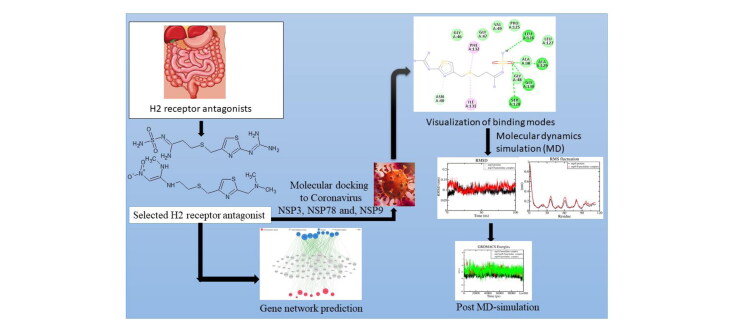
With the world threatened by a second surge in the number of Coronavirus cases, there is an urgent need for the development of effective treatment for the novel coronavirus (COVID-19). Recently, global attention has turned to preliminary reports on the promising anti-COVID-19 effect of histamine H2-receptor antagonists (H2RAs), most especially Famotidine. Therefore, this study was designed to exploit a possible molecular basis for the efficacy of H2RAs against coronavirus. Molecular docking was performed between four H2RAs, Cimetidine, Famotidine, Nizatidine, Ranitidine, and three non-structural proteins viz. NSP3, NSP7/8 complex, and NSP9. Thereafter, a 100 ns molecular dynamics simulation was carried out with the most outstanding ligands to determine the stability. Thereafter, Famotidine and Cimetidine were subjected to gene target prediction analysis using HitPickV2 and eXpression2Kinases server to determine the possible network of genes associated with their anti-COVID activities. Results obtained from molecular docking showed the superiority of Famotidine and Cimetidine compared to other H2RAs with a higher binding affinity to all selected targets. Molecular dynamic simulation and MMPBSA results revealed that Famotidine as well as Cimetidine bind to non-structural proteins more efficiently with high stability over 100 ns. Results obtained suggest that Famotidine and Cimetidine could be a viable option to treat COVID-19 with a mechanism of action that involves the inhibition of viral replication through the inhibition of non-structural proteins. Therefore, Famotidineand Cimetidine qualify for further study as a potential treatment for COVID-19.
随着世界面临冠状病毒病例数量的第二次激增,迫切需要开发针对新型冠状病毒 (COVID-19) 的有效治疗方法。最近,全球的注意力转向了初步报告,表明组胺 H2 受体拮抗剂 (H2RA),尤其是法莫替丁,对 COVID-19 有很好的效果。因此,本研究旨在探讨 H2RA 对抗冠状病毒的功效的可能分子基础。对四种 H2RA(西咪替丁、法莫替丁、尼扎替丁和雷尼替丁)和三种非结构蛋白(NSP3、NSP7/8 复合物和 NSP9)进行了分子对接。然后,对最突出的配体进行了 100 ns 的分子动力学模拟,以确定其稳定性。然后,使用 HitPickV2 和 eXpression2Kinases 服务器对法莫替丁和西咪替丁进行基因靶标预测分析,以确定与其抗 COVID 活性相关的可能基因网络。分子对接的结果表明,法莫替丁和西咪替丁与其他 H2RA 相比具有优势,对所有选定的靶标具有更高的结合亲和力。分子动力学模拟和 MMPBSA 结果表明,法莫替丁和西咪替丁能够更有效地与非结构蛋白结合,在 100 ns 以上具有高稳定性。结果表明,法莫替丁和西咪替丁可能是治疗 COVID-19 的一种可行选择,其作用机制是通过抑制非结构蛋白来抑制病毒复制。因此,法莫替丁和西咪替丁有资格作为 COVID-19 的潜在治疗方法进行进一步研究。