Department of Immunology, Bambino Gesù Children's Hospital, IRCCS, Rome, Italy.
Asthma & Allergy Clinic, Humanitas University & Research Hospital, IRCCS, Milan, Italy.
Allergy. 2022 Apr;77(4):1114-1128. doi: 10.1111/all.15112. Epub 2021 Oct 12.
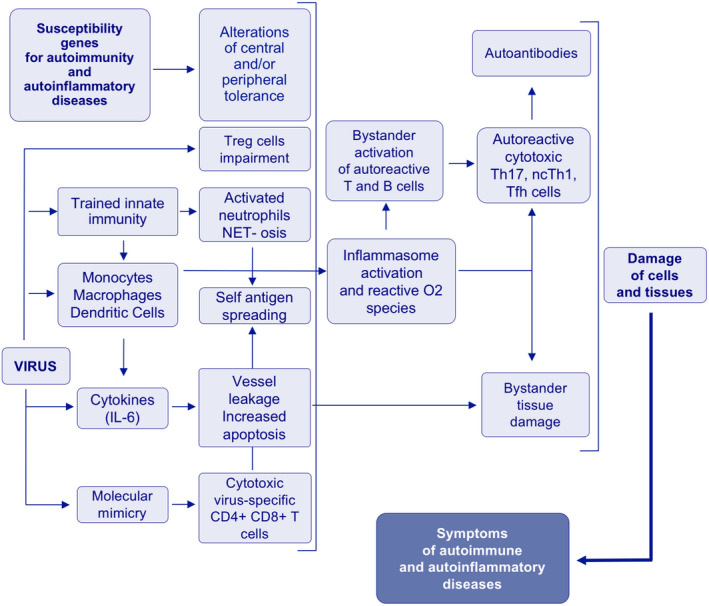
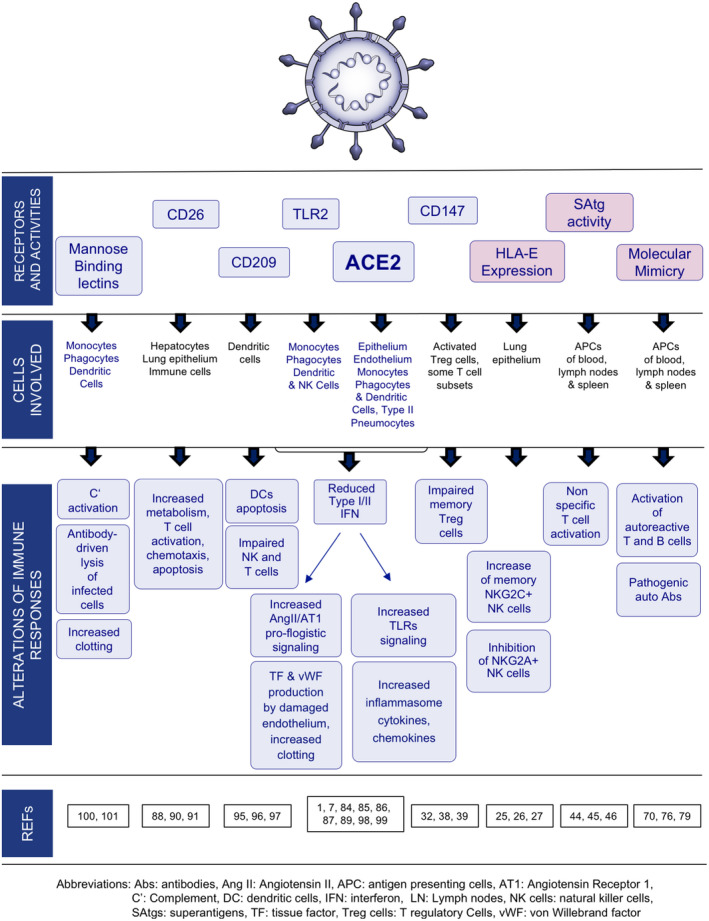
The coronavirus disease 2019 (COVID-19) pandemic started in March 2020 and caused over 5 million confirmed deaths worldwide as far August 2021. We have been recently overwhelmed by a wide literature on how the immune system recognizes severe acute respiratory syndrome coronavirus 2 (SARS-CoV-2) and contributes to COVID-19 pathogenesis. Although originally considered a respiratory viral disease, COVID-19 is now recognized as a far more complex, multi-organ-, immuno-mediated-, and mostly heterogeneous disorder. Though efficient innate and adaptive immunity may control infection, when the patient fails to mount an adequate immune response at the start, or in advanced disease, a high innate-induced inflammation can lead to different clinical outcomes through heterogeneous compensatory mechanisms. The variability of viral load and persistence, the genetic alterations of virus-driven receptors/signaling pathways and the plasticity of innate and adaptive responses may all account for the extreme heterogeneity of pathogenesis and clinical patterns. As recently applied to some inflammatory disorders as asthma, rhinosinusitis with polyposis, and atopic dermatitis, herein we suggest defining different endo-types and the related phenotypes along COVID-19. Patients should be stratified for evolving symptoms and tightly monitored for surrogate biomarkers of innate and adaptive immunity. This would allow to preventively identify each endo-type (and its related phenotype) and to treat patients precisely with agents targeting pathogenic mechanisms.
2019 年冠状病毒病(COVID-19)大流行始于 2020 年 3 月,截至 2021 年 8 月,已在全球范围内导致超过 500 万人确诊死亡。我们最近被大量关于免疫系统如何识别严重急性呼吸综合征冠状病毒 2(SARS-CoV-2)并促进 COVID-19 发病机制的文献所淹没。虽然最初被认为是一种呼吸道病毒疾病,但 COVID-19 现在被认为是一种更为复杂的、多器官的、免疫介导的、且主要是异质性的疾病。尽管有效的先天和适应性免疫可以控制感染,但当患者在发病初期或晚期无法产生足够的免疫反应时,高度的先天诱导炎症可能通过异质的代偿机制导致不同的临床结局。病毒载量和持续时间的可变性、病毒驱动的受体/信号通路的遗传改变以及先天和适应性反应的可塑性都可能导致发病机制和临床模式的极端异质性。最近在一些炎症性疾病如哮喘、鼻息肉和特应性皮炎中得到应用,我们建议在 COVID-19 中定义不同的内型和相关表型。应根据不断发展的症状对患者进行分层,并密切监测先天和适应性免疫的替代生物标志物。这将允许预防性地识别每个内型(及其相关表型),并使用靶向致病机制的药物精确地治疗患者。